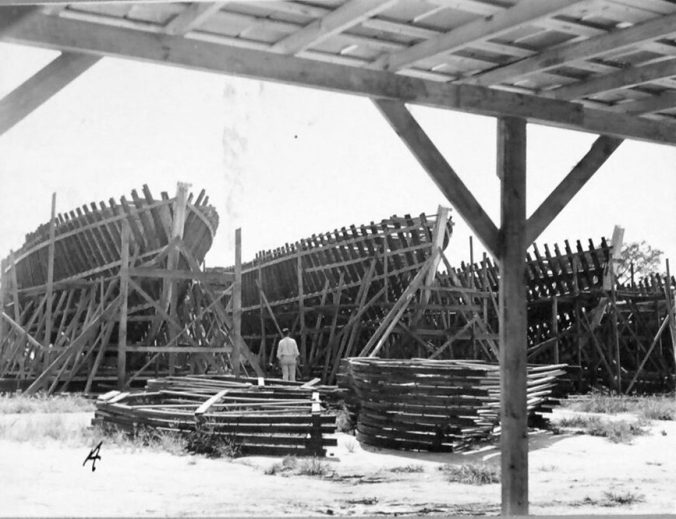
Pamlico Shipyard, Washington, N.C., August 1944. Photo courtesy, State Archives of North Carolina
This is the Pamlico Shipyard, Washington, N.C., August 1944. Built in the early part of 1943, the shipyard was located on the banks of the Pamlico River, at the site of an old gypsum mill.
During World War II, thousands of workers built ships on the North Carolina coast. The largest shipyard, by far, was the North Carolina Shipbuilding Company in Wilmington, where as many as 21,000 workers built steel-hulled Liberty ships and a variety of other military vessels.
But there were other naval shipyards, too, including the Pamlico Shipyard, which was one of four on the North Carolina coast that specialized in building wooden vessels for the American military.
The other three were in Elizabeth City, Manteo, and New Bern. The Pamlico Shipyard actually began life as a subsidiary of one of those other shipyard companies– the Elizabeth City Iron Works and Supply Company in Elizabeth City.
Dating back to the 19th century, the Elizabeth City Iron Works and Supply Company built sub-chasers and a few naval tugs during the Second World War.
Under contract to the U. S. Army Corps of Engineers and the U. S. Maritime Commission, the Pamlico Shipyard’s workers built 30 wooden oil barges at a breakneck pace between May and September 1943.
From the beginning, nearly 700 shipyard workers– many of them straight off the farm– labored 10 hours a day, seven days a week.
(So, the joke went, the shipyard not only paid better than farming, the hours were shorter.)
The shipyard hired hundreds more by the contract’s end. Many were indeed farmers, and most of them, after the long, lean years of the Great Depression, yearned desperately to do something else, almost anything else, to make a better life for themselves and their families.
Many had never worked off the farm before. For those men– and quite a few women, too– working at the shipyard was a whole new world, sometimes good, sometimes bad, and sometimes just plain disorienting.
Time clocks, a boss man looking over their shoulders, production quotas– and a steady paycheck– were all new.
Those men and women came to the shipyard from many different parts of Eastern N.C., but especially from the small towns and rural areas of Beaufort, Martin, and Pitt counties.
Their arrival quickly led to a housing shortage in Washington.
According to an excellent lecture by George Converse, USMC, Ret., for ECU’s Coastal Studies Institute, local hotels and boardinghouses could not come close to housing them. Many crowded into apartments, sometimes a dozen men in a room. They rented spare rooms in local people’s homes and more than a few slept on cots in a hallway or on a pallet on the floor.
The work did not last long however. When that first government contract was completed, the shipyard was shuttered.
Then, a few months later, in 1944, the company re-opened after being awarded a contract to build shrimp trawlers for the General Seafood Corporation.
(That company’s founder, by the way, was an inventor and businessman named Clarence Birdseye, who is remembered today as the father of the frozen food industry in the U.S.)
The company was based in Gloucester, Mass., but the boats were being built to be used in the Gulf of Mexico.
The shipyard’s first trawler, the Gale, slid down the ways into the Pamlico River on July 25, 1944.
This photograph was taken within a week or two of that date. The shipyard closed for good soon after the war.
Some of the shipyard’s workers went back to their farms. Others returned to their fishing boats. But many, in my experience, put their old lives behind them, left the land, and entered a new America, one where fewer and fewer people would make a living on the land or the water.
This is the 25th photograph in my photo-essay “Working Lives”– looking at the stories behind the photographs in the N.C. Department of Conservation and Development Collection (1937-1953) at the State Archives in Raleigh.
 David Cecelski
Fascinating as usual.
LikeLike