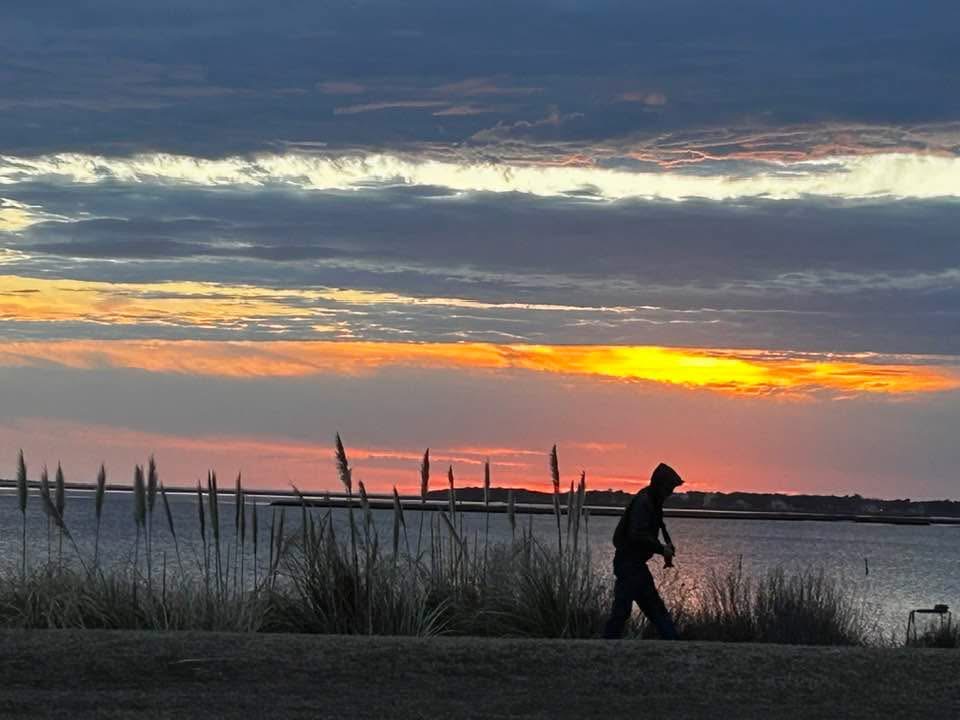
The mailboat Violet passed through the Straits at this point in May 1903. This photograph was taken recently by my dear friend Robin Chadwick. Robin and her husband Dennis and I go way back. They reside on land in the Straits that has been in Dennis’s family since Yankee whaler Samuel Chadwick purchased 130 acres at the Straits in 1725.
This is the 2nd part of “A Journey to Sleepy Creek.”
As the mailboat Violet steamed east from Morehead City, the News & Observer’s correspondent, C. J. Rivenbark, breathed in the salt air and looked out over the sea and the salt marshes.
In the article that he later wrote for the News & Observer (13 May 1903), he included notes that he made aboard the Violet:
“The day . . . is beautiful. Old Sol shines forth in all his glory, the waters are placid, the temperature is that of real spring time, and time is spent viewing and reviewing the panorama nature has provided.”
The Violet passed Fort Macon and the fish factories at Lennoxville, then turned toward the fishing villages along Core Sound.
To the south, Rivenbark could see the long barrier island known as Shackleford Banks, running almost due west of Cape Lookout.
He could see the lighthouse, and his thoughts drifted to the banks ponies that grazed in the island’s marshes and swales and to the pony pennings that happened there every summer.
The Violet and its little band of travelers– the captain, the reporter, and two other passengers– passed the North River marshes, came up on Harkers Island and then steered toward the Straits.
“Passing Harkers Island the Straits are entered. Here are beautiful stretches of water with landscape that fascinate the eye of the artist. Presently we approach, to the left, the settlement or village of Straits.“
The community of Straits is located 5 miles east of Beaufort and was long the home of “saltwater farmers” who kept one foot on shore and the other at sea.
Among its earliest settlers was Samuel Chadwick, a whaler who came from Falmouth, Massachusetts, and settled on 130 acres of land by Whitehurst Creek in 1725.
Until the Civil War, Straits was also home to some of the largest plantations Down East. Slave traders came and went there, and Black men, women, and children were bought and sold and made to work both in the fields and on the water.
My great-great grandmother’s sister was a famous Confederate spy named Emeline Pigott, and she was from one of those plantations at the Straits.
The Mailboat from Straits
As the they entered the Straits, the Violet’s captain and his passengers spied a boat coming their way.
“In the distance is seen a small boat with a lone occupant plying his oars to our path. This is Stephen Gaskill’s boat and Stephen Gaskill at the oar. He is the mail man…. He brings the mail pouch and takes the mail pouch.”
That was Stephen A. Gaskill who was married to Lydia Ann “Lillie” Whitehurst, also of Straits.
“Mr. Gaskill is lean and lank but enjoys excellent health…. Twice a day, morning and afternoon, rain or shine, rolling waves or placid sea, this man of 63 years meets the naphtha launch and exchanges mail pouches.
“He never misses the connection. Sometimes the launch picks him up down the sound where the contrary wind and rolling billows have forced him and tow him to the windward, but they always find him when they come and when they go.”
After Mr. Gaskill wished them a good day and shoved off, the Violet’s captain continued up the Straits and two or three miles later set Rivenbark ashore at the landing in Marshallberg.
Crabbing Season
He arrived in the middle of the soft-shell crabbing season, when old friends and strangers alike– of every race and background– came to Marshallberg and all of life seemed to revolve around crabbing.
Rivenbark wrote:
“The beach is lined with crab camps. The crabbing season runs from March 1st to June 1st and gives employment to a large number.”
According to Rivenbark, the village’s fishermen brought in, on average, some 50,000 dozen crabs every spring, well over half a million in all.
Soft-shell crabs had long been considered a delicacy, but a commercial fishery for soft-shell crabs had not developed anywhere in the United States until just after the Civil War.
The soft-shell crab fishery blossomed first on Chesapeake Bay, then moved down here to the North Carolina coast and most especially to Marshallberg and other parts of Core Sound.
When Core Sound’s blue crabs began to shed their shells in the last days of winter and the first days of spring, fishermen came from near and far and settled into rough-hewn camps along the village’s shoreline.
The value of the soft-shell crabs was so great, and so little else put cash in fishermen’s pockets in those days, that the crab fishermen worked night and day, seven days a week.
As is still the case, that was especially true in the early part of the season, when the Chesapeake Bay’s waters had not yet warmed up and its blue crabs had not yet started shedding.
As a result, for those few weeks, fine dining restaurants in New York City, Philadelphia, and other northern cities had nowhere else to go to find soft-shell crabs, and they paid top dollar for them.
For those few weeks, the shores of Marshallberg were crowded with crab fishermen, their boats and their dredges, trot-lines, and dip nets.
In the shallows, you could hardly go wading for all the peeler boxes where men and women alike kept watch over the not-quite-ready-to-shed hard crabs and waited for their time to come.
Crab dealers in Marshallberg typically sent soft-shell crabs to the rail depot in Morehead City, where they were put on refrigerated train cars and sent north.
According to the Charlotte News (6 April 1903), Morehead City’s fish dealers shipped out 2,000 dozen soft-crabs a day, on average, in that spring of 1903.
“The Fisherman’s . . . Very Life”
While he was waiting for a lift up Sleepy Creek, Rivenbark made a few other observations about Marshallberg.
“Deer and bear are to be found in the surrounding forest…. Ducks, geese, and brant are plentiful. Clams are had the year round. The annual catch is about 30,000 bushels….”
He also noted,
“The oyster industry is also quite large. A. B. Riggin & Co. operate[s] a canning factory here and pack[s] 40,000 gallons a season….”
Based in Crisfield, Maryland, A. B. Riggin & Co. did not just deal in oysters, but also in soft-shell crabs. Led by Abednego “Bunk” Riggin (1852-1925), the company was a large dealer in crabs and oysters on the Chesapeake Bay.
The company was also well known for its “terrapin farms” in and around Crisfield.
In the 1880s and ’90s, Bunk Riggin also came south and became the single-most important pioneer in the birth of North Carolina’s soft-shell crab fishery.
(To learn more about A. B. Riggin & Co., I highly recommend a very informative lecture that David Bennett gave at the N. C. Maritime Museum. You can find that lecture here.)
In the 1890s and early 1900s, Riggin established oyster canneries and/or soft-shell crab operations in Marshallberg and several other locales on the North Carolina coast– including at least Smyrna, Diamond City, Swan Quarter, and Shallotte.
In Marshallberg, so-called “Bohemian immigrants” were among the company’s cannery workers. Riggin recruited them in Baltimore and brought them south either by railroad or steamer.
(You can learn more about those immigrant families in my story “A Forgotten People: Bohemian Oyster Shuckers on the North Carolina Coast, 1890-1914.”)
Still speaking of Marshallbergers and how they made their livelihoods, C. J. Rivenbark continued:
“The fishing season is the fisherman’s…. very life, other industry is incidental. Nearly every family owns a smack, a skiff, a sharpie[,] and these line sound and creek.”
In his story, Rivenbark went on to say:
“They are a sturdy, intelligent, thrifty people. They enjoy life in a way peculiar to themselves. They are hospitable and kind-hearted.”
There it is– Marshallberg, then and now, in a nutshell.
-To be continued-
 David Cecelski
Fascinating. Thank you for a good read.
LikeLike