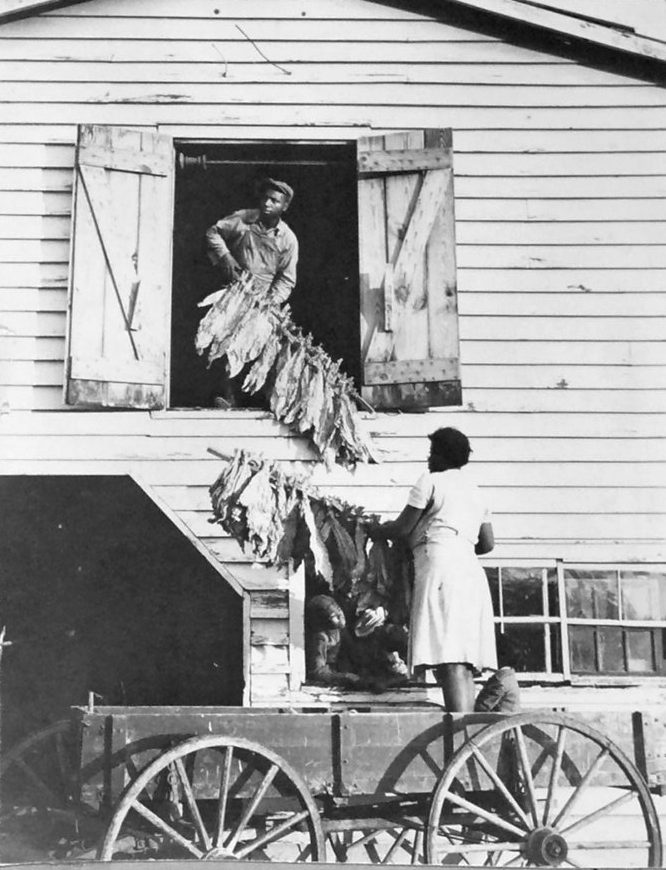
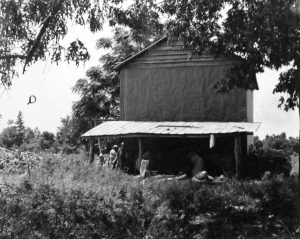
Barning tobacco on one of the Braswell Plantation’s many tenant farms in Battleboro, N.C., August 1944. Courtesy, State Archives of North Carolina
This is the 17th photo-essay in my series “Working Lives: Photographs from Eastern North Carolina, 1937 to 1947.”
You can find my introduction to the series here.
Like all the photographs in this “Working Lives” series, this group of 15 images come from the N.C. Department of Conservation and Development Collection at the North Carolina State Archives in Raleigh.
All of them offer us intimate views of families harvesting tobacco on several different tenant farms that were part of what local people called the “Braswell Plantation” in Battleboro, N.C., in August 1944.
Located 60 miles northeast of Raleigh, Battleboro is now a neighborhood within Rocky Mount’s city limits.
However, at the time these photographs were taken, Battleboro was a separate, incorporated town, divided in two, like Rocky Mount, by railroad tracks and the county line. Nash County was on the west side of the tracks; Edgecombe County was on the east side of the tracks.
By the Second World War, when these photographs were taken, life in Battleboro had revolved around the Braswell family’s farms and its farm supply store, that of M. C. Braswell & Co., for almost 75 years.
In the years leading up to the war, a Raleigh newspaper referred to the family’s store in Battleboro as the seat of a “farm empire.”
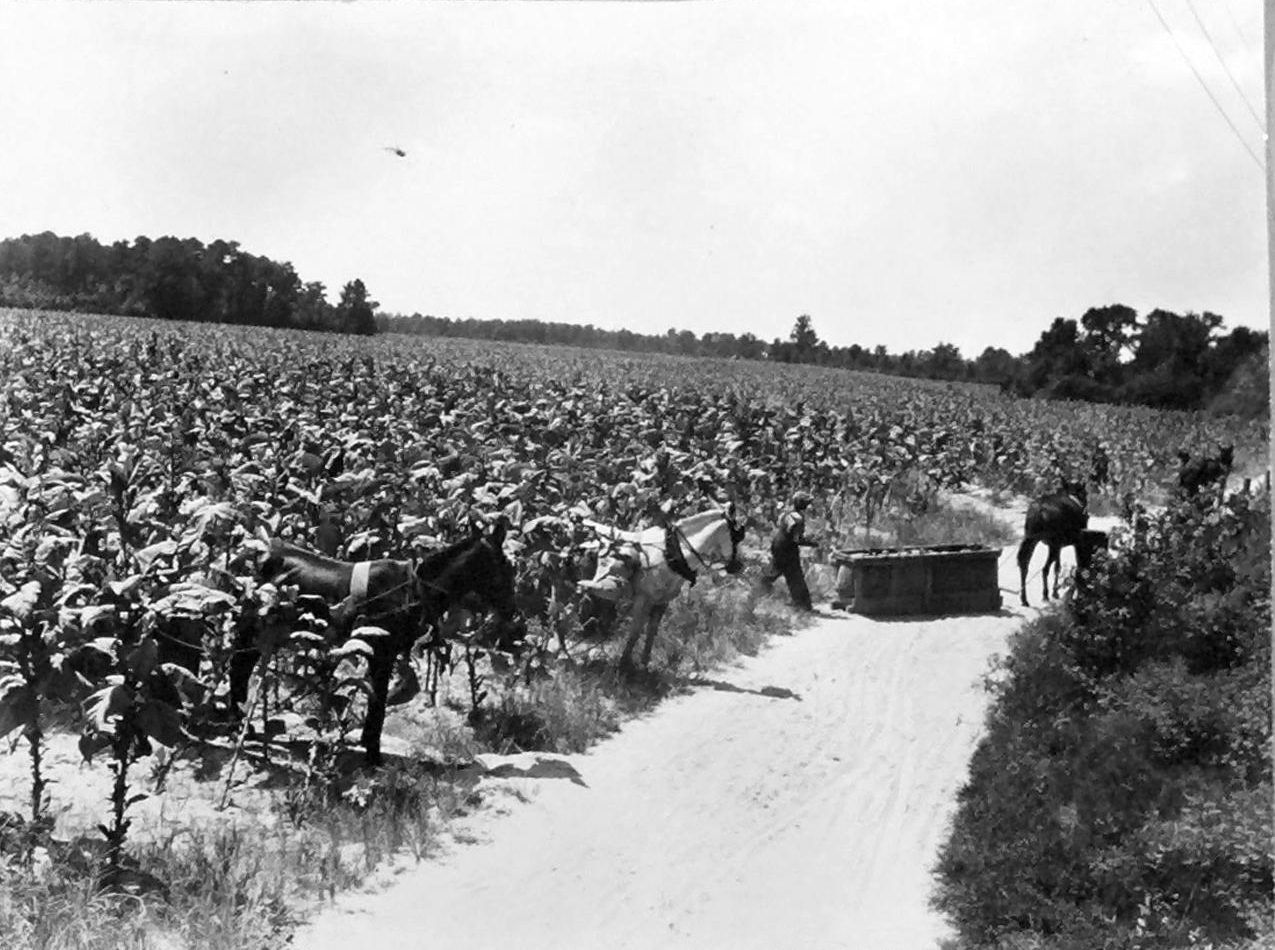
One of the many tobacco fields on the Braswell Plantation, Battleboro, N.C., August 1944. Courtesy, State Archives of North Carolina
That empire reached back three generations. Thomas P. Braswell– “Squire,” he was called– had first opened a store in Battleboro in 1873. That store was said to be one of the largest mercantile businesses in the state and Braswell used the profits to buy farmland and invest in other businesses.
At the time of his death in 1907, the Raleigh News & Observer (17 March 1907), described Squire Braswell as one of the two wealthiest men in Nash County.
His son, Mack Claude “M. C.” Braswell, worked alongside him. After finishing college in Chapel Hill, M. C. played a central role in building the tobacco industry in that part of Eastern North Carolina.
At a time when only a few local farmers were raising tobacco, M. C. spearheaded the establishment of the region’s first tobacco market in Battleboro in or about 1885.
(A couple years later, the market moved a few miles down the road to Rocky Mount, where it grew into one of the world’s largest tobacco markets.)
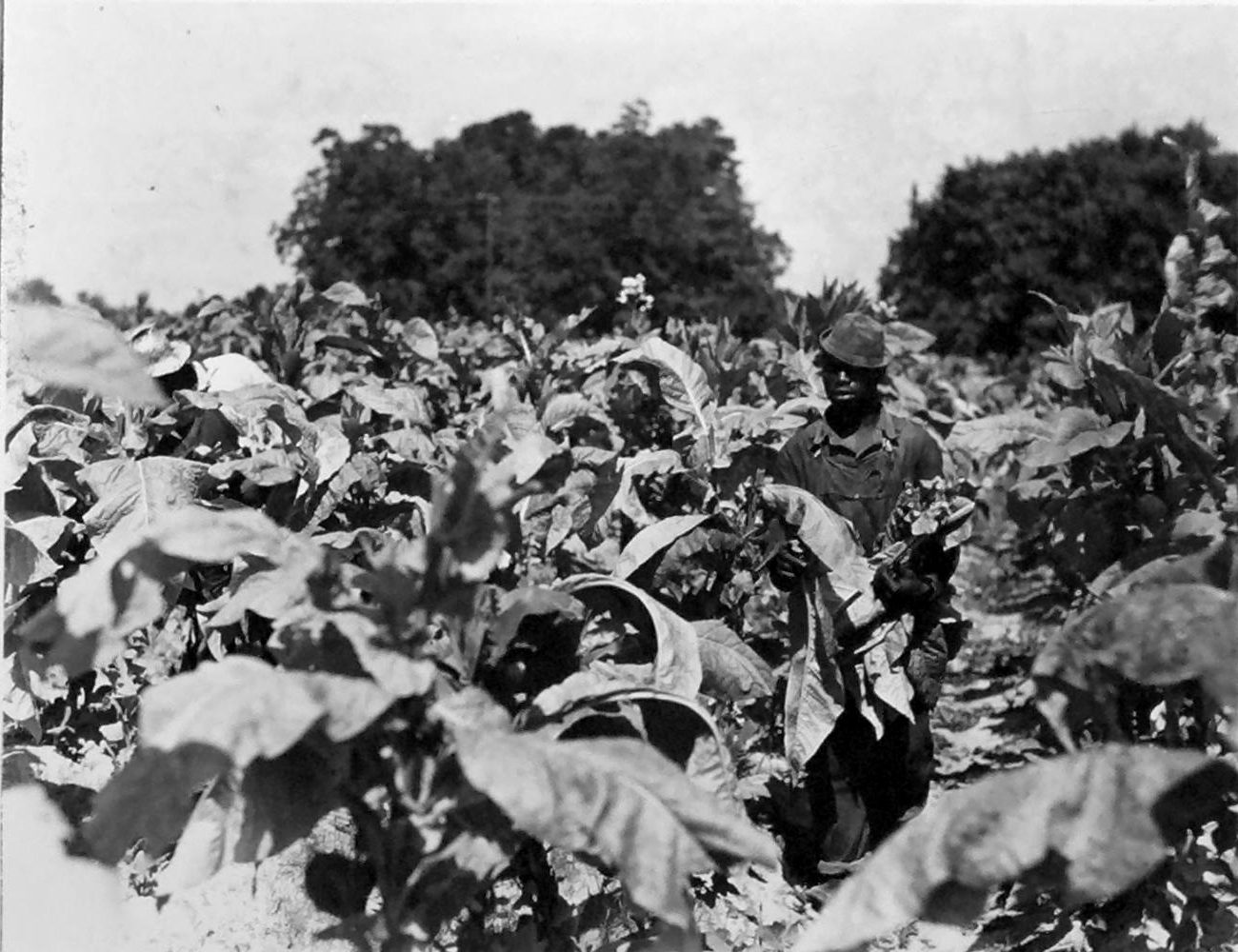
Cropping tobacco, Hillside farm, Battleboro, N.C., 1944. Courtesy, State Archives of North Carolina
Over the years, M. C. Braswell accumulated thousands of acres of farmland. He divided that land into several large farms and more than 50 smaller tenant farms. Most, but not all, of his tenants were African American families.
Braswell’s farmland extended across three counties– Edgecombe, Nash, and Halifax. He also had extensive other business interests.
Among much else, he and his brother, who was the president of a cotton mill in Rocky Mount, established the Planters National Bank, an important regional financial institution headquartered in Rocky Mount– and one whose fortunes were tied to the growth of the tobacco industry.
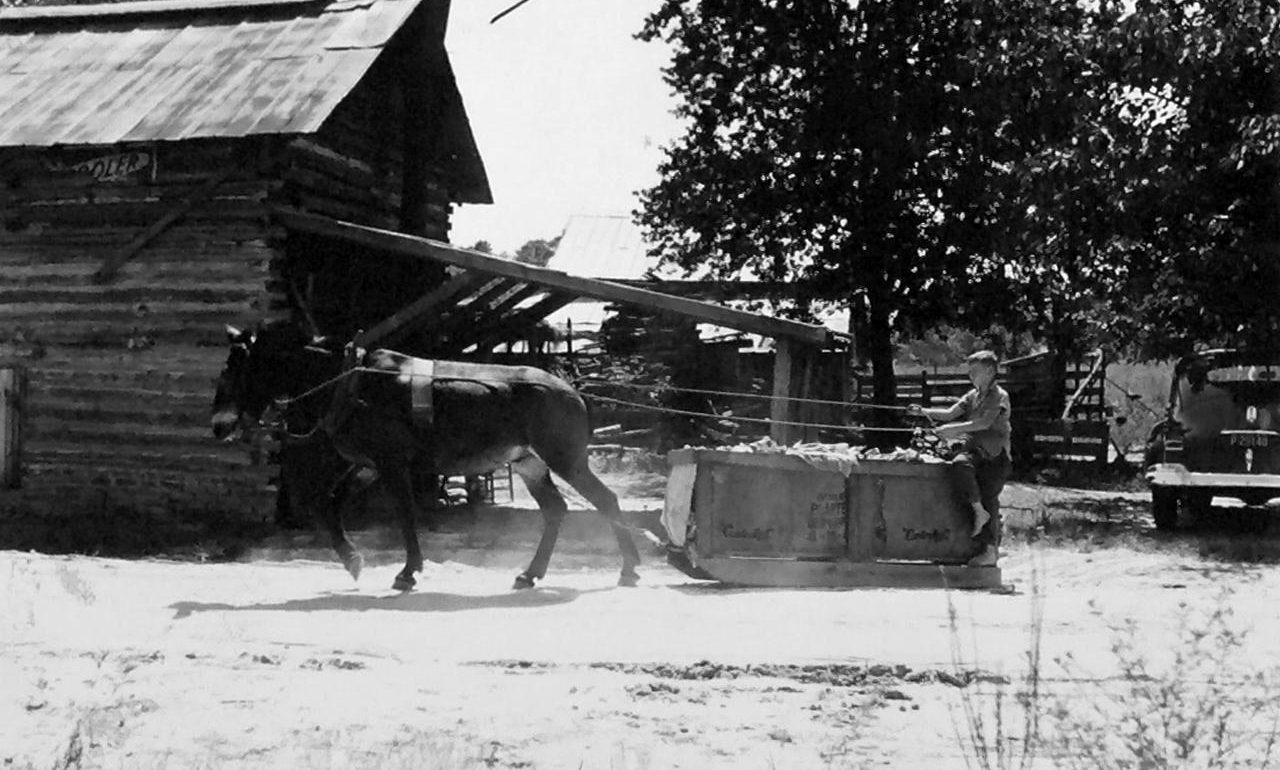
Hauling tobacco. Battleboro, N.C., August 1944. Courtesy, State Archives of North Carolina
M. C. Braswell was also very big into cotton. He owned thousands of acres of cotton fields, a cotton gin, and a cottonseed oil company in Battleboro.
In addition, he owned thousands of acres of timberland in Alabama, Georgia, and Florida, as well as half interest in a tony resort called Panacea Springs in Warren County, N.C.
When he died in 1922, at the age of 61, a front page story in the Raleigh News & Observer referred to M. C. Braswell as “probably the wealthiest citizen of Northeastern Carolina.”
For a dozen years after his death, his widow Alice (Bryan) Braswell ran the M. C. Braswell Company. Cotton remained one of the family’s main crops– and the state’s press often noted how striking it was that North Carolina’s largest and most influential cotton farmer was a woman.
Alice Braswell died in a boiler explosion in 1935. After her death, her three daughters inherited the M. C. Braswell Company, including the store and more than 20,000 acres of farmland.
At that time, her daughter Emily’s husband, a young Rocky Mount attorney named Thomas J. Pearsall, become manager of both the farms and the store.
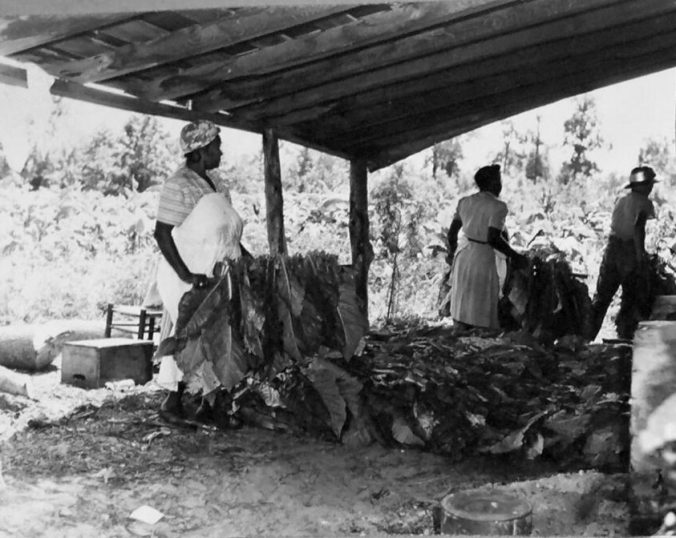
Braswell plantation, Battleboro, N.C., August 1944. Courtesy, State Archives of North Carolina
Tom Pearsall was an interesting man. He was a liberal and a progressive for that time and place, by which I mean that he stood in a white political tradition of which the central historical figure was Charles B. Aycock, the governor of North Carolina from 1901 to 1905.
Originally from Fremont, 45 miles south of Battleboro, Aycock was the state’s most influential and popular governor of the 20th century.
He was first and foremost a white supremacist. He was among the handful of most influential instigators of the white supremacy movement that carried out the Wilmington Massacre of 1898, and he led the white supremacy movement that took away the voting rights of North Carolina’s black citizens in 1900.
Ironically, Aycock is often considered the father of the state’s liberal political tradition because of his support for public schools and higher education, and perhaps particularly so because that support included investing in public schools for black children.
That stance distinguished him from the state’s “conservative” political tradition, which embraced an even harsher, leaner brand of white supremacy and black subjugation.
Later commentators often considered Charles B. Aycock’s commitment to white supremacy and his relative, though unequal, support for black schools and colleges to be at odds with one another– to be a contradiction or a paradox.
That was not at all the case. That view reflects a fundamental misunderstanding of North Carolina politics in that era that I will discuss in another essay later this year or early in 2026.
In Battleboro, Tom Pearsall’s career exemplified one of the more interesting veins of Aycock’s political legacy.
At the time that these photographs were taken– or at any later time, as best I can tell–Pearsall never questioned or challenged the legitimacy of white supremacy in public or in private.
When these photographs were taken, he had also never said a word in favor of the restoration of black voting rights. He had never called for racial equality. He had never advocated for an end to Jim Crow racial segregation.
A few years after these photographs were taken, Pearsall could have done so and conceivably made a real difference. During and after the war, he had a brief career in state electoral politics, and in the late 1940s, he was even speaker of the N.C. House of Representatives.
Needless to say, Pearsall also never supported policies that might have addressed more fundamental causes of racial inequality and economic injustice in Eastern North Carolina.
For instance, he never called for land reform. He never supported a tenants rights law that would have given black tenant farmers more leverage in their negotiations with white landlords.
Among other things, he also never called for a prohibition to the racially discriminatory credit practices that banks and other lenders, including the M. C. Braswell & Co., universally applied to black farmers.
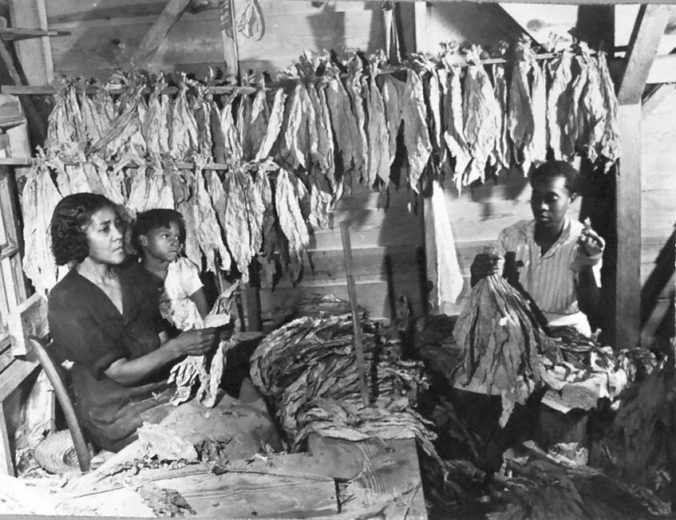
Tying tobacco on one of the Braswell family’s tenant farms, Battleboro, N.C., August 1944. Courtesy, State Archives of North Carolina
On the other hand, Pearsall did often show deep concern for the welfare and fortunes of black families.
Speaking out publicly, and at times serving on special government commissions, he often called for greater public investment in the health, welfare, and educational needs of Eastern North Carolina’s black citizens.
He spoke out especially on behalf of the region’s African American tenant farmers and sharecroppers.
“A Miserable Existence”
The reports of agricultural experts give us some sense of the historical level of poverty and exploitation found on tenant farms in the vicinity of the Braswell Plantation.
On the eve of World War II, there were 2,282 farms in Edgecombe County, for instance– on the east side of Battleboro. Nearly 80 percent were operated by people who were landless. Most of them were African American or Native American.
In his annual reports, the supervisor of the state’s black agricultural extension agents, Cassius R. Hudson, reported that malnutrition, disease, and inadequate housing were widespread on tenant farms throughout Eastern North Carolina.
Hudson observed that pellagra, a disease of malnutrition, was especially common. Many landless black farmers subsisted on what he called a “3-M diet” of meat (fatback or side meat, typically), meal (ground corn meal), and molasses.
Touring Edgecombe County, a pioneering black ag extension specialist named Thomas M. Campbell described the county’s tenant farmers living in “squalid, ramshackle cabins.”
Campbell, based at Tuskegee Institute, wrote that he found them “forlorn, emaciated, [and] poverty-stricken,” and he observed that “year after year [they] struggled in cotton fields and disease-laden swamps, trying to eke out a miserable existence.”
F. D. Wharton, Edgecombe County’s first black extension agent, echoed Campbell’s findings.
In his 1939 annual report, Wharton described “ramshackle log cabins and dilapidated frame houses covered in worn weatherboard siding,” walls insulated only with newspapers or cardboard, and windows, their homes had them at all, “fitted with broken glass, scraps of cloth, or crude board and batten shutters.”
See esp. Cassius R. Hudson, Annual Narrative Reports, African American County Agent Work, 1937 and 1938, Special Collections Research Center, NC State University Libraries. Cited in the National Register for Historic Places Registration Form (draft) for the Annie H. and F.D. Wharton House, Tarboro, N.C.
While advocating publicly for health and social welfare programs that targeted black tenant farmers, Tom Pearsall also began a rather unusual experiment on his tenant farms in the late 1930s.
When I first learned of Pearsall’s farm program, I was reminded of textile magnate James W. Cannon’s paternal vision of a company town that had unfolded in Kannapolis, N.C., earlier in the century.
Working hand in hand with Edgecombe County’s first black agricultural extension agent, Fletcher Decatur “F. D.” Wharton, Pearsall established a community center in Battleboro for his tenant farmers and other farmers in the Battleboro area. The center housed a library with magazines, government reports, and films that highlighted modern farming practices.
That center also contained a 150-seat auditorium where, at least twice monthly, county extension agents, home demonstration agents, and even agricultural experts from North Carolina State gave lectures.
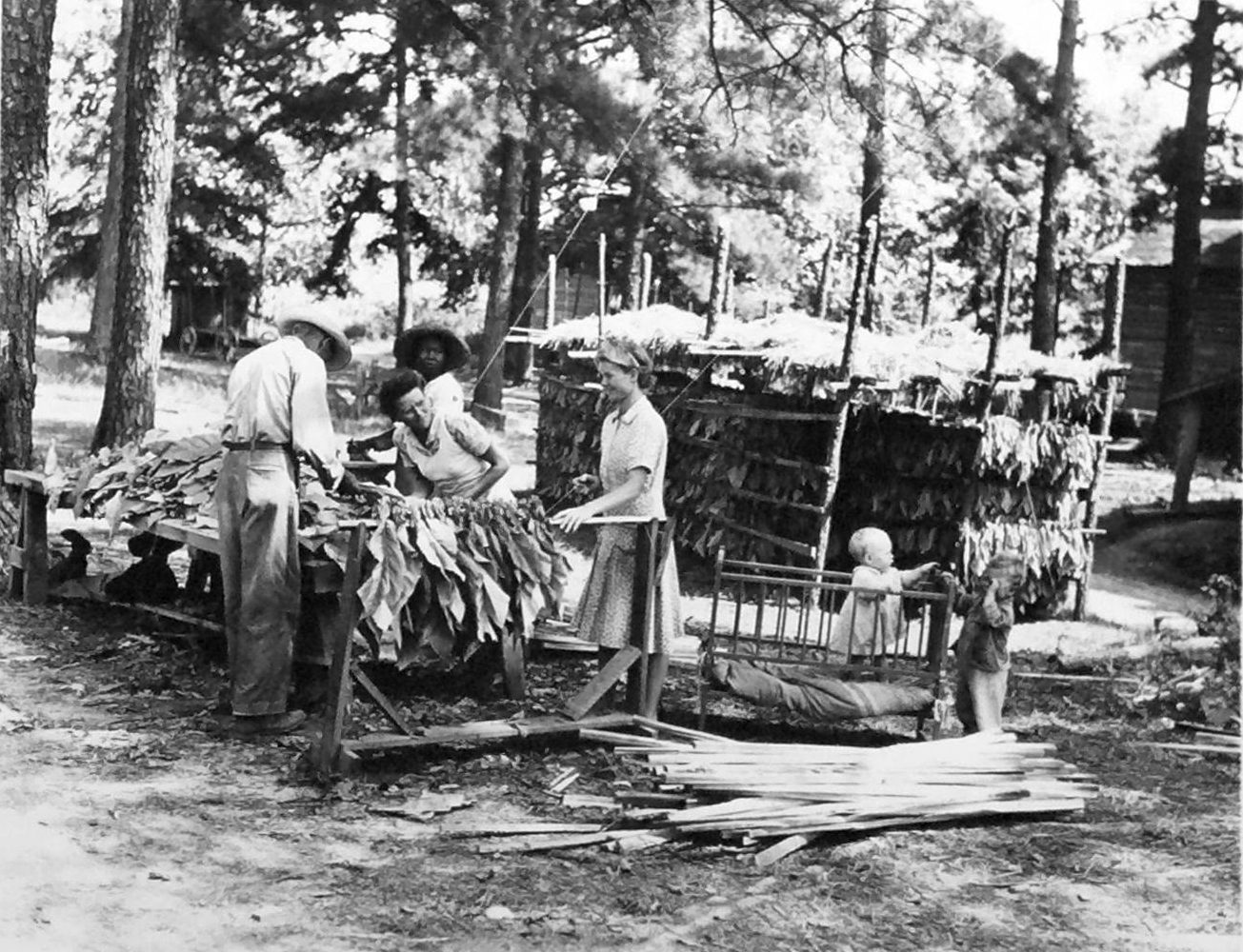
Tying tobacco, Mason farm, another of the Braswell family’s tenant farms, Battleboro, N.C., August 1944. Photo courtesy, State Archives of North Carolina
Those lectures covered topics ranging from hog raising practices and the latest fertilizer research, to home canning and proper sanitation practices.
Unlike many landlords, Tom Pearsall also encouraged his tenants to grow their own gardens and raise their own food for the sake of their health and to foster their financial independence.
Every fall he also sponsored a giant barbecue for the more than 500 tenants who worked his farms. F. D. Wharton was always the master of ceremonies: prizes were given for the best farm practices, gospel groups sang, and a guest speaker was featured.
In the autumn of 1944, just a few weeks after these photographs were taken, the guest speaker was Dr. Charlotte Hawkins Brown. (See Greensboro News & Record, 25 Sept. 1944.)
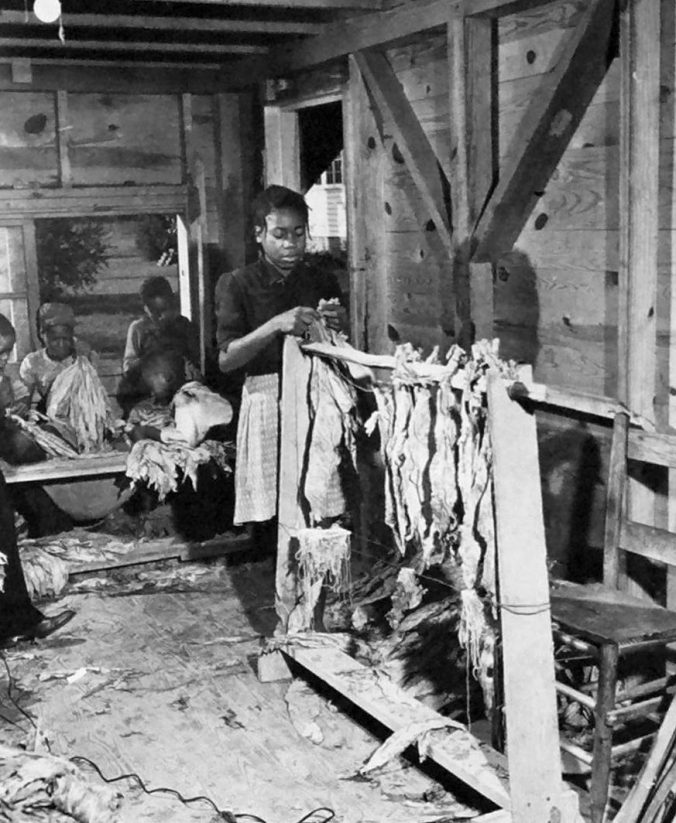
Braswell plantation tenant farm, August 1944. Courtesy, State Archives of North Carolina
The granddaughter of a couple born in slavery, Dr. Brown was the founder and president of the Palmer Memorial Institute, a remarkable school for African American students in Sedalia, N.C.
(Tom and Emily Pearsall were among the Palmer Memorial Institute’s financial backers. Dr. Brown visited Braswell Plantation on at least three occasions.)
An April 1, 1940 article in the Greensboro News & Record offered some detail on Pearsall’s agricultural model.
It was, first of all, not an optional activity on the Braswell Plantation, and there was nothing democratic about decision making on the plantation. Pearsall made the decisions, and you were either in or you were out.
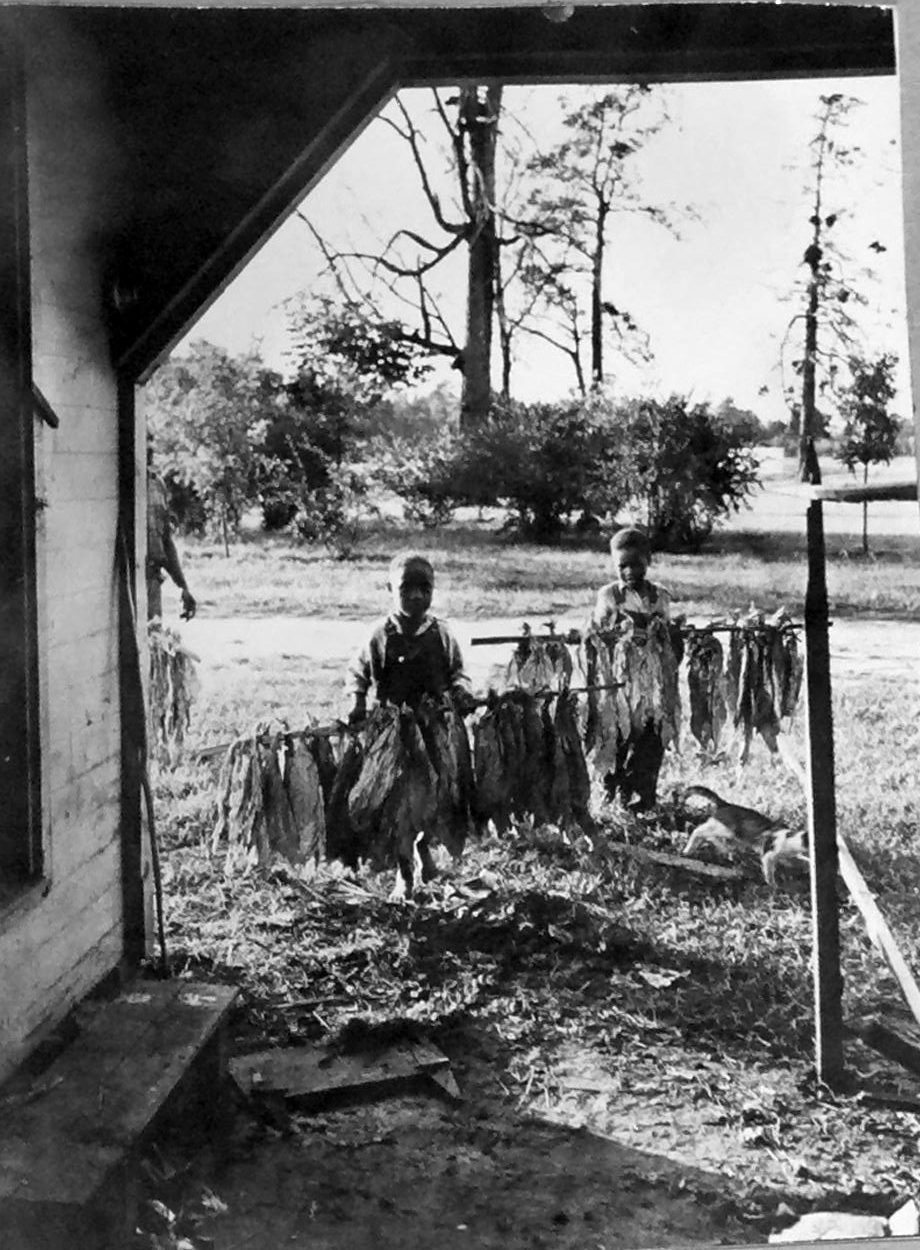
Braswell plantation tenant farm, Battleboro, N.C., August 1944. Courtesy, State Archives of North Carolina
According to the News & Record, for example, Pearsall required attendance at agricultural lectures from all 55 of the tenant farming families on his land.
He sought control even over his tenants’ personal gardens. He provided each family with land for a large garden, $8.65 worth of garden seed, and, at least one year, cabbage plants.
“Pearsall says the next step will be to require every tenant family to keep a cow,” the Raleigh News & Observer reported. (Italics are mine.)
Tom Pearsall supplied each of his tenants with a wall calendar that instructed them what to plant in their home gardens, when to plant it, and the major steps in each crop’s growth and harvest. Likewise, the calendar charted a timetable for caring for the livestock that had been allotted to them.
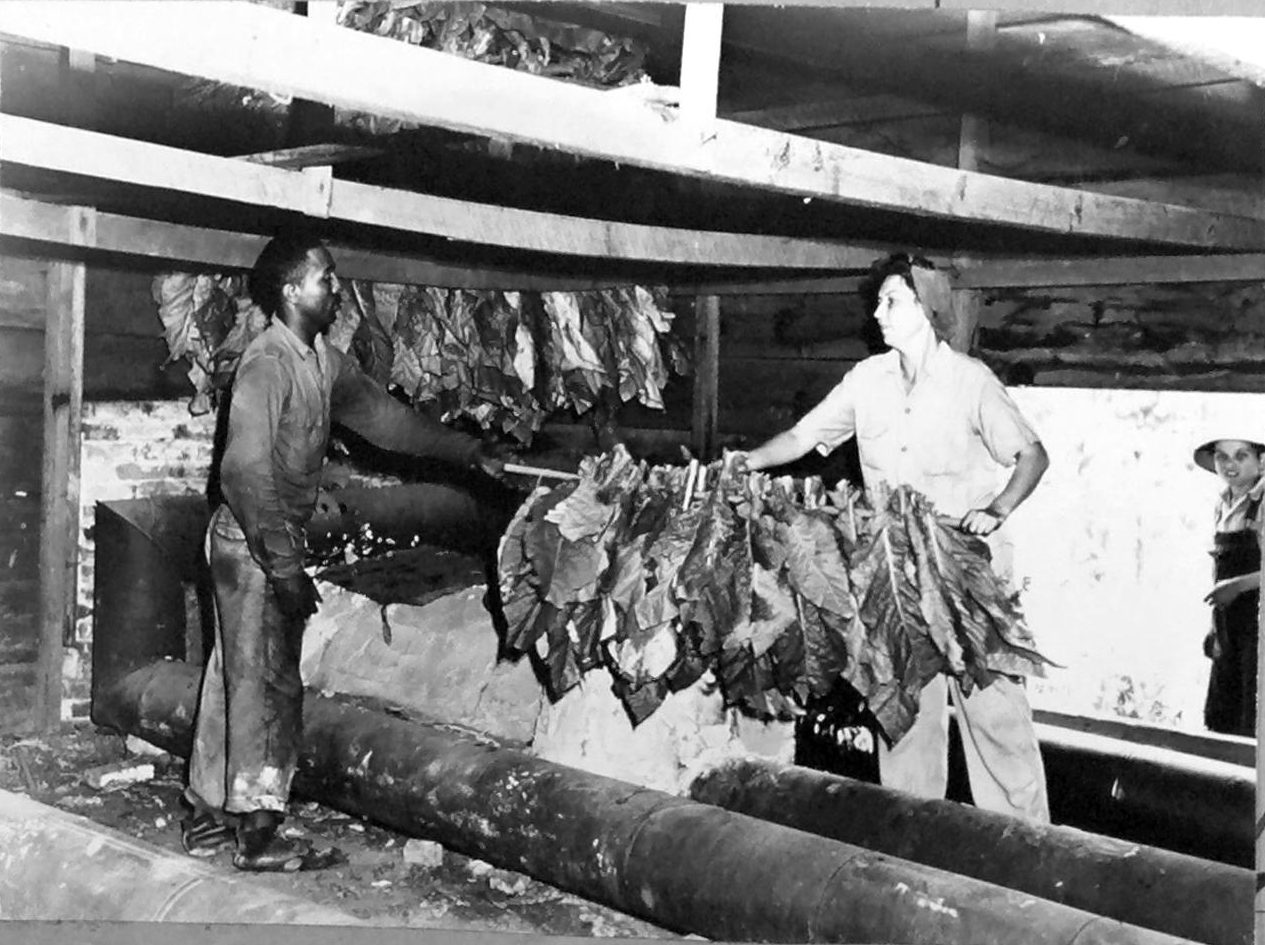
Barning tobacco, Braswell Plantation tenant farm, Battleboro, N.C., August 1944. Courtesy, State Archives of North Carolina
To assure compliance with the calendar’s instructions, his 15 farm overseers inspected every tenant farm’s personal garden, as well as its cash crops and livestock, on a regular basis.
From the point of view of the tenants, none of this was negotiable. Like much else at Braswell Plantation, attendance at meetings, obedience to the calendar’s timetable, and abiding by the overseers’ instructions with respect to their cash crops, their personal gardens and their livestock were all requirements for living and working on the Braswell family’s land.
When I first read of Pearsall’s approach to being a landlord, I thought, as I said above, of the paternalistic cotton mill villages of the South.
As I learned more about his agricultural model, I increasingly thought about the myth of the “good master” in the plantation South, and how “enlightened” slaveholders sometimes tried to defend human bondage by saying that the institution of slavery could be defended if it was made more scientific, orderly, and humane.
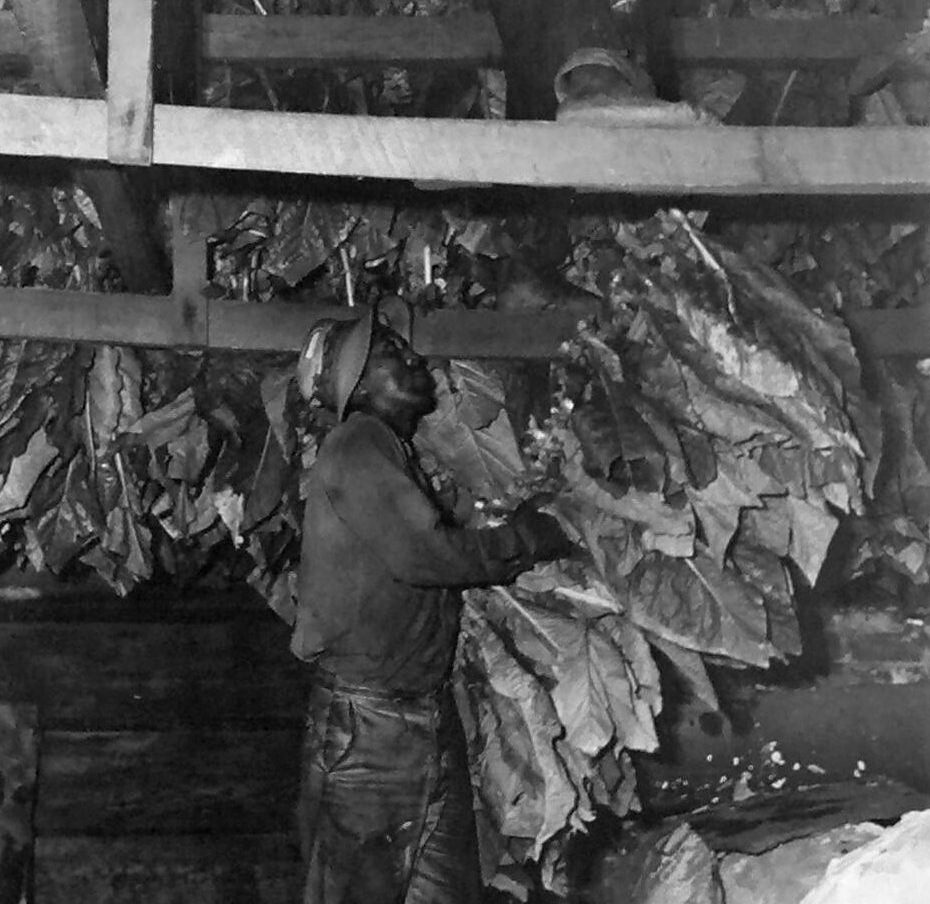
Barning tobacco, Braswell Plantation tenant farm, August 1944. Courtesy, State Archives of North Carolina
Maybe I am being too harsh– Tom Pearsall and the Braswell family really do seem like the best of their lot for their time and place– but I am afraid that that says a great deal about their time and place.
Today I think Tom Pearsall’s experiment in tenant farming has largely been forgotten. As best I can tell, it was short lived and gave way, after the war, to the rise of corporate, mechanized agriculture that swept black and white tenant farmers alike off the land in the first decades after the Second World War.
However, for other reasons, Pearsall has not been forgotten, at least not by historians of the 20th century South.
After the U.S. Supreme Court ruled that racially separate schools were unconstitutional in 1954, North Carolina’s governor at that time appointed Pearsall chairman of a committee to fashion the state’s response to Brown v. the Board of Education.
That committee came to be known as the “Pearsall Committee.”
The adoption of the Pearsall Committee’s recommendations by the state legislature– they were collectively known as the “Pearsall Plan”— was the driving force behind North Carolina’s refusal to comply with the U.S. Supreme Court’s ruling in Brown v. the Board of Education.
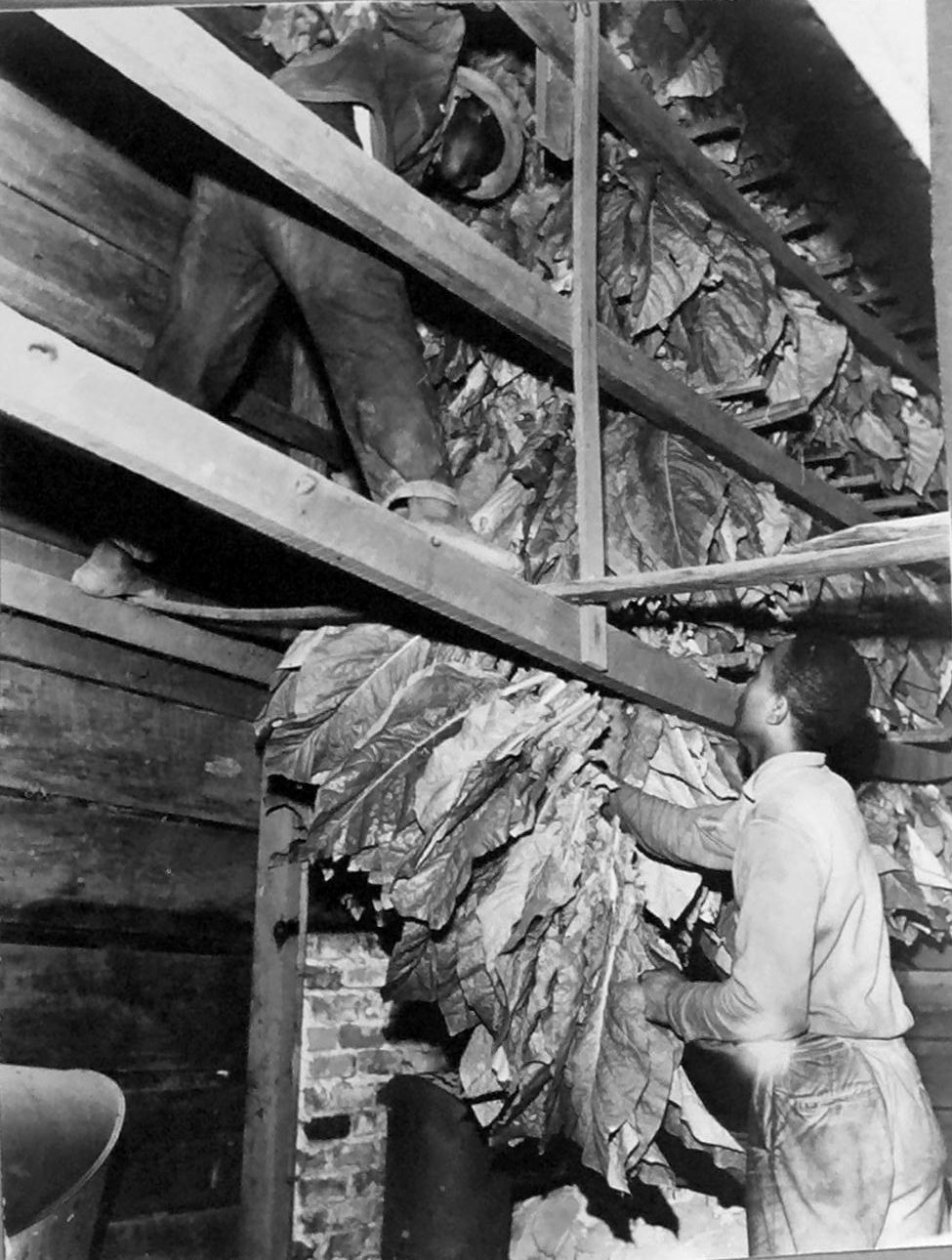
Barning tobacco, Braswell Plantation tenant farm, August 1944. Courtesy, State Archives of North Carolina
The Pearsall Plan played a central role in assuring that racial desegregation occurred later in North Carolina’s public schools than in the public schools of Mississippi, Alabama, and most other southern states. A federal court ruled the “Pearsall Plan” unconstitutional in 1969.
In his declining years, Tom Pearsall was said to have been wracked by guilt over his work with the Pearsall Committee.
By most accounts, he was haunted until his dying days by his work on the committee and by the thought that, throughout his life, he had not done enough to help the state’s black citizens.
The more I read about him, the more I came to see Tom Pearsall as a good man who, like so many good men before and since, failed, at great cost to his soul, to get beyond the white supremacy of the times into which he was born.
Courtesy, State Archives of North Carolina
 David Cecelski