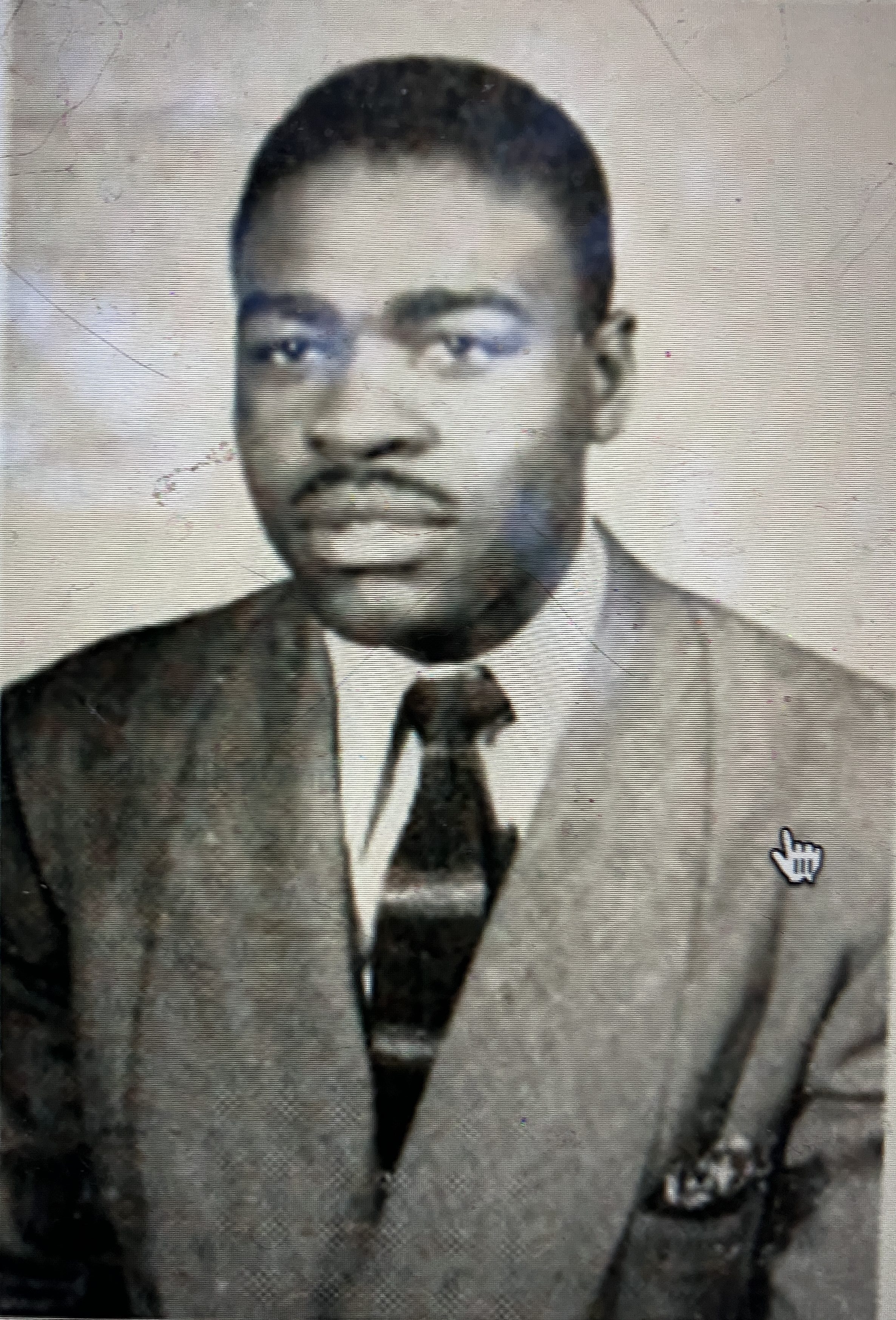
Charles E. Bradford in The Ram, the yearbook of Winston-Salem State Teachers College (now University). From Lisa Y. Henderson’s excellent blog Black Wide-Awake
There are times when I hear a story, sometimes even a very small story, that seems to say more about our history than a whole shelf of history books.
On Facebook yesterday, the historian Dr. Charles McKinney related such a story about North Carolina during World War II.
With Dr. McKinney’s permission, I am republishing his post just as he wrote it, except that I have broken the post up into paragraphs to make it fit the format I use here a little better.
This is Dr. McKinney’s Facebook post.
* * *
Charles Branford was a black army recruit in Wilson, NC.
In 1942, he signed up to join the Army. He goes to the segregated hot dog stand in his hometown in an attempt to get a hot dog before going to basic training.
The waitress, knowing the rules but taking pity on this black serviceman, hooks him up.
But as he’s about to bite into the first hot dog he’s ever had from the joint (remember– it’s segregated) the manager comes up and slaps the dog out of his hand: “You know we don’t serve n@@@@ here.”
As he turns to leave, he notices three men eating at the counter. Behind them stand two military policemen. The initials “POW” are emblazoned on the three men’s backs.
The three men were German soldiers– prisoners of war– and they got to sit down inside and eat hog dogs in Wilson, North Carolina in 1942 because they were white.
In the United States during the 1940s, their race was the factor that trumped all others. That’s what mattered first. The fact that they were Nazis came in a distant second to the fact of their race.
Charlie Branford told me this story when I interviewed him back in 2002– sixty years after this event.
It took him thirty minutes to retell this story because he had to catch his breath and choke back tears of unspeakable rage, hurt, and disappointment.
Happy Veterans Day.
* * *
Dr. McKinney, an old friend of mine, is a professor of history at Rhodes College in Memphis, Tennessee.
He interviewed Mr. Branford as part of his research on the history of the civil rights movement in Wilson. That research led to his pathbreaking book, Greater Freedom: The Evolution of the Civil Rights Struggle in Wilson, North Carolina.
 David Cecelski
This story made me feel such a stone in the pit of my stomach….why is it that color matters so much and brings some to their lowest selves? I have never understood it. Thanks for sharing it as a reminder of what we should not be again… and yet here we are as a country, trying to put other faces on the monsters we refuse to admit we are feeding.
LikeLike
The best Veterans’ Day piece I have read. Thanks for sharing it.
LikeLike