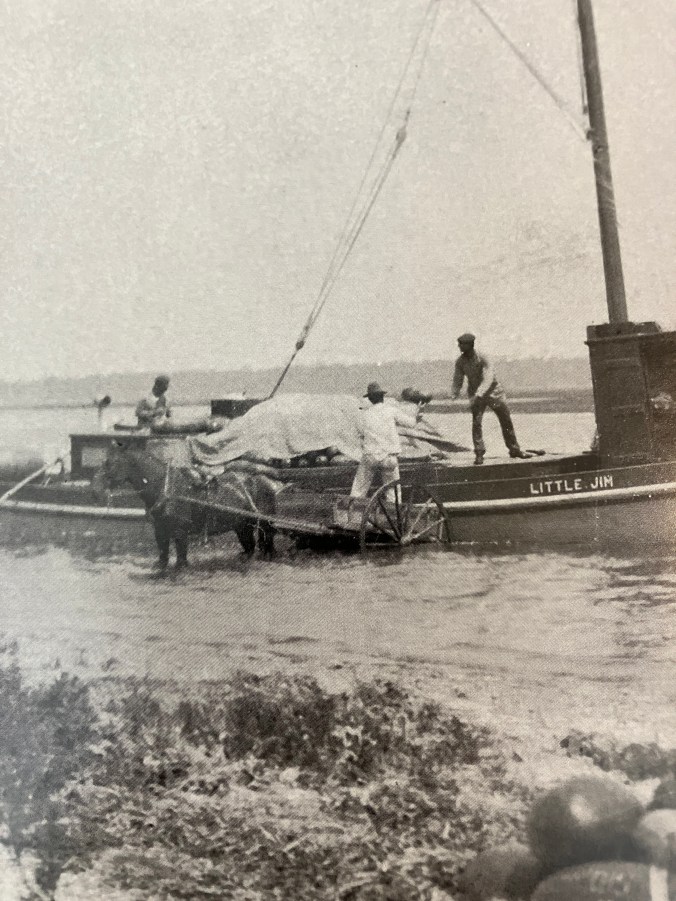
The freight boat Little Jim on Bogue Sound, 1907. Courtesy, State Archives of North Carolina
This is an absolutely iconic photograph of life on the North Carolina coast at the turn of the 20th century. Taken in July 1909, the photograph shows a man standing in a horse-cart on Bogue Sound, east of Swansboro. He is tossing a watermelon to another man who is standing on a scow-built freight boat called the Little Jim.
A large pile of watermelons is already under a tarp on the boat’s deck. In the foreground, we can see that there are more to come.
In the distance, we can make out Bogue Banks, the long barrier island that is now, but what was not then, home to popular beach resort towns such as Atlantic Beach, Pine Knoll Shores, and Emerald Isle.
The photograph is preserved at the State Archives of North Carolina in Raleigh. However, I first saw the photograph in my friend Jack Dudley’s book Swansboro: A Pictorial Tribute, which was published back in 1998 and is unfortunately now out of print.
Jack’s book is a fascinating portrait of Swansboro and one of the very best collections of historical photographs that I have ever seen from the North Carolina coast.
I think that I like this photograph so much because it captures so poignantly the way that the boundary between farm life and maritime life was blurred for most of North Carolina’s history.
When we think of America’s maritime history, we usually think of seaports crowded with ships and shipyards, fishing fleets and busy wharves.
But most settlements in coastal North Carolina did not have a harbor nearby and were nothing like that at all. They lay on winding salt marsh creeks, quiet bays, and remote sections of sounds and rivers that were far too shallow for seagoing shipping.
Relatively small, shallow-draft boats such as the Little Jim were what was needed on those parts of the North Carolina coast.
For that reason, the scene that we see here—a boat edging onto a wharf-less shore, a horse standing in the shallows, a farmer loading his crop— could not have been more typical.
* * *
Standing in shin-deep water, the horse in the photograph has backed the cart up against the Little Jim. A local farmer is tossing watermelons one at a time into the waiting hands of the boat’s deckhand, who is placing them beneath a tarp on the boat’s deck. The captain is standing aft.
Built in Morehead City in 1897, the Little Jim was a workhorse of a boat.
According to Jack Dudley’s book, the Little Jim was originally owned by two Swansboro merchants and boatmen, first G.W. “Pete” Smith and later Capt. Jim Parkin.
She was 42-feet in length, weighed 10 gross tons, and was powered by a gasoline screw engine. She probably drew only 18 inches or a couple of feet of water.
As we can see in this photograph, the Little Jim had a classically scow-like bow and bowsprit, a small pilot house and rigging for lifting freight. A skiff is tied to the scow’s stern next to a water barrel.
I am not sure who the boat’s captain was in 1907. I did find however that two years later, she was sailed by Capt. Martin Bloodgood, a fisherman’s son from Swansboro.
As a freight hauler, the Little Jim carried a little bit of everything. Newspaper reports indicate that the boat hauled livestock, bricks, lime, barrels of salt fish, general merchandise, and, as we can see here, truck produce such as watermelons.
According to contemporary accounts, the Little Jim’s most regular run was between her homeport, Swansboro, and New Bern, a seaport that was 60 miles away by water.
The Little Jim was part of a small fleet of freight boats that connected the Swansboro area to the wider world. The connection to New Bern was especially important: Swansboro did not have a railroad in 1907; New Bern did.
Via New Bern’s rail lines, these Bogue Sound watermelons could have been purchased in the fresh markets of Baltimore or New York City a day or two later.
As I mentioned earlier, we can see Bogue Banks in the distance. In the foreground, we can see the mainland side of Bogue Sound and the edge of a tall pile of watermelons yet to be loaded onto the Little Jim.
* * *
My great-grandfather, Guy Sabiston, was a farmer in Core Creek, a rural community in Carteret County, 15 or 20 miles from Bogue Sound, when this photograph was taken.
According to my great-aunt Irene, who was one of his daughters, he took off a whole day every summer and made a special trip to Bogue Sound to buy watermelons. He drove a horse-drawn cart probably a lot like the one in this photograph.
When my great-grandfather got back to Core Creek, he shared the watermelons with his family and neighbors. To this day, the watermelons grown on the shores of Bogue Sound are famous far and wide for their sweetness.
* * *
The Little Jim traveled the backwaters of the North Carolina coast for several more years after this photograph was taken.
In 1909, she was seen hauling lime on the Trent River, south of New Bern. A year later, she was back in Swansboro with a load of general merchandise and guano. A year later, she was reported resting at the Blades Lumber Co.’s wharf in New Bern.
News reports indicate that she sank at least twice between 1910 and 1913. In 1910, she went down in a gale on the Neuse River, near the river’s inlet into Clubfoot Creek. That was not an unusual: she was raised and continued to ply local waterways.
Two years later, in 1912, she was sold to a merchant in Trenton, a village on the Trent River. She sank again later that year, apparently after hitting a snag on Swift Creek, north of New Bern.
One account indicated that the Little Jim was raised again and brought into New Bern for repairs to her hull. But another account, dated 1913, said that the boat remained on the bottom of Swift Creek. The two reports may refer to two separate sinkings.
According to the 1913 report, the Little Jim rested from her labors beneath waters not far from Vanceboro, somewhere close to the docks of the Norfolk & Southern Railway Company. Her cargo, four tons of lime, had evidently sunk with her. She may still be there to this day.
 David Cecelski
I love reading your pieces, David. Life is good at Lake Waccamaw. I referred you to the Whiteville Chamber exec, who is on a committee researching black history in our area. She thought I had written about July 6 and the black Fourth of July. She knows about what you wrote. I just wanted to mention that after reading Pat Conroy’s “The Water is Wide,” we did a tour of Daufuskie Island with one of his former students, Sallie Ann Robinson. If you haven’t been, it is really good. It is near Hilton Head. Hope you’re doing well. I have a B&B here at the lake if you’re ever in the area again (Weaver’s Landing). Take care and keep up the good work! Ginger Littrell
Sent from my iPhone
LikeLike
Hi Ginger– it’s wonderful to hear from you. Thank you so much for your kind words about my writing. And thanks for the heads up about Daufuskie– I’ve heard a lot about Daufuskie but never been there. I’ll move it up my “to do” list! I’m so glad you reminded me about your B&B too– some botanist friends and I are just beginning to plan a trip to the Green Swamp and we were thinking about staying a night or 2 at Lake Waccamaw! They want to go at a very specific time– when some wild orchid or another is blooming, I think. I don’t know if it’ll be this summer or next summer but I’ll be in touch! It would be nice to visit down in the swamps! Take good care, and thanks again for being in touch!
LikeLike
I had a botanist here last week who visited the green swamp and brought back lots of pics of the wild orchids blooming.
LikeLike
Thank you, David. I love reading about the coastal fisher-farmer life!
LikeLike
Another great read. Your love of the coast and its history so evident.
LikeLiked by 1 person
This is good stuff! Keep it coming.
Ed
LikeLiked by 1 person
You have written another Swansboro classic!
LikeLike
Small world. My brother and I grew up with Greg, son of Connie Sabiston, from Core Creek. Connie and my father were both New Bern Police Officers in the early 60’s. We visited with Connie’s parents – I do not remember their names – a few times on the banks of Core Creek.
LikeLiked by 1 person