“I walk down to the pond in the morning to watch and wait for the blue heron who comes at first light … She bows her wings and slowly lifts into flight, grey and slate blue against a paler sky…. I see the light create a russet curve of land on the farther bank where the wild rice bends heavy and ripe under the first blackbirds… I see the light curve in the fall and rise of her wings.”
From Minnie Bruce Pratt, “The Sound of One Fork“
The celebrated poet, feminist and LGBTQ+ activist Minnie Bruce Pratt passed away earlier this week at the age of 76. I only met her once or twice many years ago, but I have long held her in high esteem both for her poetry and her social activism.
To honor Pratt’s legacy, I’d like to share an excerpt from an oral history interview that highlights the years that she spent in Fayetteville, N.C., in the 1970s.
A historian named Kelly Anderson interviewed Pratt in 2005 as part of the Voices of Feminism Oral History Project at Smith College in Northampton, Massachusetts.
You can find the original recording of the interview in the Sophia Smith Collection of Women’s History at Smith College’s library. You can find a full transcript of the interview here.
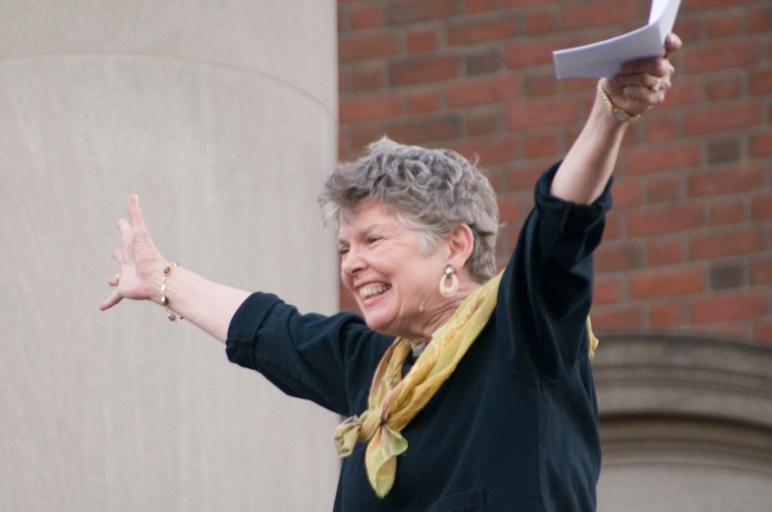
Minnie Bruce Pratt at a “Take Back the Night” march in Syracuse, N.Y., 2008. Photo by Rachel Fus
Pratt was born and raised in Alabama, studied literature at UNC-Chapel Hill, and later lived, among other places, in Washington, DC, back home in Centreville, Alabama, and in Syracuse, New York, where she taught for many years at Syracuse University.
But for several years in the late 1970s, she lived in Fayetteville, a military town 60 miles south of Raleigh.
I chose this excerpt for two reasons. First, it illuminates a chapter in the history of Eastern North Carolina’s small towns and cities that I think deserves more attention: the women’s rights movement of the 1970s.
And second, Pratt’s time in Fayetteville was a crucial turning point in her life, and in more than one way.
The quoted passages below are Pratt’s words, as she told them to Kelly Anderson. I have edited them very lightly, mainly to delete overly repetitive phrases for the sake of clarity and conciseness.
* * *
In 1975 Pratt and her then-husband and their two children moved to Fayetteville so that her husband could take a job there.
Moving to Fayetteville, she said, seemed “like going back to Alabama.” And she added: “I mean, it was brutal.” Fayetteville was the home of Fort Bragg (now Fort Liberty), and the Vietnam War had taken a devastating toll on soldiers, their families and the town.
At the time, Fayetteville had an extraordinary amount of domestic violence and one of the highest violent crime rates in the U.S. “It was brutal, brutal, brutal,” Pratt remembered.
“And there I was with this newly awakened consciousness,” she added, by which she meant a new awareness of being part of a struggle for women’ equality throughout the U.S.
“But the result of all this… was that I got involved with organizing in Fayetteville. I went to a NOW meeting. [She is referring to the National Organization for Women, the nation’s largest feminist group; it was founded in 1966.] I can still remember how scared I was to drive there by myself, because I wasn’t — it was a place I’d never been to, so it was scary.”
At the time, Pratt was almost 30 years old and had very little experience with any kind of political activism.
“… That was back when the NOW chapters were really more wild and woolly than NOW proper, because it was just groups of women who needed some kind of affiliation to do stuff. But we were, you know, we were doing all kinds of local organizing…
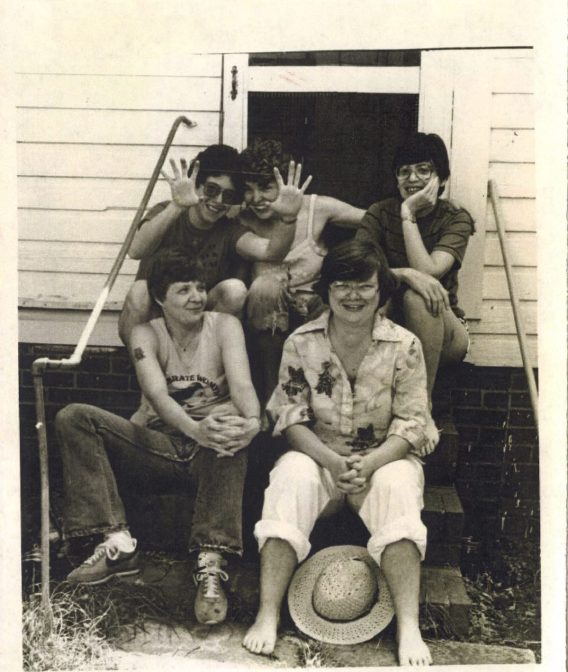
This is a photo of the editorial collective that published the groundbreaking feminist and lesbian journal Feminary beginning in 1978. Left to right, top to bottom row: Helen Langa, Minnie Bruce Pratt, Eleanor Holland, Chris South, and Mab Segrest. Photo by Elena Holland. From the Minnie Bruce Pratt Papers, Duke University Library
“There weren’t many people there. They were all white women, maybe there were four or five, and it was strange. It was very strange to be there. But then it quit being strange really fast.”
KELLY ANDERSON: Because didn’t you go on to be the chapter president? I mean, you stayed connected to NOW.
“Oh, . . . absolutely. I guess I was president and I edited the newsletter and … we put on these big, big, big community forums. I mean, they were the first ones, you know.”
She means the first such community forums held in Fayetteville or Cumberland County.
“We had one on battered women. We had one on women in the arts. We had one on women and religion. We had something on women in the military. We had a big one on women and rape, you know, where we had self-defense [classes], and, I mean, hundreds of people came to these things.
“They were the first. We had the first march. We marched down Hay Street in Fayetteville for probably International Women’s Day, I can’t remember. Or maybe it was Women’s Equality Day, but anyway, we did all this stuff. You know, we’d set up hot lines and everything.”
At that time, local women’s groups had just begun to start the first rape crisis and domestic violence hotlines in many of Eastern North Carolina’s small towns and cities.
“… What I think out of that period, I guess, what I would most like to comment on is — and I think this was not untypical for the people who were… not in New York, who were not in Boston or Chicago, right, which means most of us — we didn’t know.
“We knew almost nothing of movement history, almost nothing of what had gone before. We didn’t have any of the political lessons to draw on, you know, of what we know now about the abolitionist movement and the women’s suffrage [movement] and the kinds of struggles that went on there….”
KELLY ANDERSON: You probably didn’t even know much about the civil rights movement happening under your nose.
“No, no, no, no. I knew almost nothing. And so we were making this movement, but with hardly any tools, really, hardly any tools. And we made mistakes. We made mistakes.
“On the other hand, we did some things well that I think people in other places didn’t do well, because, for instance, there were just a handful of us in Fayetteville, of white women who were interested in this. Now, how are we going to make anything happen?
“We had to look around to who else was politically active. What did that mean? That meant people in the black community. And so, there were African American women who were willing to do stuff with us — not join, but to do stuff with us.
“Well, they would co-organize. They would co-endorse. Like when we did the session on women and rape…, there were political heavies, women, in the African American community, who would lend their endorsement to it.
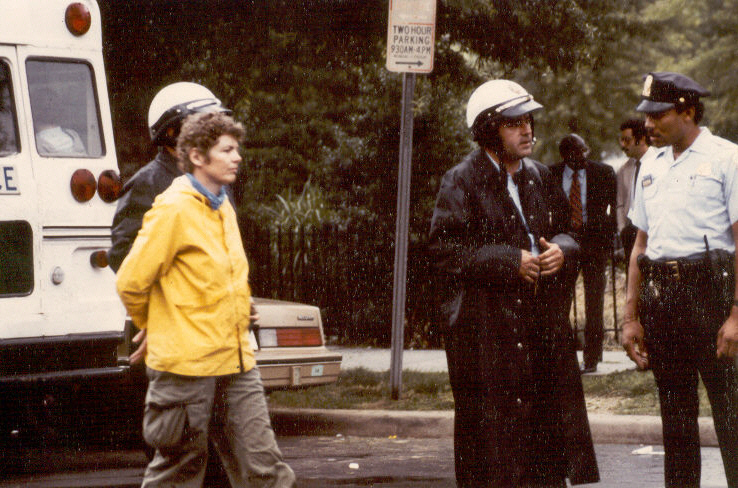
Minnie Bruce Pratt being arrested for civil disobedience against U.S. military intervention in Central America, ca. 1984. Photo by Joan E. Biden (JEB)
“And we tried to, you know, in the planning, we would try to — we really did pretty well, about representation in speakers and so forth. We really did pretty well.
“. . . I’m sure we were insufferable in many ways, in terms of unexamined stuff around racism, but the pragmatics of the situation in the South was that you couldn’t get anything done and not organize with the black community…. You just couldn’t get it done.
“I mean, … we had enough of a consciousness that we really did believe it was about all women. You know, we really did. So for instance, when we did this forum on battered women, I was teaching. By that time, I was teaching at Fayetteville State University, which was the first teaching school for African Americans in the state of North Carolina.
“It has a very distinguished, long history. I was teaching there. I was sharing an office with a wonderful African American man who was in the theater department. So I wrote a play and he staged it with his students, dramatizing domestic violence.
“So there’s many ways in which we did very well. We backed Caletha Powell, who was an African American woman who was trying to win a seat on the city council, and she had a suit going against the county or the city, and we backed her…
“But I’m proud of those years, you know. We made mistakes, but we were organizing in Fayetteville, in the South, in 1976 and ’77 and ’78. I remember going door to door in Fayetteville campaigning for the Equal Rights Amendment, knocking on doors, door to door…
“It was the heart of the heart of women’s liberation outside the metropolitan areas. We were doing it. And we did well. We did very well. You know, we made the newspapers. We raised the issues. And the work is still going on. I mean, the NOW chapter is still there…
“But they were very important years, and one of the things that happened was that I fell in love with another woman and I came out as a lesbian….”
* * *
You can find some of Minnie Bruce Pratt’s best-known poems here. You can learn more about her eight books of poetry, her political activism and other parts of her life here. Many thanks to Mab Segrest for sharing the passage from “The Sound of One Fork” on her Facebook page on the morning of Pratt’s death.
 David Cecelski
Thank you, David, for honoring Minnie Bruce Pratt’s time in Fayetteville. I met Minnie Bruce when I moved to NC. Rebecca and I lived in Elizabethtown during 1978-1979. I met Minnie Bruce in Fayetteville during that time.
LikeLiked by 1 person