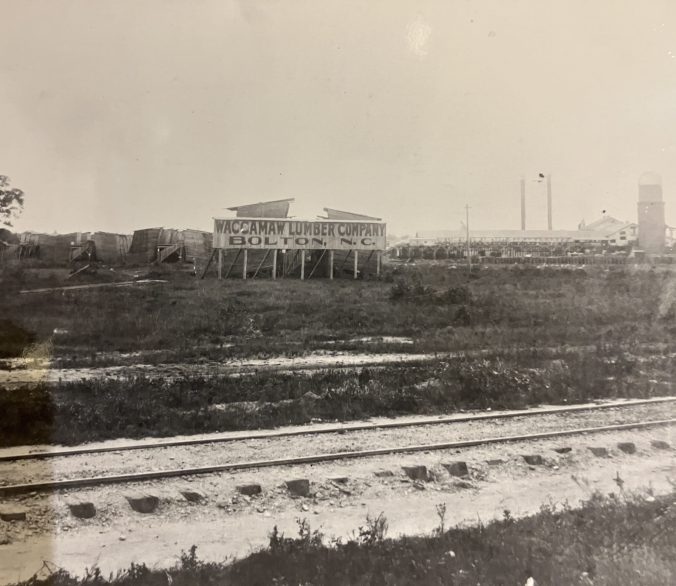
The Waccmaw Lumber Co.’s mill, Bolton, N.C., early 20th century. From Waccamaw Lumber Co. Photographs and Journal, Rubenstein Library, Duke
This is a selection of historical photographs depicting the Waccamaw Lumber Company’s logging and lumber operations in Columbus and Brunswick counties, N.C. They date to the early 20th century, sometime, I would estimate, between 1910 and 1930. They are now preserved, and available for the general public to see, at Duke’s David M. Rubinstein Rare Book and Manuscripts Collections Library.
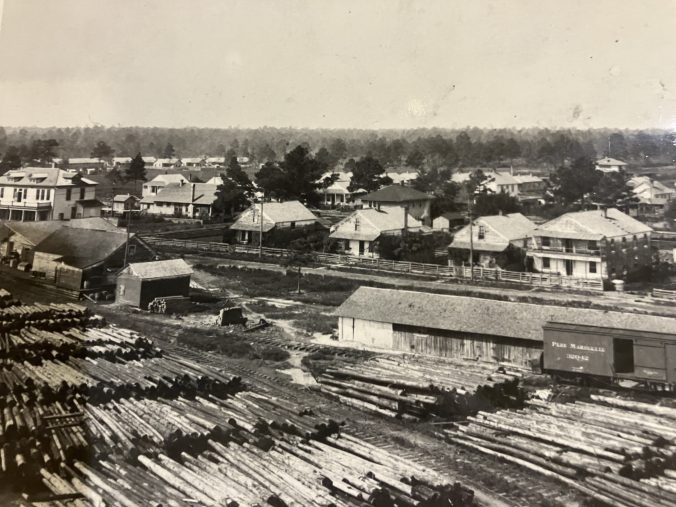
The town of Bolton, N.C., looking across the company’s log pond and railroad tracks, ca. 1910-30. Bolton was a lumber mill boomtown established in 1899 when the Bolton Lumber Co. built a mill there. Photo courtesy, Waccamaw Lumber Co. Photographs & Journal, Rubenstein Library, Duke University
In my recent essay on the Italian immigrant laborers who built railroads on the North Carolina coast, I used four other photographs from that collection. You can find them here.
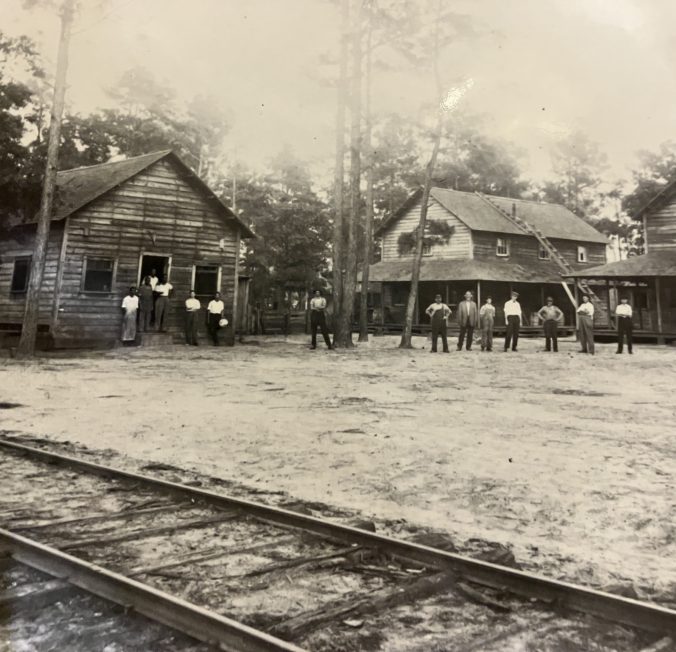
Gangs of African American mill workers lived in the “Quarters,” just below the Waccamaw Lumber Co.’s mill in Bolton. Italian, Russian, and other immigrant laborers may also have stayed there. One of the buildings was a boardinghouse “sorta like barracks in the army,” one of the former employees told the students from Kin’ Lin.’ The ladder on the middle building was apparently a fixture: it served as a fire escape. Courtesy, Waccamaw Photographs & Journal, Rubenstein Library, Duke University
But I thought that quite a few of the other photographs in the collection were also worth sharing.
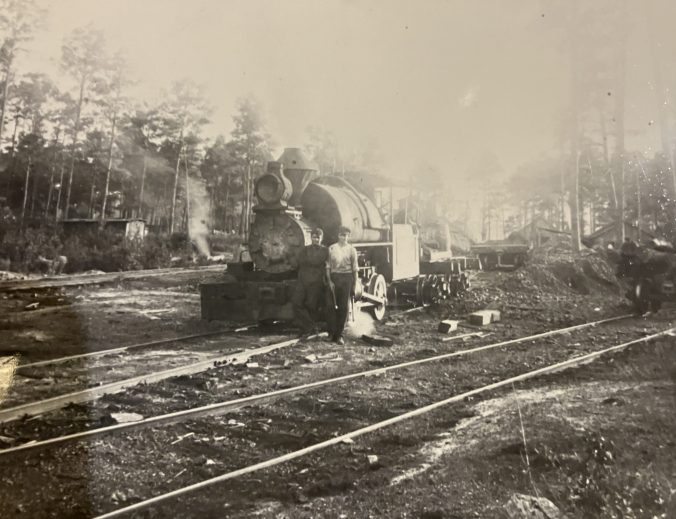
The company’s workers built spurs into even the most remote corners of the Green Swamp. Smaller train engines, such as this one, traveled those rails and carried logs out to the main line. From Waccamaw Lumber Co. Photographs & Journal, Rubenstein Library, Duke University
Incorporated in 1904, the Waccamaw Lumber Co. acquired more than 230,000 acres of land in Columbus and Brunswick counties, N.C., in the first decade of the 20th century.
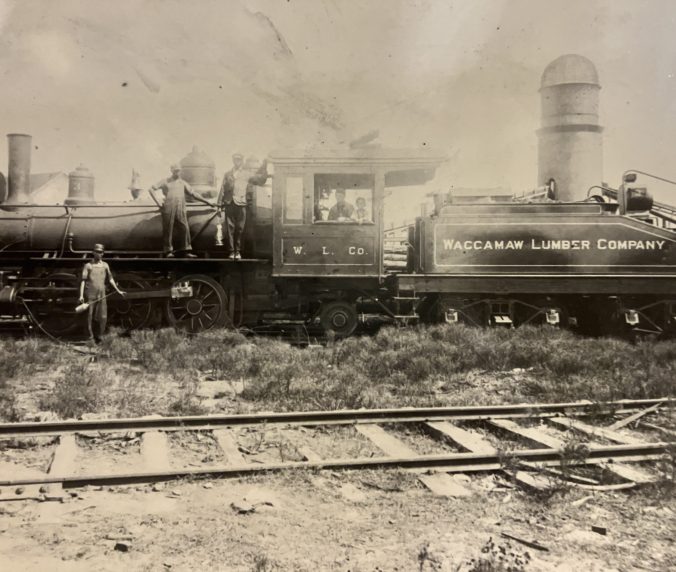
Train engine and tender, Waccamaw Lumber Company. Whit Martin, our photographer, was the engineer on the company’s #3 train (shown here), which ran along the main line between the Makatoka logging camp and the company’s mill in Bolton. Waccamaw Lumber Co. Photographs & Journal, Rubenstein Library, Duke University
The company built a sprawling lumber mill in the town of Bolton, a logging camp called Makatoka, and an 18-mile-long railroad that ran into the Green Swamp.
One of the Waccamaw Lumber Co.’s train engineers, Anson Whitfield “Whit” Martin, took the photographs.
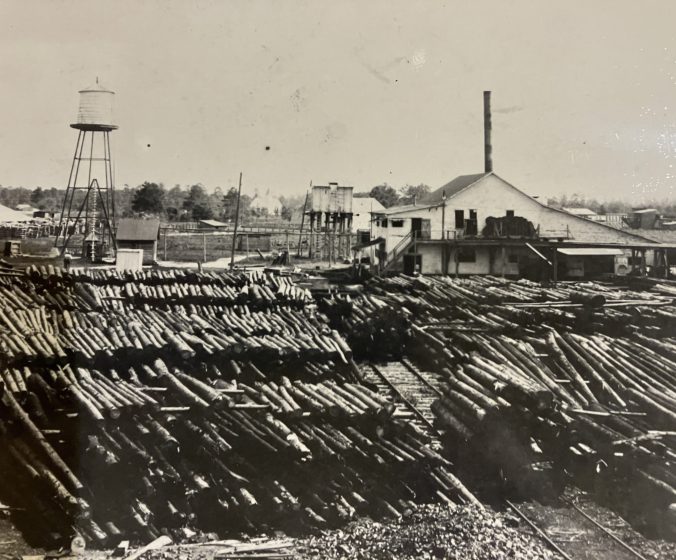
Log pond at the company’s mill in Bolton. Arthur Little (former employee): “They had plenty of timber then. They didn’t think it would ever give out. But they found out between fire and what they cut…, they soon found out it won’t going to last.” Waccamaw Lumber Co. Photographs & Journal, Rubenstein Library, Duke University
Whit Martin was born in 1883, so he was a relatively young man at that time.
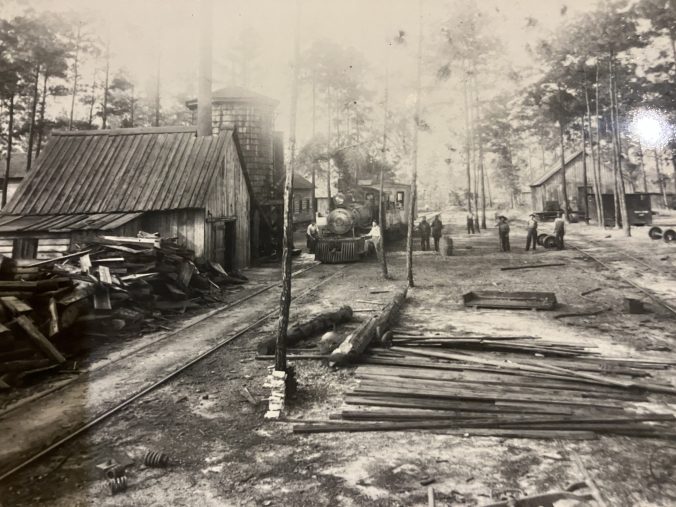
The Makatoka logging camp had a tough, violent, hard drinking reputation, but the stories in Kin’ Lin’ also bring it to life with memorable figures: Italian and Russian immigrants, Gullah loggers, a young African American woman named Bessie, and a camp cook and his partner that walked around the camp playing the guitar after dinner every night, among many others. Photo courtesy, Waccamaw Lumber Co. Photographs & Journal, Rubenstein Library, Duke University
To write captions for the photographs, I have relied heavily on a special edition of a local heritage journal called Kin’ Lin’. That journal was published from 1975 to 1985 by the students at Hallsboro High School, 10 miles west of Bolton.
Kin’ Lin’s faculty sponsors were Mary W. Mintz and Ruby Campbell. They apparently used the journal to improve the writing and research skills of their students, as well as to deepen their students’ appreciation for Columbus County’s history and cultural heritage.
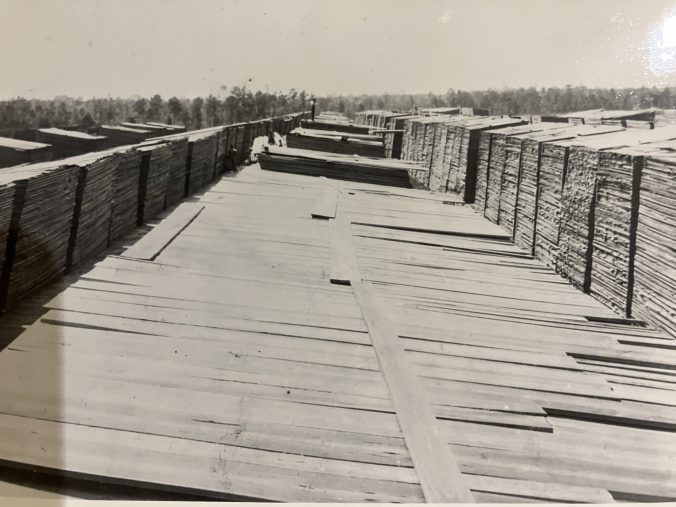
Lumber air drying at the Waccamaw Lumber Co.’s mill in Bolton. Most of this lumber was cypress and black gum from the Green Swamp. The surviving portions of the swamp are widely recognized today as one of the most biodiverse ecosystems in North America. The area is especially well known for its wild orchids and insectivorous plants. The Waccamaw Lumber Co. cut and ditched the vast majority of the swamp’s 140 square miles, but a precious piece of the swamp’s heart has survived at the Nature Conservancy’s Green Swamp Preserve. Photo from the Waccamaw Lumber Co. Photographs & Journal, Rubenstein Library, Duke University
During the 1982-83 school year, Whit Martin’s widow, Bessie Burney Martin, leant the album containing her husband’s photographs to the students and faculty members who produced Kin’ Lin’.
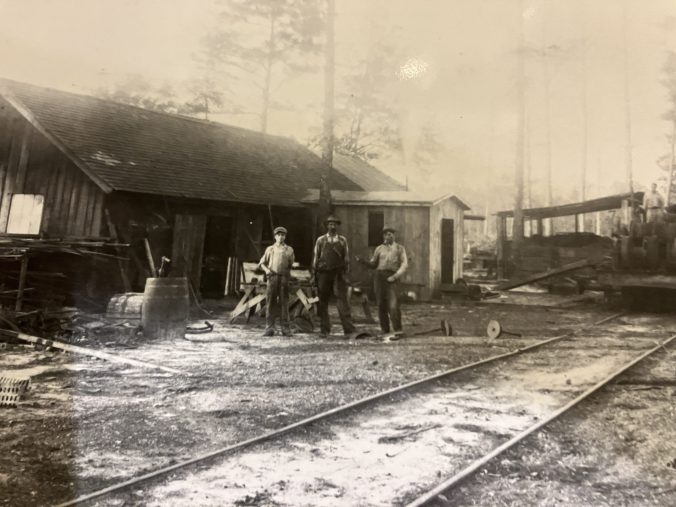
The company blacksmith’s shop. From Waccamaw Lumber Co. Photographs & Journal, Rubenstein Library, Duke University
The students then built a special edition of Kin’ Lin’ around those photographs. They discussed the photographs with a diverse group of local senior citizens who had either worked at the Waccamaw Lumber Co. or who otherwise remembered its mill and logging camp.
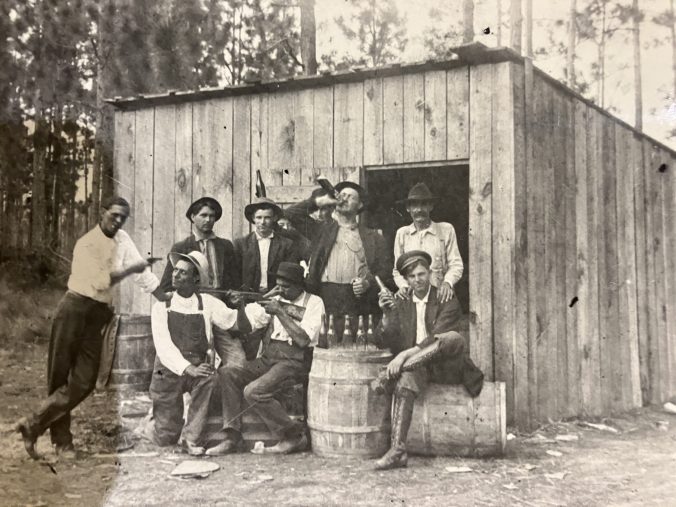
Revelers mugging for the camera at the Makatoka logging camp. One man is holding a pistol, another a rifle, and at least three are holding a bottle. From Waccamaw Lumber Co. Photographs & Journal, Rubenstein Library, Duke University
Those individuals were quite elderly by that time, of course. But they generously sat down with the students and answered their questions about the scenes in the photographs and their memories of the company and its workers.
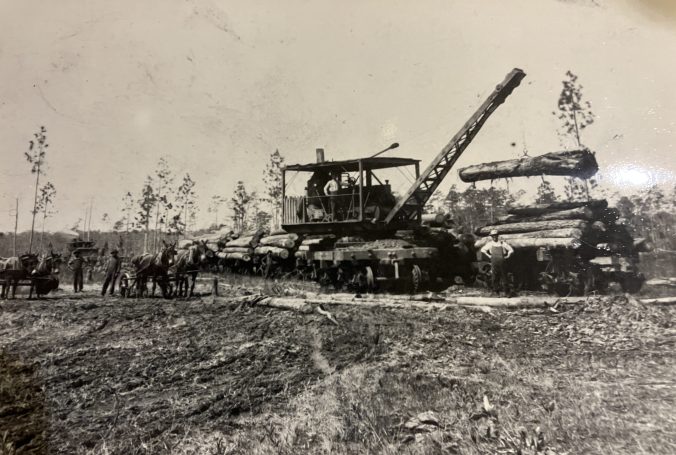
Mule teams “snaked” logs out of islands in the swamp– steam powered skidders did the same work in the low parts of the swamp– and brought them to a railroad, where a loader lifted them onto railroad cars that carried them to the mill. Waccamaw Lumber Co. Photographs & Journal, Rubenstein Library, Duke University.
A copy of that issue of Kin’ Lin’ accompanies the photographs that I studied at Duke’s library.
You can find that issue and other issues of Kin’ Lin’ elsewhere as well, including UNC-Chapel Hill’s North Carolina Collection and at many local and regional libraries across the state.
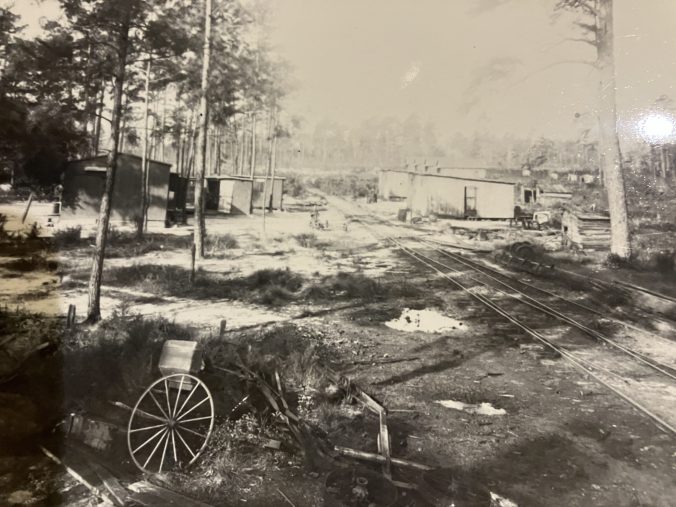
I am not at all sure, but this may have been the camp on the outskirts of Makatoka where the Italian railroad construction workers stayed. The Italians prepared their own traditional meals, and they had an open air bread oven. Makatoka was also home to contingents of Russian, Polish and Hungarian immigrants. Waccamaw Lumber Co. Photographs & Journal, Rubenstein Library, Duke University
The world of lumber mills and logging camps is one of the least documented parts of North Carolina’s coastal history.
The irony, and I suppose shame, of it all, though, is of course that the photographs give us a glimpse at an almost Wild West-like society of loggers and lumbermen that we can’t help but find almost irresistibly interesting.
Yet at the same time, we can’t forget that we are also seeing the inside of a lumber industry bonanza that was sweeping across the North Carolina coast at that time, cutting down thousands of square miles of ancient forests and draining and burning the land until it was unrecognizable, much like what we see happening in the Amazon rain forest today.
* * *
 David Cecelski
David, thank you for sharing this piece of history. As you wrote, there’s been significant incursion into this vast stretch of land, a place that wowed the botanist and writer, John Lawson, in the early 1700’s and obtained National Natural Landmark status in the 1970’s.
Despite such distinctions, incursions continue. These include commercial and residential development, a highway facilitating traffic to and from beaches, man-made chemicals in the form of run-off, wildfires, climate change, and so forth. All this, plus ongoing logging. Yet, for now, the swamp and the Green Swamp Preserve, remain.
Thank you also for mentioning Mrs. Mary Mintz and Mrs. Ruby Campbell–to their students, both teachers were, and are, treasures. And each edition of Kin’lin remains a treasure. I didn’t know Mrs. Campbell but I can share that today Mrs. Mintz, at 105, is still vitally connected to Columbus County and to her community.
LikeLike
As a history buff of regional history, I learned something new today. Thanks.
LikeLike
As you said “irresistibly interesting”. And “OFF” hadn’t been invented!
LikeLike
Thank you David. My wife Carolyn started her teaching career at Hallsboro in the early 80’s and spent 10 years there. We knew Mrs. Mintz and her work with Kin Lin. Hallsboro during the same period about which you wrote had four saw mills. The Methodist church there where I pastored had wood cut, sawed, and milled there by church family who worked in the mills. One of the land marks of that community was a company store, Pierce and Company, that still thrives in that community ven today. Again, thanks for the history.
LikeLike
Great to hear from you, Neal. And I love your family’s connection to Hallsboro! Here’s a story I did years ago about Pierce & Co. that might interest you! Ray Wyche gave me the tour of the place– his daughter is an old friend.
https://www.ncpedia.org/listening-to-history/wyche-ray
LikeLike