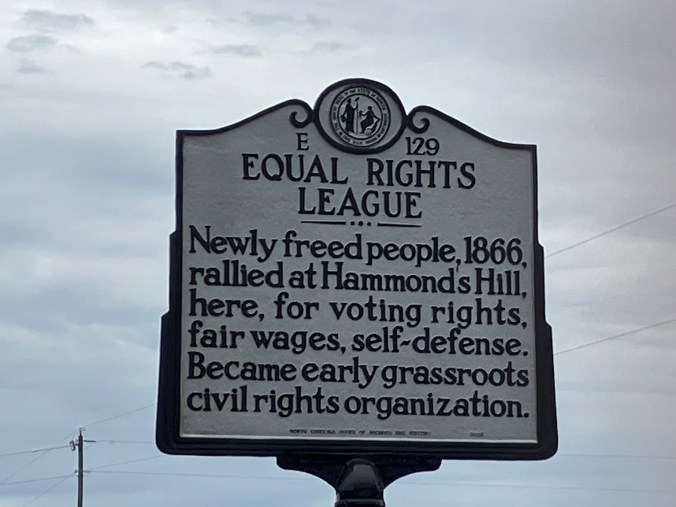
Red Hill, N.C., November 11, 2023. Photo by David Cecelski
A few days ago, a large crowd gathered in the rural community of Red Hill for the unveiling of a state historical marker commemorating the establishment of an Equal Rights League there in 1866. Sponsored by the Phoenix Historical Society, the ceremony was hosted by the Red Hill Missionary Baptist Church, the heart of that rural community 18 miles northeast of Rocky Mount.
Speakers included Jim Wrenn and Mattie Miller of the Phoenix Historical Society; Leonard Wiggins, the chair of the Edgecombe County Board of Commissioners, and his fellow commissioner, Evelyn Powell; Janice Bellamy, president of the Community Empowerment Alliance; and Vincentt Sutton of the African American Historical Commission.
The Rev. Dr. Frances Davis presided at the ceremony. The Rev. Dr. Joyce Lane gave the invocation, and the Rev. Dr. James Battle extended the welcome to the guests. The church’s choir celebrated the occasion in song.
I was honored to be asked to say a few words as well. This is a copy of my remarks on that special day.
Red Hill Missionary Baptist Church, Nov. 11, 2023
“… the negroes (former slaves) are holding mass meetings in various parts of this county…. At these meetings they drill and go through all the military evolutions directed I suppose by some who have served in the Federal Army…. The ostensible purpose of these meetings [is] a strike for higher wages… Nearly every negro is armed not only with a gun but a revolver… The meeting of a thousand or two negroes every other Sunday with officers and drilling… is a serious matter.”
Dr. John Bellamy to Gov. Jonathan Worth, Nov. 29, 1866
I am deeply honored to be with you today as we gather to honor those African Americans who met here in 1866 to establish the Hammond’s Hill Equal Rights League. All of us who call North Carolina home owe a debt of gratitude to the Phoenix Historical Society and to the Rev. Dr. Battle, the Rev. Dr. Davis, and the entire congregation here at Red Hill Missionary Baptist Church for making this day possible.
I would also like to acknowledge Dr. Robert Hinton, who could not be with us today, but whose scholarship on the African American struggle for justice in Edgecombe County’s cotton fields more than 20 years ago led us to where we are today.
In addition, I would like to recognize the good people at the NC African American Historical Commission and the North Carolina Historical Marker Program for all they have done to make this marker a reality.
Through all your efforts, you remind us, at a time when we need reminding, of a time and a place when people who had next to nothing, who were only months out of slavery, and who were surrounded by a thousand perils, found the courage, faith, and determination to fight for a better world for their children and for us all.
My comments today will be brief. But if you will bear with me for a few minutes, I would like to take a little time to share some of what I learned while writing The Fire of Freedom that might help us to appreciate more fully what happened here in Red Hill (as Hammond’s Hill is now known) more than 150 years ago.
I will begin my story many years ago and a thousand miles from here. I will then work my way back to Eastern North Carolina, and finally we will come back to Red Hill.
My story begins on October 4th, 1864. In that third year of the Civil War, African American leaders from across the United States gathered in Syracuse, New York, at the National Convention of Colored Men of the United States. That convention was a historic occasion for black America. Never before had African Americans come together in a national assembly that drew from those who resided in both the free states of the North and the slave states of the South.
At that convention, black political, cultural, and intellectual leaders convened to contemplate what race, nation, and freedom might mean after the Union was victorious and the arrival of Emancipation. They did so not in a hypothetical, what-if-one-day-we-gained-our-freedom way, as they had done in the past, but on the verge of a Union victory and slavery’s demise.
Much was debated and discussed over the convention’s four days. But what matters most to us today is that the delegates concluded their gathering by giving birth to the nation’s first truly national human rights organization, the National Equal Rights League.
The convention was a Who’s Who of black America. Frederick Douglass was there. The Rev. Henry Highland Garnet was there. The Rev. J. W. C. Pennington, who had been born a slavery in Maryland, escaped, and ultimately played a key role in supporting the rebellious slaves who took over the slave ship Amistad, was there.
Novelist, playwright, and anti-slavery activist William Wells Brown was there. Black leaders of the Underground Railroad were there. Black soldiers fresh from battles in Louisiana and Mississippi were there. Black teachers who had gone south to educate the former slaves were there, too, including Edmonia Highgate and the poet Frances Ellen Watkins Harper.
The large majority of the 144 delegates resided in the northern states—at that time, most of the South was still held by the Confederacy. But when the convention opened with the singing of the old Charles Wesley hymn, “Blow Ye the Trumpet Blow,” the crowd also included at least a small group of delegates who had made the journey from the parts of the South that had been held by the Confederacy but which had already been liberated by Union troops. One of those was a man named Abraham Galloway.
At that time, Galloway was only 27 years old. But he had already escaped from slavery in Wilmington, North Carolina, gone behind enemy lines as a spy for the Union army, and played a central role in organizing North Carolina’s first black regiment in the Union army. Earlier in 1864, he had also led an historic delegation of five African Americans from the North Carolina coast to a meeting with President Abraham Lincoln at the White House. At that meeting, Galloway had warned the president that freedom was not enough and had demanded voting rights and all the other rights of American citizenship.
At a celebration of the first anniversary of the Emancipation Proclamation in Beaufort, N.C., Galloway had proclaimed, “we choose the death of a hero rather than the life of a slave.”
In Syracuse, Galloway and the other African American delegates founded the National Equal Rights League. They also insisted that the courage and sacrifice of African American soldiers and sailors in the South had earned them the full rights of American citizenship.
“We have fought and conquered but have been denied the laurels of victory. We have fought where victory gave us no glory and where captivity meant cool murder on the field, by fire, sword, and halter; and yet no black man ever flinched.”
The Syracuse delegates proclaimed that the time for America to pay its debt to those African American soldiers and sailors had arrived.
“We declare that all men are born free and equal, that no man or government has a right to annul, repeal, abrogate, contravene, or render inoperative, this fundamental principle, and therefore we demand the immediate and unconditional abolition of slavery. Here were we born. For this country our fathers and our brothers have fought, and here we hope to remain in the full enjoyment of enfranchised manhood and its dignities… as citizens of the Republic, we claim the rights of other citizens.”
When the delegates adjourned on the convention’s final day, they raised their voices to sing:
From all that dwell below the skies
Let the creator’s praise arise
Alleluia, alleluia!
Let the redeemer’s name be sung
Through every land by every tongue.
Alleluia, alleluia, alleluia, alleluia, alleluia!
Their founding of the National Equal Rights League was the first step toward the gathering that we are celebrating here in Red Hill today.
But the path to Red Hill was long and arduous. As the delegates left Syracuse, they resolved to return home and organize chapters of the Equal Rights League across the United States. However, most of the delegates returned to homes in the northern states, far from battlefields and slavery. That was not the case for Abraham Galloway or the other delegates who had come out of the South.
Yet when he returned to New Bern, only 90 miles from here, Galloway began to organize Equal Rights League in the Union-occupied parts of the North Carolina coast.
Only a few days after Thanksgiving in that year of 1864—while war still raged— he and his comrades organized the first state Equal Rights League anywhere in the United States.
By early December, African American men and women had organized local chapters of the Equal Rights League in New Bern, Beaufort, Roanoke Island, Washington, and Morehead City. According to contemporary sources, each chapter had roughly 200 members, many of them women. According to Galloway, the Equal Rights Leagues seemed to grow “like a gourd in the night.”
The members of the Equal Rights League made their politics plain in the names that they chose for their local chapters.
They named one chapter after President Abraham Lincoln. They named another for the Rev. Henry Highland Garnet, a black abolitionist renowned for his strident militancy. A New Bern chapter chose to honor the renegade John Brown, while one of the other branches was named after the Rev. Joseph J. Clinton, an important AME Zion bishop in Philadelphia. In Morehead City, other ex-slaves named their chapter of the Equal Rights League after Abraham Galloway. They were doing something that had never been done before—anywhere in America.
A few weeks later, on New Year’s Day 1865, that group of Equal Rights Leagues gathered in New Bern to mark the second anniversary of the Emancipation Proclamation. I do not have evidence, but I believe with all my heart—based on everything I know from the historical record—that African Americans who were later part of the 1866 gathering here in Red Hill were there that day.
We know that black men and women from Edgecombe County and much of the rest of Eastern North Carolina were in New Bern. Many of them—men, women and children— had risked their lives to escape from plantations and make their way to Union lines and to freedom.
The gathering was a celebration like no other. Anticipating the end of centuries of American slavery, the Equal Rights League activists worshiped together. They broke bread together. They also dreamed together– of a new, more democratic, more just America, one in which their people would be full citizens.
Students from New Bern’s eight African American schools attended the celebration. A large body of black soldiers and sailors were there. Four thousand people, nearly all of them African Americans, gathered to be part of the proceedings and paraded together through New Bern’s streets, listened to speeches, and gave praise to God.
One of the highlights of the two-day celebration occurred near the end of the gathering’s second day. At that time, they listened to James E. O’Hara, a black man who was principal of one of the local African American schools, read Lincoln’s words:
“That on the first day of January, in the year of our Lord one thousand eight hundred and sixty-three, all persons held as slaves within any State or designated part of a State, the people whereof shall then be in rebellion against the United States, shall be then, thenceforward, and forever free.”
Throughout Edgecombe County, black families had to be aware of all that was happening in New Bern. By that time, some had relatives in the Union army or navy. Others no doubt heard about the Equal Rights League at church or from people beside whom they worked in the fields.
Again, I do not have the evidence for it, but I think that it is safe to assume that African American men and women from this very part of Edgecombe County were in New Bern at that time. After escaping to Union lines, some may even have been members of one or another of the Equal Rights Leagues. Others might have simply watched the proceedings during that New Year’s gathering in New Bern.
When, a few months later, the Confederacy’s leaders finally surrendered, at least some of those men and women came home to Edgecombe County, looking for family and a new beginning. And wherever they went—and most especially in their churches— they told stories about black men like Abraham Galloway and what they had witnessed during the gathering of Equal Rights Leagues in New Bern.
We know, too, thanks to the Phoenix Historical Society’s excellent research, that two black men from Edgecombe County—the Rev. W. H. Pitt and Frank Hart—were at the Equal Rights League’s annual convention in Raleigh more than a year later, in October 1866.
Only a month after that Raleigh convention, thousands of African American men and women left the cotton fields and gathered here in Red Hill to organize their own Equal Rights League.
By all accounts, they were determined to build schools for their children. They yearned for justice in the fields. They sought to repudiate the North Carolina General Assembly’s “Black Codes.” They sought voting rights. And they prepared to defend themselves against those who seemed determined to return them to slavery.
They must have had great courage, a strong faith in God, and an unquenchable thirst for freedom to dare to come together here in Red Hill in that day and time.
The Civil War was over, and slavery was over, too. But you could barely tell it if you lived among the cotton fields of Edgecombe County.
When the state’s other Equal Rights Leagues had organized on the North Carolina coast, they faced serious dangers, but they at least were located in areas where Union troops stood guard.
But that was not the case in rural Edgecombe County that autumn of 1866. The former Confederates had unleashed a reign of lawlessness and violence upon the land when they lost the war. Here in Edgecombe, there was no shelter. At the same time, the North Carolina General Assembly seemed bound and determined to turn back the clock and treat the state’s African American population like slaves again.
That is the most astonishing thing of all about what was really a series of gatherings that occurred here in Red Hill and in much of this part of Edgecombe County in 1866.
When those African American field workers and sharecroppers gathered here, they knew that they were on their own. They knew that, if they were going to gain voting rights and any real semblance of freedom and justice, they would have to do it for themselves.
The obstacles were great. The dangers, many. Yet, despite the unspeakable perils they faced, those black men and women put their faith in God and in the trust and love that they had for one another. Here, on what today we consecrate as hallowed ground, they made a stand that they would never again be treated like slaves and that they were determined to build a new and better world.


Bravo!!!!
Catherine Bishir
>
LikeLike
Another thing I had no idea happened. My God, I give praise for those brave and amazing people.
LikeLike
Kudos to the good people of Edgecombe County — then and now!
LikeLike
Pingback: Minutes of the Freedmen’s Convention of 1866. | Black Wide-Awake