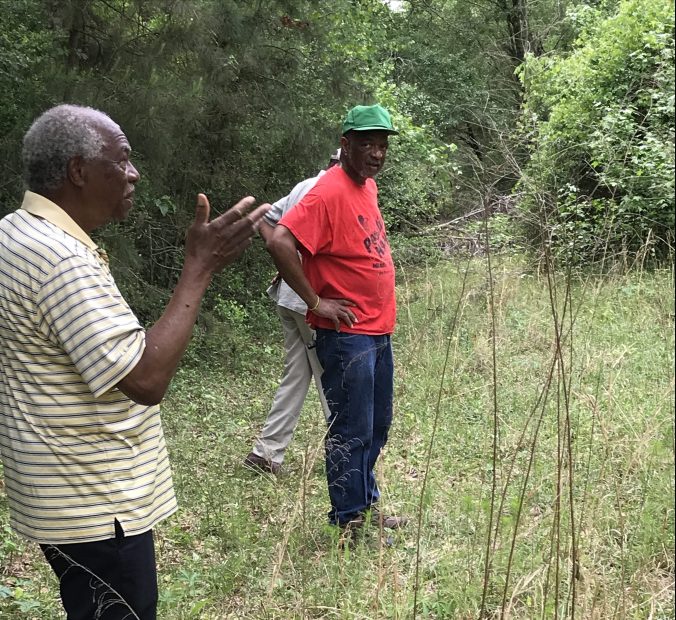
George Beatty, Jr. (left) and his brother Alfonso Beatty at the original site of Reaves Chapel, on the west bank of the Cape Fear River, 12 miles NW of Wilmington, N.C., May 2001. Using oxen and log rollers, the congregation moved the church to its current site on Cedar Hill Road in 1911. Photo by David Cecelski
In memory of George Beatty, Jr.
A little less than three years ago, in May of 2021, I spent a day with George Beatty, Jr. down in what used to be the rice plantation district of the Lower Cape Fear.
We met at his mother and father’s farm in Cedar Hill, a rural community that is now part of Navassa, a historically African American town that is located just a few miles from Wilmington, N.C., on the west side of the Cape Fear River.
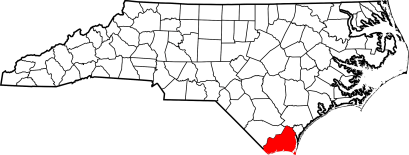
Cedar Hill and Navassa are both located in Brunswick County, in the far southeastern part of the North Carolina coast. Map courtesy, Wikipedia
Mr. Beatty had invited me to come and see the restoration work that was underway at Reaves Chapel, a now abandoned AME church that is one of the oldest African American buildings on that southeastern part of the North Carolina coast.
Mr. Beatty had been born in Cedar Hill in 1938. He attended the local schools, then left home so that he could go to Greensboro and earn an electrical engineering degree at N.C. A&T. After graduating, he had a long and accomplished career at NASA.
He traveled all over the world, but when he retired, he came back to Brunswick County. And once he was home, he put his heart and soul into making sure that Cedar Hill’s history would be remembered.
As we walked around the farm, we talked about the orchards and gardens, and what his father and mother used to grow, and of course we talked about Cedar Hill’s history.
He told me that Cedar Hill was one of a host of rural communities on that western side of the Cape Fear River that African Americans had established after the Civil War.
Mr. Beatty reminded me that people used to refer to that tidal section of the Cape Fear as the “Rice Kingdom.” Until the Civil War, sprawling rice plantations, worked by thousands of enslaved laborers, lined that whole side of the river, a kind of gulag of their times.
When the African American men and women on those plantations were liberated, they set off to build their own communities, and Cedar Hill, Mr. Beatty told me, was one of them.
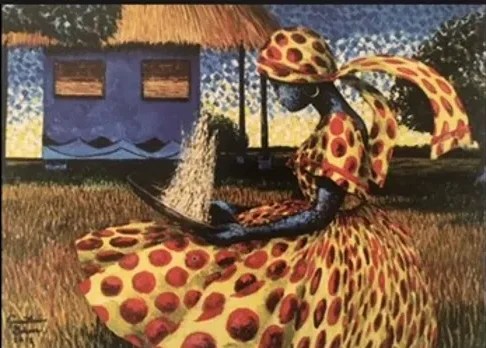
From 2019 until his death a few weeks ago, Mr. Beatty also served as chair of the North Carolina Rice Festival, a celebration of Gullah Geechee culture on the Lower Cape Fear. As chair, Mr. Beatty never ceased to remind festival goers of the people who made the culture–and profits– of the “Golden Grain” possible. “It should have a focus on education and [on] the enslaved people who actually grew the rice here, ”the Wilmington Star-News quoted him. Running from Feb. 28 to March 2nd, this year’s festival will feature Gullah Geechee food, music, dance and storytelling, as well as an “ancestry reveal” event. You can learn more about the festival’s schedule here. The paintings of renowned Gullah Geechee artist Jonathan Green (including the one above) were featured at the festival’s annual Gullah Geeche Heritage Dinner in 2022.
After walking around the farm, Mr. Beatty and I got into his car. We pulled out onto the Cedar Hill Road, then followed the Cape Fear north, with him telling me stories about every little creek and settlement.
He guided me through the communities of Hooperstown, Jenkinsville, Old Bridge, Northwest, and Phoenix. He also showed me the locations of other settlements that are only a memory now.
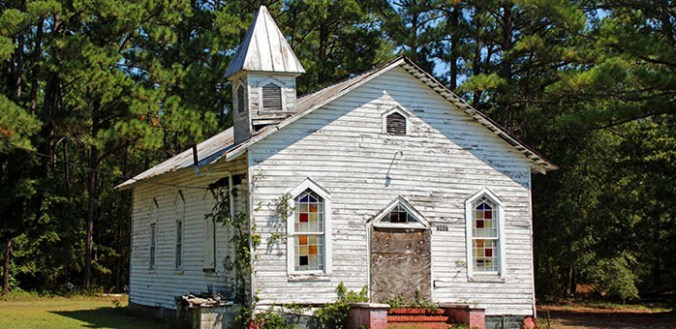
Reaves Chapel, in Navassa, N.C., ca. 2019. Photo courtesy, North Carolina Coastal Land Trust.
We visited the former sites of antebellum rice fields and slave quarters. We wandered into woods and traced the paths of old roads where coffles of enslaved Africans, chained one to another, had once been driven from a landing just north of Wilmington up the Cape Fear.
We explored lost cemeteries. We walked on the ruins of rice field levees and dams. He told stories of baseball teams and hunting trips, and he showed me a creek where his mother’s church used to hold baptisms.
We passed the relics of two or three old juke joints, including one that, he said, had been run by a tough, no-nonsense woman who was always doing things to help the down and out.
At one point, when we turned onto Mount Misery Road, he showed me the former site of the Phoenix Graded School. He reminisced about his childhood years there, and he told me how much the school’s teachers had meant in his life.
Later that morning, we met Mr. Beatty’s brother Alfonso and several other community activists at Reaves Chapel. When he retired and moved back home, he and Alfonso had founded the Cedar Hill/West Bank Heritage Foundation to raise the funds necessary to restore the church.
(Alfonso Beatty still chairs the group’s board of directors.)
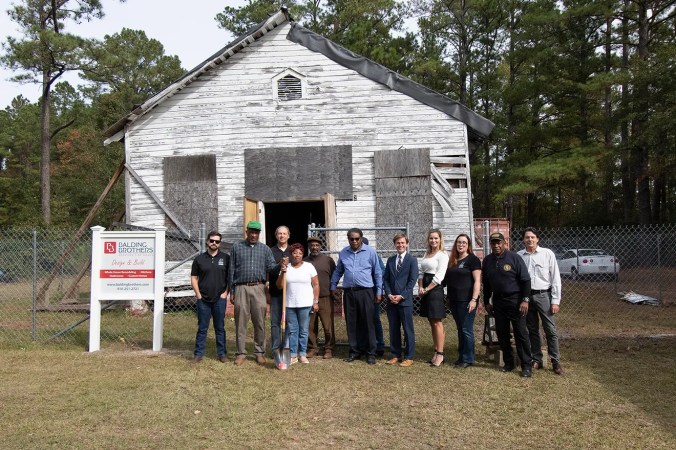
On Nov. 10, 2021, community partners from the Cedar Hill/West Bank Heritage Foundation, the N.C. Coastal Land Trust, the Historic Wilmington Foundation, and the Balding Brothers contracting firm gathered at Reaves Chapel to mark the formal beginning of the church’s restoration. Photo by Walker Golder. Courtesy, Wilmington Star-News (10 Jan. 2022)
Survivors of the rice plantation called Cedar Hill had built Reaves Chapel sometime just after the Civil War. That was a mile east, near the banks of the Cape Fear. In 1911, rolling the building on logs, hauling it by oxen, the congregation had moved the church to its present location.
Later in the day, we all walked back through the woods to visit the church’s original site. There were still daffodils blooming in what used to be the churchyard.
As we walked through the woods, Mr. Beatty told me that they were working to make Reaves Chapel into the crown jewel of a new historical and cultural center highlighting the African American experience on that section of the Lower Cape Fear.
As part of their vision, he told me, the new center would also be included in a National Heritage Area, created by the U.S. Congress in 2006, called the Gullah Geechee Cultural Heritage Corridor.
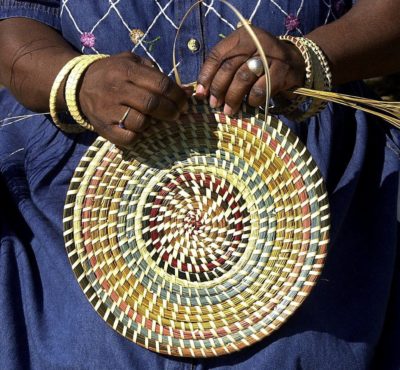
Created by an act of Congress in 2006, the Gullah Geechee Cultural Heritage Corridor is dedicated to preserving, sharing, and interpreting the history and culture of the Gullah Geechee peoples of coastal Florida, Georgia, South Carolina, and North Carolina. The terms “Gullah” and “Gullah Geechee” was once used mainly with respect to the descendants of Africans that had been enslaved on the rice, indigo, and Sea Island cotton plantations of South Carolina’s Low Country. More recently, in recognition of a common history and cultural heritage, the term has been embraced by African Americans on that broader swath of the tidewater South, including in the old rice growing sections of the Cape Fear. Photo courtesy, the Gullah Geechee Cultural Heritage Corridor
After exploring the area around Reaves Chapel, we drove back to the Beatty family’s farm. Sitting out in the yard, we talked some more about Cedar Hill’s history and why he and his brother and so many other people cared so much for the old church.
Mr. Beatty was then 82 years old, and he was 85 when he passed away a few days after Christmas. I will never forget sitting out there in the yard with him, listening to him talk about why remembering Cedar Hill’s history was so important to him.
He told me that he just wanted his ancestors, their ancestors, to be remembered. He wanted them, he said, to get the credit they deserve for their toughness and for surviving and not giving up. He wanted them, he said, to be remembered for all they sacrificed for their children, and for all they gave the world.
As I listened, I realized that his feelings on the subject somehow ran even deeper, to a place beyond words, and that they were part of his bones and sinew and even the timbre of his voice.
According to his obituary, Mr. George Beatty will be laid to rest at Johnson’s Chapel AME Zion Church, in the land of his ancestors. May he rest in peace. And may those of us still living not let him down, now that the responsibility for remembering falls on us.
 David Cecelski
David,
<
div> This is fascinating info th
LikeLiked by 1 person
Beautiful. Thank you. Thanks for noticing and mentioning those resilient daffodils. They are such evocative splashes of color at many old sites, reminding us of someone who planted and enjoyed them long ago.
Always your fan,
Catherine
>
LikeLike
Was it 2021 not 2001 perhaps?
Catherine
>
LikeLike
loved the essay, glad to see Catherine still around. Some one should get a young whippet snapper historian to do an oral history on some of the At:Am churches along Masonboro.
LikeLiked by 1 person
I’m glad that the Coastal Land Trust has been participating in the restoration of Reaves Chapel.
LikeLike
Dear David, what a caring and thoughtful tribute. I love that you found ways to spend time w the Beatty brothers and share that experience and their church with us. Thank you once again. Love, lanier
LikeLike