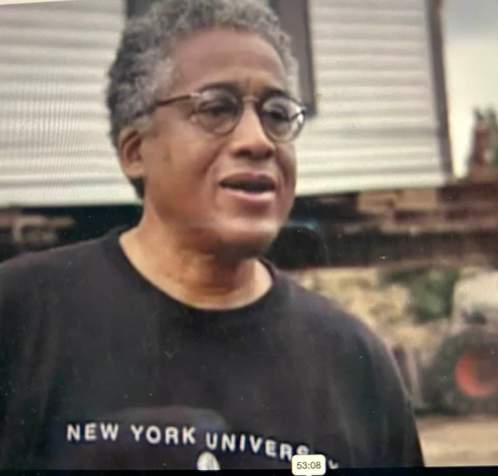
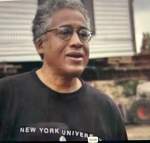
Dr. Robert Hinton passed away in December 2023, at the age of 82. This photograph was made during the filming of Godfrey Cheshire’s wonderful documentary Moving Midway (2007). Courtesy, Godfrey Cheshire
I recently learned from Jim Wrenn at the Phoenix Historical Society in Tarboro, in Edgecombe County, N.C., that my old friend Robert Hinton passed away in the early part of December.
Robert was a gifted scholar and teacher, and a very good man. Born in Raleigh in 1941, he grew up in the city’s historically black Chavis Heights neighborhood, went on to become a remarkable journalist and eventually earned his Ph.D. in history at Yale University.
In his Yale dissertation, Robert did pathbreaking work on race, labor, and the black struggle for freedom in Edgecombe County from the Civil War to the first years of the 20th century.
He later revised that dissertation into a book called The Politics of Labor: From Slavery to Freedom in a Cotton Culture, 1862-1902. For me and many others, Robert’s book was both a tremendously helpful scholarly work and an inspiring example of a historian bringing forth the lost and unheard voices of the past.
In subsequent years, Robert also did considerable research on the history of the enslaved in Wake County, N.C., including on the Hintons, his own family.
You can get a glimpse at that research, and Robert’s passion, intelligence, and wit, in Moving Midway, an award-winning documentary film that Godfrey Cheshire directed in 2007. (Robert appears in the film, and he was the film’s chief historian and associate producer.)
I knew Robert many years ago, when he and his wife Annie– the fabulous artist and choreographer Annie Sailer– were living here in North Carolina. That was before he finished at Yale and long before he began teaching at New York University, where he spent most his academic career.
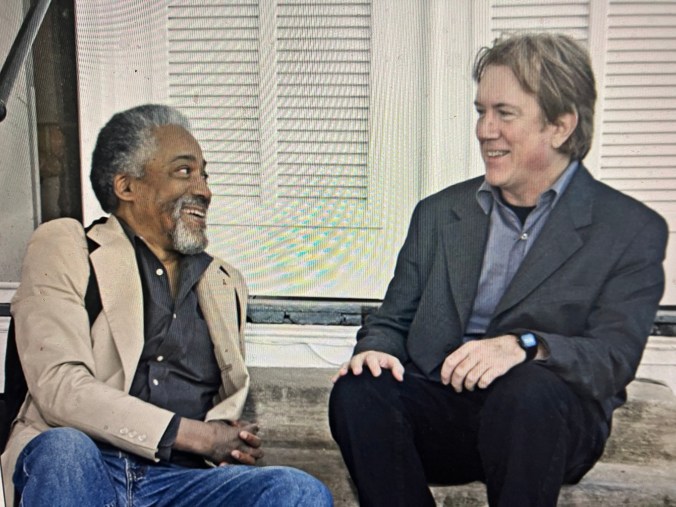
Robert Hinton and Godfrey Cheshire in the 2007 documentary Moving Midway.
We were rotten at keeping up with one another after he and Annie left North Carolina. But even from afar, I followed Robert’s life and career, always with deep admiration for his work and for the way he was in the world.
It felt especially right to hear the news of Robert’s passing from Jim Wrenn at the Phoenix Historical Society.
In 2001, Robert played a crucial role in the birth of the Phoenix Historical Society, a group that I admire tremendously for its dedication to honoring the history of Edgecombe County’s African American community.
In a recent note to supporters, Jim described how much Robert meant to him and the rest of the Phoenix Historical Society.
Back in 2001, Jim wrote, he had heard about, but had never seen, Robert’s scholarly work on the African American freedom struggle in Edgecombe County.
Jim went on to say:
“I tracked him down to the University of Wyoming, [where Robert was teaching at the time] and in spring of 2001 he graciously mailed me (a stranger!) his personal copy of his book, based on his PhD dissertation at Yale. . .. This became our road map for the nascent Phoenix Historical Society.”
Robert visited Jim and his wife Mavis and the Society’s other founding members later that year, in July 2001. A few months later, on the 10th of November, Robert was one of two keynote speakers (along with Dr. Ben Justesen) at the group’s inaugural event in Tarboro.
That event was a tribute to George W. White, the African American congressman and civil rights leader who represented Tarboro and the “Black Second” from 1897 to 1901.
In his note, Jim also said:
“Many of the North Carolina historical markers the Phoenix Society has successfully nominated recognized events we learned from Robert Hinton, especially State v Will, the Knights of Labor, and most recently the Equal Rights League. . .. I am truly indebted to Robert . . . for his mentorship and collaboration.”
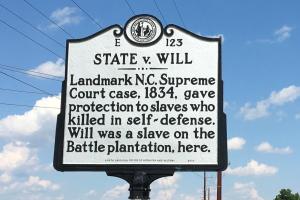
Located on US 64 Alternate at Dunbar Road northwest of Tarboro, N.C. Courtesy, NC Dept. of Natural and Cultural Resources
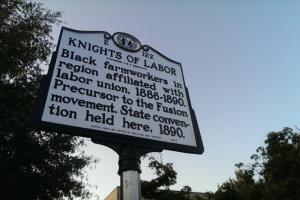
Main Street, Tarboro, N.C. Courtesy, NC Dept. of Natural and Cultural Resources
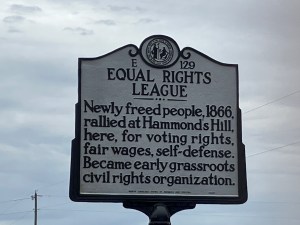
Next to the Red Hill Missionary Baptist Church, Hwy. 33 outside Whitakers, N.C. Photograph by David Cecelski
Robert was a special person. A wise soul. A man of depth and feeling and grace.
By way of doing our little part to celebrate his life, Jim and I have agreed that it would be fitting for me to publish Robert’s lecture at that inaugural meeting of the Phoenix Historical Society here today.
Go easy into the night, old friend.
* * *
From Slavery to Freedom in Edgecombe County, 1862 to 1902
By Dr. Robert Hinton
November 10, 2001
The African American experience in Edgecombe County has been defined by the struggle to move from slavery to freedom. This struggle began at almost the same moment that enslaved Africans were introduced into this area to provide labor and I contend that the struggle is still in process.
There is a book entitled Incidents in the Life of a Slave Girl, written by Harriet Jacobs who was enslaved up in Edenton. Working on the waterfront at Edenton, there was an African American man named Peter, himself a slave, who was part of the “underground railroad” that smuggled people out of Edenton, by boat, to freedom in Philadelphia. With his connections, Peter had the opportunity to escape himself but for reasons about which we can only speculate, he chose to remain in slavery and help others escape.
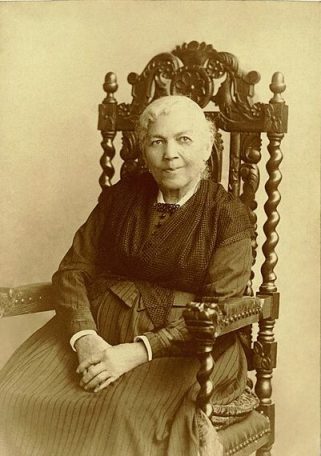
The African American abolitionist and writer Harriet Jacobs published her autobiography Incidents in the Life of a Slave Girl in Boston in 1860, after her escape from slavery in North Carolina. It is now widely considered a classic of American literature.
Peter could be seen as a precursor to other freedom fighters, including George H. White, who worked, in different ways, at different times, for black freedom.
The turning point in the struggle against slavery was, of course, the Civil War. As soon as the Union Army took control of Little Washington and the coast of North Carolina, slaves from as far west as Raleigh began to run away to the Union troops. Slave masters from as far west as Raleigh complained that those slaves who did not run away were working only one-third as much as normal because of the Union presence on the coast.
When the Confederates surrendered, everyone understood that slavery was over but not everyone agreed about the meaning of freedom for the former slaves. On 16 September 1865, 1,500 people attended a meeting here in Tarboro to elect delegates to a Freedman’s Convention to be held in Raleigh later in the month. The delegates to that convention organized themselves into the North Carolina State Equal Rights League and called upon the upcoming state constitutional convention to eliminate racial discrimination.
This self-organization of African Americans in North Carolina took place during Presidential Reconstruction, when the North Carolina-born racist Andrew Johnson was in charge of the Reconstruction process.
In late 1865 and early 1866, the state legislature passed a new “Black Code” that gave the former slaves the same rights that had been enjoyed by free people of color when North Carolina was still a slave society. The notion of a black man as simply a free man was inconceivable.
In 1866, in eastern counties, there were reports of black men, led by veterans of the Union Army, organizing themselves into militias for self-defense.
The excesses of President Andrew Johnson led the Congress of the United States to take charge of the Reconstruction process in 1867. One of their first moves was to extend the franchise to all men, regardless of race or property. The Freedmen’s Bureau was given the responsibility of registering all eligible men to elect delegates to a constitutional convention that would prepare North Carolina to re-enter the Union.
In March of 1867, a Republican Party was formed in North Carolina by a coalition of black freedmen, mostly from eastern counties; native white scalawags, mostly from the west; and northern-born carpetbaggers.
In 1867, the members of the black militias and others were drawn into a new secret organization, the Union League, intended to teach the freedmen how to work the political process for their own benefit and to discourage freedmen from being intimidated by Democrats.
Delegates were chosen, in the election of 1867, for a new constitutional convention. That convention produced the Constitution of 1868 which abolished slavery, eliminated the property requirement for voting and holding office, and took away the power of local planter elites to control local government by providing for democratically elected county governments.
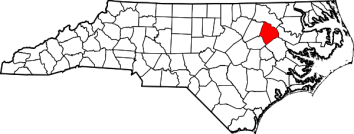
Tarboro is the county seat of Edgecombe County, North Carolina. Map courtesy of Wikipedia
The election of 1868, which ratified the new constitution, also gave political control of Edgecombe County to the predominantly black Republican Party. Despite the cries of “negro domination” coming from the Tarboro Southerner, the county government of Edgecombe was dominated by white Republicans, including sheriff Battle Bryan.
The planters of Edgecombe had great difficulty adjusting to management of free black labor. Some were so disoriented they gave up planting all together. The more persistent began working almost immediately, both through the Ku Klux Klan and the political process, to return political, and consequently economic, power to the planter class.
The Democratic Party was able to regain control of the state legislature in 1870 and they began immediately to work toward repealing the Constitution of 1868. In 1872, the General Assembly gerrymandered the state’s congressional districts, gathering as many black votes as possible into one district– the famous Black Second– so as to guarantee safe white majorities in other districts.
It was not until late 1874 that the Democrats had the political resources to call a new constitutional convention. They waited until the U.S. Congress adjourned in 1875 before calling the convention.
When Republicans appeared to be winning the vote for delegates to that convention, election officials in Robeson County threw out the votes in four predominantly Republican townships, giving the victory in the county and the state to the Democrats. William P. Mabson, a schoolteacher and principal, representing Edgecombe County, was one of the six black delegates to this convention.
In 1876, under the authority of the Constitution of 1875, the General Assembly of North Carolina passed two laws that formed the backbone of the new post-slavery labor system.
“The County Government Law” gave the state legislature the power to appoint justices of the peace in the counties, who in turn would appoint county commissioners. This allowed elite Democrats in Edgecombe to nominate safe men for appointment in the county.
The second law, “The Landlord and Tenant Act,” reduced tenant farmers to the status of agricultural laborers and gave landlords every advantage in disputes with tenants.
Through the manipulation of debt peonage, black agricultural laborers in Edgecombe became the rough equivalents of the indentured servants of the late eighteenth century– not quite enslaved but tied to one specific piece of land.
Many black agricultural laborers responded to their new social reality by migrating out of North Carolina, to Kansas, Arkansas, Mississippi and Texas. Those who remained began to adjust themselves to the new social system that we can now identify as “Jim Crow.”
About 1880, James Redmond, J. L. Smith and John C. Dancy formed the Fulton Fire Company, a black volunteer fire company. William P. Mabson was appointed principal of a new “colored free school for Tarboro township,” but not without controversy. In 1883, 21 colored teachers, led by William A. Williams, S. B. J. Powell, and Miss Aric J. Pittman, formed a teachers association.
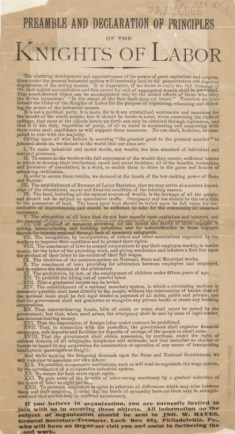
A broadside listing the principles of the Knights of Labor. The first principle reads: “We declare to the world that our aims are: To make industrial and moral worth, not wealth, the true standard of individual and national greatness.” You can find an easier-to-read printout of all the Knights’ principals here. From the Rubenstein Rare Book and Manuscript Library, Duke University
In the late 1880s, a new force arrived on the Tar River in the form of the Knights of Labor. Formed in 1886, the Knights of Labor were dedicated to organizing all workers, regardless of level of skill. In the South, they compromised by organizing separate locals for men and women and blacks and whites.
On the 7th of November 1887, a black agricultural laborer from eastern North Carolina, Nathaniel Marriott, wrote to Terence V. Powderly, Grand Master Workman of the Knights of Labor, in Philadelphia, to say that:
“I have called the peoples together in my community and reasoned with them about the Labor Union and have temporarily organized a small crowd amounting to about 80 members and we have been to gather meeting regular every Friday night for about two months waiting for some one to organize us. and cannot get anyone seem like. Therefore I thought it best to write you of our condition. and want you to send some one to our rescue because we are in a bad place to start any thing and then fail to accomplish it.”
Nathanuel Marriot’s “small crowd” met in New Hope Church in western Edgecombe County, about seven miles from Battleboro, on the Wilmington and Weldon Railroad line, which marked the boundary between Nash and Edgecombe counties.
By October 1889, there were 11 locals of the Knights of Labor in Edgecombe County.
“On last Sunday, the Rev. F. W. Fulford, pastor of the AME Zion Church and a true Knight of Labor preached a very interesting sermon in St. Stephen’s Colored Missionary Baptist Chuch for the benefit of Fidelity Assembly, No. 7949 and Rosebud Assembly. No. 195, both of this town. About 3 o’clock in the afternoon several sisters of the latter assembly met together with the members of the former in the hall owned by LA 195 and forming in line marched two by two to the church. All members were in holiday attire and wore white gloves.”
— Correspondent from Tarboro in the Knights of Labor’s Journal of United Labor (July 1889)
By the spring of 1888, the Knights of Labor were the dominant faction in the Edgecombe County Republican Party.
In the late 1880s, in many of the same places where the Knights were organizing black workers, white farmers were being organized in the Southern Farmers Alliance. Around 1892, the Farmers Alliance split into a conservative faction, committed to the Democratic Party, and a radical faction that formed the nucleus of the new People’s Party.
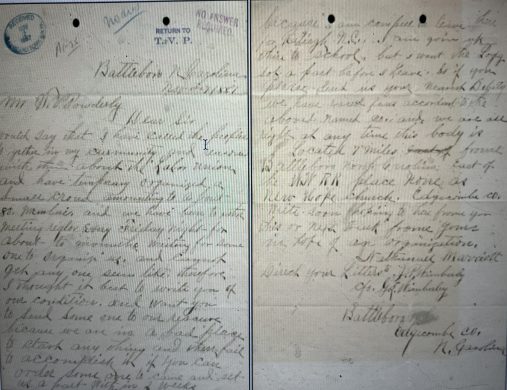
Original copy of letter from Nathaniel Marriott to Terence V. Powderly, 7 Nov. 1887. Reprinted by permission of the American Catholic History Research Center and University Archives at the Catholic University of America, Washington DC (and provided to me by the Phoenix Historical Society).
Many white farmers who were not willing to suffer the social ostracism that would result from joining the majority-black Republican Party joined the People’s Party as a means to oppose elite planter domination of North Carolina politics and the Democratic Party.
In 1894 and 1896, the Republican and People’s parties ran fusion campaigns that resulted in the most progressive government since Radical Reconstruction. In the Black Second, George H. White was elected as the fourth and last African American to represent the Tar River region during an extended Reconstruction Era. The fusionist General Assembly restored many of the progressive features of state government that originated in the Constitution of 1868.
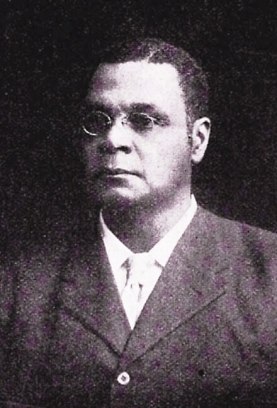
Educator and attorney George H. White represented North Carolna’s 2nd Congressional District from 1897 to 1901. He left North Carolina after white supremacists took power and banned black citizens from voting in 1900. After his departure, no black individual represented the state in the U.S. Congress for more than 90 years. Photo courtesy, The Crisis (March 1919)
In 1898 and 1900, the Democratic Party brought down the hammer of Jim Crow through a violent, corrupt “White Supremacy” campaign that resulted in the disfranchisement of most black voters and a serious threat to disfranchise those white voters who refused to act like white men.
The white leadership of the Republican Party had already begun to feel embarrassed by its association with blacks. Once blacks were unable to vote, the white Republican leadership had no more use for its black members and all blacks, including elected officials, were barred from the party’s state convention.
The era of civil rights moved the struggle from slavery to freedom forward but recent experience with the gerrymandering of district lines so as to dilute the black vote suggest the struggle continues. This event and the organizations that sponsored it are a continuation of the tradition of liberation politics represented in the past by the underground railroad, the Union Army, the Republican Party of Abraham Lincoln, the Union League and the Knights of Labor.
I can’t express how grateful I am that you have given me the opportunity to play a small part in that struggle.
 David Cecelski
Thank you David, very much. I loved Moving Midway. I wish the Phoenix Society could get George White as one of the 2 NC people represented in the US Capitol. Bernard and I made some inquiries several years ago. But to no avail.
Catherine Bishir
>
LikeLike
David, I haven’t been seeing your postings lately and I miss them. Hope you are doing well.
Catherine
>
LikeLike
Hi Catherine– thanks for your note! Yes, I’ve been running around like the proverbial chicken with his head cut off lately! So not as much writing here as usual, but I have done 6 or 7 posts since New Years if you want to look back and check them out! Always nice to hear from you!
LikeLike
thank you for this. I learned a lot.
LikeLiked by 1 person
As always, thanks, David.
Although I never had the honor of meeting Robert Hinton, like Jim, I am indebted. My hope is that Robert went easy into the night indeed.
LikeLike
David,
Just read about Dr. Hinton today for the first time…… My great grandfather (enslaved) and grandfather were from Edgecombe, and I appreciate learning about more about the county and its people. I will certainly buy the book and plan to visit in the future other family counties like Hyde, Craven, Guilford, etc.
Thank you for keeping us all aware of the history in the state!
A. O. (Jones) Cohen
LikeLike
I’m so glad you found the story– He was a fine man and a real pioneer in uncovering and appreciating Edgecombe Co.’s African American history– good luck with your research and travels!
LikeLike