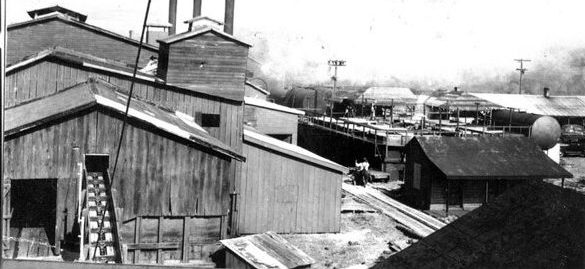
Courtesy, State Archives of North Carolina.
This is the Charles S. Wallace Co.’s menhaden factory in Carteret County, N.C., 1939. The factory was located three miles west of Morehead City, on Bogue Sound, just opposite the site of the county hospital today.
Menhaden– more often called “shad” or “pogie” in Carteret County– are a small silvery fish that congregates in North Carolina’s coastal waters in massive schools that often number in the millions.
Catching and processing menhaden into oil, meal, and fish scrap (a popular ingredient in fertilizers in that day) was the largest industry in Carteret County in the late 19th century and for much of the 20th century. The two small towns were the capitals of the state’s menhaden industry and were among the largest menhaden fishing ports anywhere in the United States.
Charles S. Wallace, the owner of this factory, was one of the local menhaden industry’s pioneers. He was also one of the few local “menhaden barons” with roots in Carteret County.
For more on the northern entrepreneurs who were more often the local menhaden industry’s pioneers, see David Bennett’s fascinating lecture called “Northern Capital and the Expansion of North Carolina’s Commercial Fishing Industry.” Bennett is the curator of maritime history at the N.C. Maritime Museum in Beaufort.
Wallace came from an old family on Portsmouth Island, at the far end of Core Sound, where there was a village that, before the Civil War, was the largest on the Outer Banks.
After the Civil War, the village gradually faded away. By the time I first visited the island as a child, only three people lived on the island.
Wallace left Portsmouth Island and moved to Morehead City when he was 13 years old, in or about 1877.
For some time, he worked for a local merchant and seafood wholesaler named Daniel Bell. I cannot say for sure, but I would not be surprised if Wallace first learned the ins-and-outs of the menhaden business under Bell’s tutelage. Bell had started out as a fisherman and by the 1880s was one of the most prominent figures in Morehead City’s seafood industry.
According to the Goldsboro Messenger (18 Nov. 1886), Bell also operated a pair of menhaden factories by 1886, one on Bogue Sound and the other on the outskirts of Lennoxville.
At the same time, he was running a seasonal bottlenose dolphin fishery on Bogue Banks, an island south of Morehead City.
A dolphin fishery was a gruesome, slaughterhouse kind of work, but it had some similarities to a menhaden factory and Wallace may have had a hand in both.
Putting aside their notorious aromas, their strongest similarity was that they both processed their catches into a valuable oil.
Nye’s Clock Oil
At a bottlenose dolphin fishery, the big money was not in the leather or even in the oil rendered from the sea mammals’ blubber (though fisheries in Carteret County dealt in both).
Instead, it was in the oil taken from the dolphin’s melon, which is a mass of connective tissue in the foreheads of bottlenose dolphins and other toothed whales that is central to their ability to produce the sonar that they use to navigate and find prey (a phenomenon also called echolocation).
At that time, the melon oil of bottlenose dolphins and pilot whales was highly valued as a lubricant for clocks, navigational instruments, and other delicate machinery.
To learn more about the history of dolphin fisheries and the manufacturing of “Nye’s Clock Oil,” as it was often called, see my “Of Time and the Sea: Nye’s Clock Oil and the Bottlenose Dolphin Fishery at Hatteras Island, North Carolina, in the Early Nineteenth Century,” North Carolina Historical Review 92, No. 1 (Jan. 20, 2015), 49-79.
By 1895 at the latest– Daniel Bell died that year– Charles Wallace had gone out on his own and established his own seafood business in Morehead City.
According to Steve Goodwin’s Beyond the Crow’s Nest: The Story of the Menhaden Fishery in Carteret County, NC (a book I love), Wallace opened his first menhaden factory at Crab Point in 1898.
He opened another in Smyrna in 1900, then built the factory that we see in this photograph in 1911.
Within a few years, a cluster of three menhaden companies operated side-by-side on that part of Bogue Sound: Wallace Fisheries Company, the Carteret Fish & Oil Company, and R.W. Taylor & Company.
Together they formed what amounted to a village of fishing people, a place where fishermen, factory workers, boatbuilders, net menders, cooks, and clerks– people of all backgrounds and races– worked, ate, and sometimes slept– and made their livings from the sea.
* * *
This is the 20th photograph in my photo-essay “Working Lives”– looking at how people made their livings on the North Carolina coast just before, during, and just after the Second World War. The photographs all come from the N.C. Department of Conservation and Development Collection at the State Archives in Raleigh.
Tomorrow– another photograph from the menhaden industry in Beaufort and Morehead City.


Interesting as always.
LikeLike