Courtesy, State Archives of North Carolina
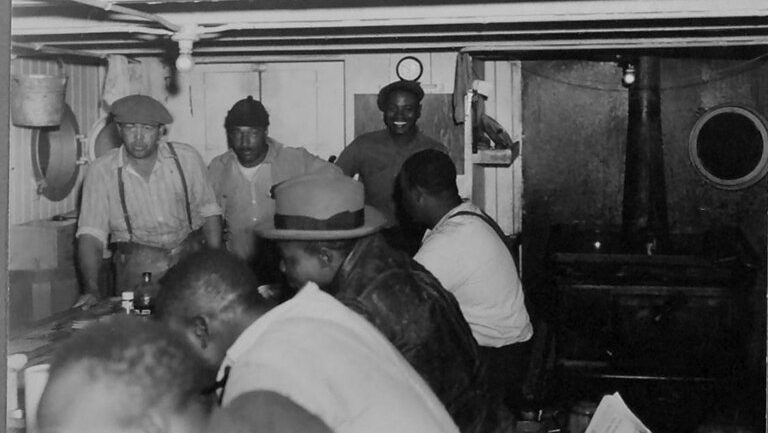
In this photograph, we see fishermen gathering in the galley of the menhaden steamer Dewey in the waters off Morehead City, N.C., November 1942.
Owned and operated by the Wallace Fisheries Co., the Dewey was named after one of her captains, Capt. Dewey Lewis, a longtime, highly respected fisherman in the local menhaden fleet.
No fisherman aboard the Dewey or any other local menhaden boat ever forgot 1942.
For much of that year, menhaden fishing crews got a far too up-close view of the Second World War.
Day after day, while they hauled their purse seines, they could see smoke billowing in the Atlantic, somber evidence of the toll that German submarines were taking on merchant shipping.
They saw crude oil washing up on the shore, piles of dead seabirds, and army patrols searching local beaches for the dead.
That year the menhaden fleet did not venture far into the Atlantic, and captains made sure to get their boats back inside the inlet before dark.
For fishermen like those on the Dewey, another incident that year was at least as unforgettable.
On December 17, 1942, a menhaden boat called the Parkins, Capt. David Davis, went down in a storm a few miles west of Beaufort Inlet.
Eighteen fishermen, including Capt. Davis, drowned in the surf. The crew was the cream of the crop. Capt Davis, who was African American, was from a legendary fishing family with roots on a local island called Davis Ridge. His boats attracted some of the best fishermen in the business.
As recently as 1940, according to The Beaufort News, the Parkins had been “high boat” for both the Atlantic Coast and the Gulf of Mexico– — that is, Capt. Davis and his crew were credited with catching more menhaden than any other boat between New Jersey and Texas.
In the African American communities that were home to menhaden fishermen– in Morehead City and Beaufort, in rural communities such as North River and Harlowe, and in fishing ports up and down the coast– it seemed like everybody lost a loved one when the Parkins went down.
* * *
This is the 22st photograph in my photo-essay “Working Lives”– looking at how people made their livings on the North Carolina coast just before, during, and just after the Second World War. The photographs all come from the N.C. Department of Conservation and Development Collection at the State Archives in Raleigh.
Tomorrow– another photograph from the menhaden industry in Beaufort and Morehead City.


Thanks for these posts. I’m enjoying them. We moved to SE NC in 1966. The menhaden industry was still going, but waning. My father, who worked for Hartford Steam Boiler Inspection and Insurance Company, would have to go to many of the plants to inspect their boilers. I remember going to one in Southport with him, but I know he also covered many of those in the Bogue Sound region.
LikeLike
David- I hope one day you write a novel full of elements of all of your missives! It’d be a page-turner!Love these.JJulie Mooney919.698.7722Sent from my iPhone
LikeLike