Photo courtesy, State Archives of North Carolina
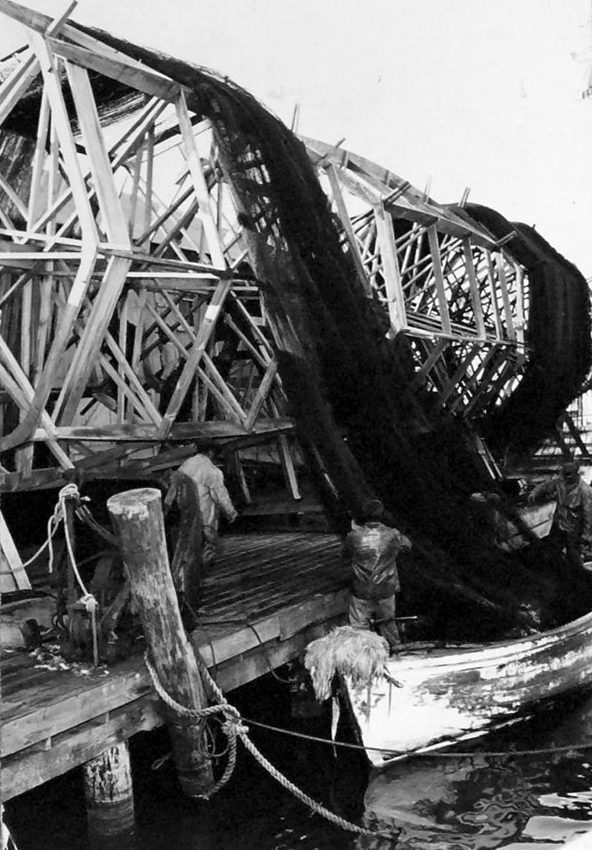
In this photograph, we see fishermen raising a purse seine onto a net reel at a menhaden factory in Beaufort, N.C., December 1944. They are standing in one of their crew’s purse boats and another fisherman, or a factory hand, is turning the reel and lifting the seine onto the reel.
The photograph was taken at the height of the local menhaden fishing season. During the fishing season, the fishermen would usually have kept their purse seine on their “mother boat,” not on a net reel at the factory, if they did not have a good reason to do so.
The purse seine may have been torn while they were out in the Atlantic earlier in the day. If that was the case, they are hoping that the factory’s net house can repair it overnight so they can take it fishing the next day.
It is also possible that the fishermen are switching out nets. They may be changing to a a larger or smaller seine, which was sometimes done, depending on the fishing conditions. Alternatively, the seine may have been torn or punctured so severely that they will leave it with the factory’s net house for an extended time and carry another seine.
A second net reel, with a seine already on it, stands next to the reel where they are working.
I can’t be sure, but I believe this is at one of Beaufort’s menhaden factories that I haven’t talked about yet– The Fish Meal Company, more often called “Harvey Smith’s” by locals.
Located on the shores of Town Creek, in West Beaufort, The Fish Meal Co. was one of at least eight menhaden factories owned by a New York attorney and businessman named J. Howard Smith.
Starting out in Monmouth, New Jersey, sometime around 1910, Smith and his three sons built an international conglomerate grounded in catching and processing menhaden, the small, herring-like fish that was harvested by the hundreds of millions on the Atlantic coast in those days.
Over much of the 20th century, Smith family’s factories produced fish oil that was used in paints, cosmetics, lubricants, fish oil pills, and pharmaceuticals, among other products, and fish meal, which was used especially as a fertilizer and in chicken and livestock feed, cat food, and the like.
By the time the family sold its interest in the business in 1973, the Smiths had established more than a dozen fish factories in the U.S., as well as in Canada, Peru, and Chile.
One of J. Howard Smith’s sons, Harvey Smith, ran the family’s menhaden factory in Beaufort. Judging from his actions during the East Coast menhaden fishermen’s strike of 1952, he deserved his reputation for being hard-nosed, no-nonsense, and at least a little bit cold-blooded.
If you lived in Beaufort in those days, one of the things you’ll never forget is the aroma of the fish scrap drying in the yards of the local menhaden factories.
My mother often told me about that smell. She grew up in Harlowe, but she and her family would go “to town” in Beaufort to do their shopping. She also attended high school in Beaufort during the Second World War.
No menhaden plant was located within a mile of Beaufort High School, but, my mother remembered, that often did not seem to matter.
She recalled hot summer days, especially at the beginning of the school year, when the smell of the fish was so strong that her teachers closed the school’s windows, leaving her and her fellow students to swelter in the heat rather than breathe in the aroma of the rotting fish.
In Steve Goodwin’s Beyond the Crow’s Nest: The Story of the Menhaden Fishery in Carteret County, NC, I found a reminder that the smell was even stronger when you lived in Lennoxville, the community of mostly fishing people that had built up around the menhaden factories east of town.
In Beyond the Crow’s Nest, Steve quotes the memoir of a woman named Thelma Pake Simpson. Her family had left Smyrna and moved into company housing at a menhaden plant in Lennoxville sometime around 1920.
In that memoir, Ms. Simpson recalled,
“It took us quite awhile to get used to the terrible odor of rotting fish and the smell of fish oil…. In the summertime, when the wind ruled the Southwest, the smoke from the [factory] dryers blew right in our windows and almost smothered us at times. When we went down to the dock to board the school boat, which took us to school in Beaufort, we had to be careful not to get any of the fish refuse on our feet because we did not want the schoolchildren to smell the odor.”
My cousin Edsel remembered that smell, too. He lived in Harlowe, but in the 1930s and ’40s, he used to go into Morehead City and “break roe” in the holds of the menhaden boats that were docked at the fish factories.
Edsel once told me that, when he was a young man, he used to burn pine straw and stand in the smoke to try to get the smell off him, an especially urgent task if he had any hopes of going courting that night.
As Cousin Edsel and Ms. Simpson knew all too well, no one ever confused the aroma of menhaden with French perfume.
On the other hand, to many people in Carteret County, that aroma was, as the saying went, “the smell of money.”
This is the 23rd photograph in my photo-essay “Working Lives”– looking at how people made their livings on the North Carolina coast just before, during, and just after the Second World War. The photographs all come from the N.C. Department of Conservation and Development Collection at the State Archives in Raleigh.
Tomorrow– a photograph from the menhaden industry in Beaufort and Morehead City just after the Second World War.
 David Cecelski
Hi Mr. Cecelski,
My name is Cathy Steever. I am a volunteer researcher for the National Park Service at Fort Raleigh. I’ve been looking at the industry happening at the Freedmen’s Colony in Roanoke Island in 1863/1864.
It seems there was an effort to have a government sponsored shad fishing enterprise for the Freedmen. I have a letter from Horace James to a Major Carvey asking for a quantity of gilling-twine and cordage.
I’ve been reading your articles on shad fishing in Coastal North Carolina with great interest. And The Waterman’s Song is a book I enjoyed very much and refer to often in my research.
I’m hoping I might send you this short letter and get your opinion on it. By that I mean, based on the amount of twine and cordage he is looking for, how big of an operation were they planning? I am not a fisherman and don’t have any context around this (is it one net per use per boat etc.) 500 nets sounds like a lot to me but I’m assuming your knowledge will give me a lot better idea.
Thank you and I’ll forward on the letter if you have time to take a look at it.
Cathy Steever
LikeLike
Of course Ms. Steever– I’d be glad to look at it. You can just send it to my email– david.s.cecelski@gmail.com. All my best, David
LikeLike