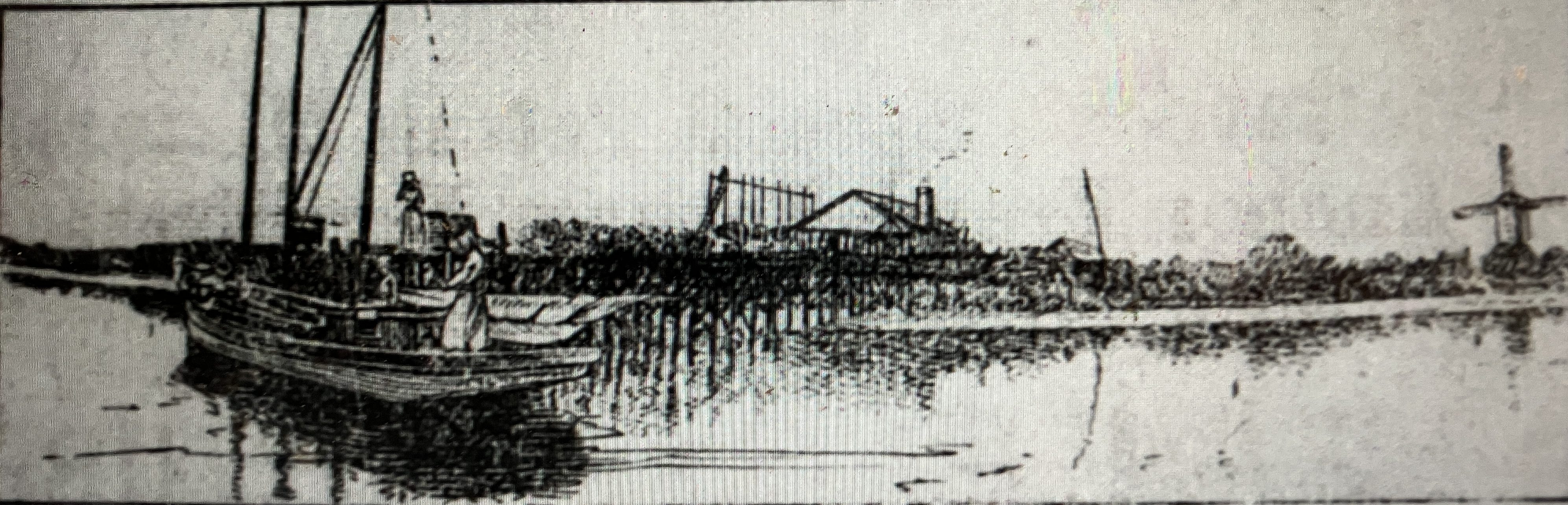
The naphtha launch Violet coming into the Straits east of Beaufort, in the Down East part of Carteret County, N.C. In the distance, we can see a windmill and a menhaden factory on Harkers Island. (Raleigh News & Observer, 13 May 1903)
I stumbled on this travel account while looking for historical sources for the story I published here last week. That story focused on Marshallberg’s Crockett cannery and the sea turtle fishery in the 1930s.
In the May 13, 1903 edition of the Raleigh News & Observer, correspondent C. J. Rivenbark told the story of his journey to Graham Academy, a school on the outskirts of a fishing village called Marshallberg that is located in the Down East part of Carteret County, N.C.
Marshallberg is located on a peninsula bound by Sleepy Creek, Core Sound, and a body of water called The Straits that runs between the village and two islands, Harkers Island and Browns Island.
In the early 1900s, Marshallberg was far more out of the way than it is today. It is only eight miles east of Beaufort, the seat of Carteret County, but at that time, no bridge had yet been built across the North River, and no roads had yet been paved anywhere east of Beaufort.
As we can see in C. J. Rivenbark’s account, people, freight, and mail in Marshallberg all came and went by boat.
Rivenbark arrived in Morehead City by train on May 11, 1903. He then boarded the naphtha launch Violet for the trip to Marshallberg.
Operated by the Morehead City, Beaufort, and Ocracoke Steamship Co., the Violet left Morehead City on a regular schedule, stopped just across the river in Beaufort, then worked its way Down East.
The Violet’s captain carried mail to the fishing and farming communities between Beaufort and Cedar Island, then crossed the sound to the southern end of the Outer Banks– first to the village of Portsmouth, then to the village of Ocracoke on the other side of the inlet.
Along the way, the captain also picked up and dropped off passengers and freight as the need arose.
According to Jack Dudley’s lovely book Ocracoke Album, the steamship company’s captains left Beaufort at first light on Monday mornings and aimed to be in Ocracoke by Wednesday evening at 6 PM.
After spending the night in Ocracoke, they set off for home early the next morning, hoping to make it back to Beaufort by 6 PM on Saturday.
On the spring day that Rivenbark was on board, the Violet was only carrying him, the captain and two other passengers.
“Aboard the Violet..., the writer has but two traveling companions. Dr. W. T. Paul, of Atlantic, who is recovering from a fractured rib, the result of a fall through the trestle work at Pier No. 1 at Morehead…, and a lonely widow, en route to the Island of Hatteras.”
I could not confidently identify the Violet’s “lonely widow en route to the Island of Hatteras,” but I wondered if it might have been Viola Johnston Scarborough, a Hatteras Island woman who had lost her husband only a month earlier.
Ms. Scarborough’s husband, George M. Scarborough, was said to have been a native of Cape Hatteras.
At the turn of the 20th century, Scarborough was the assistant keeper of the Roanoke Marshes Lighthouse, a screw-pile lighthouse located at the southern end of Croatan Sound.
On April 14, 1903, he had been home visiting his wife and child on Hatteras Island, then set off in what was apparently rough weather in a sail skiff bound for the lighthouse. His boat overturned in the storm about a mile offshore, still in sight of his family.
Viola Scarborough– if it was she on board the Violet— was left feeling grief upon grief. According to a notice of her husband’s death that appeared in the North Carolina Advocate (20 April 1903), she had already lost one husband in her young life.
The Advocate’s story did not say how her first husband died, and it could have been anything. But thinking of that time and place, one can’t help but wonder if she had also lost him to the sea.
The Violet’s only other passenger that day, Dr. W. T. Paul, was born in Pitt County, N.C. in or about 1848.
Paul served in the Confederate army’s reserves during the Civil War, when he was no more than 16 or 17 years old.
“His youth gave great promise,” one source said.
The village of Atlantic, where he came to practice, was on the northern end of Core Sound. It was some 30 miles north and east of Beaufort, and like Marshallberg, it was reachable only by boat.
In Atlantic, Dr. Paul did whatever was in his powers to do: he treated the sick and dyspeptic, delivered babies, mended broken bones, and performed surgery when, as was almost always the case, there was no time to get a patient to a hospital.
In those days, the people of Atlantic made their livings largely by fishing, waterfowl hunting, and going to sea, though many of the village’s women also worked in a clam cannery that was there for a few years around the turn of the century.
Like so many of the local fishing villages, Atlantic also seemed to attract outsiders, perhaps like Dr.. Paul, who were looking for a place to hide from the world or to shelter their frailties.
Dr. Paul died on New Year’s Day, 1917. He was 69 years old. I found several of his obituaries, and while only disclosing so much, they make it seem as if he had had a tough time of it.
In the Greensboro News & Record’s (2 Jan. 1917), for instance, the obituary writer implied that Dr. Paul had been worn down by “drink and dope,” to the point that he had long been reduced to poverty.
(At that time, “dope” most often meant opium, morphine, or heroin, not marijuana.)
Dr. Paul ended his life at the Confederate Soldiers’ Home, a residence for indigent Civil War veterans in Raleigh. He committed suicide there on New Year’s Day 1917.
I guess it is always that way. If seen from a distance, the scene would have seemed so idyllic: a boat, a captain at the helm, the three travelers, the sea around them, the lighthouse in the distance.
I am reminded again of how little we know of the burdens that others carry, or of the wounds they bear.
-To Be Continued-
 David Cecelski
David,I’m looking forward to the next chapter…I love this one. Lanier
LikeLike
Thank you Lanier! Always love hearing from you! Means so much to me!
LikeLike
Oooooo I do love a good mystery, David! As always, thanks. Lisa@LKW
LikeLike
Enjoyed the story. So true we don’t know the burdens others carry.
LikeLike
Hi Betsy– wonderful to hear from you!!! And I do hope you’ll come visit! Be sure to go by and visit my friends at the Core Sound museum on Harkers Island when you come! They’d love to meet you! Thanks for writing! David
LikeLike
Hi, David. I grew up visiting Sleepy Creek in the 70s and 80s, because my grandmother lived in Marshallberg, her childhood home, after my grandfather died. I have always thought she made up that name, but I just randomly googled it on a whim, and found your website. I’ve looked at all the links, too. My family names kept popping up: Grahams, Davises, Lewises. My middle name is Graham for my great-great-grandfather, the Dr. Graham of Graham Academy. I’m a Texan, so this was the next best thing to visiting. I cannot believe you just posted this a few months ago, and that I’d never googled it before today. Crazy. I’m already planning a visit.
Thank you!
Betsy Graham Lewis in D-TX
LikeLike