Old Smithville Burying Ground, Southport, N.C. Photo courtesy, Southport Historical Society
For Lisa and Amy
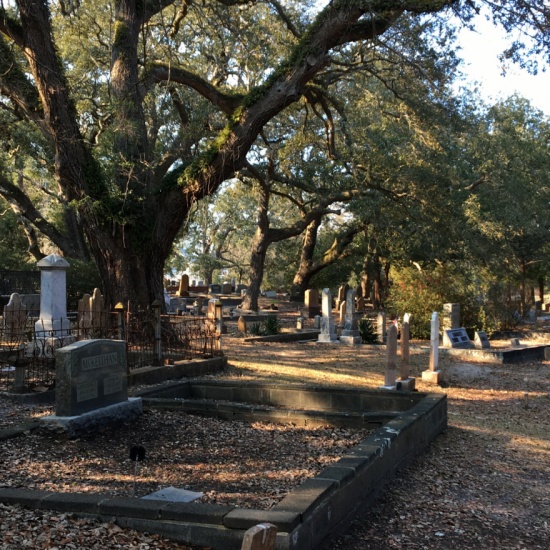
On a hot sunny afternoon last summer, Laura and I found a little shade in the Old Smithville Burying Ground, a lovely and peaceful cemetery in Southport, down near the mouth of the Cape Fear River.
We walked among the old graves, beneath the red cedars and live oaks, taking in the spirit of the place and reading the gravestones.
The graves of those who lost their lives at sea were the first that stood out to me. There were quite a few of them and they were a stark reminder of the precariousness of life at sea.
A monument marking two groups of ship pilots was among the most memorable. Five vanished in a storm in 1872. Another five were on the pilot boat Mary K. Sprunt when she went down in 1877.
The feeling of being close to the sea, and to those who were lost there, was deeply moving.
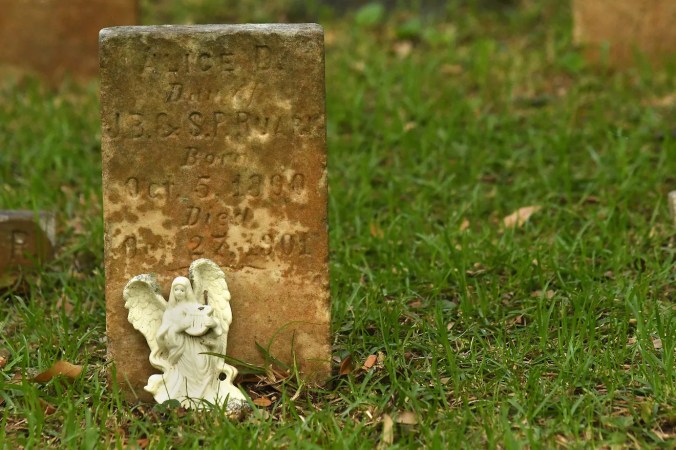
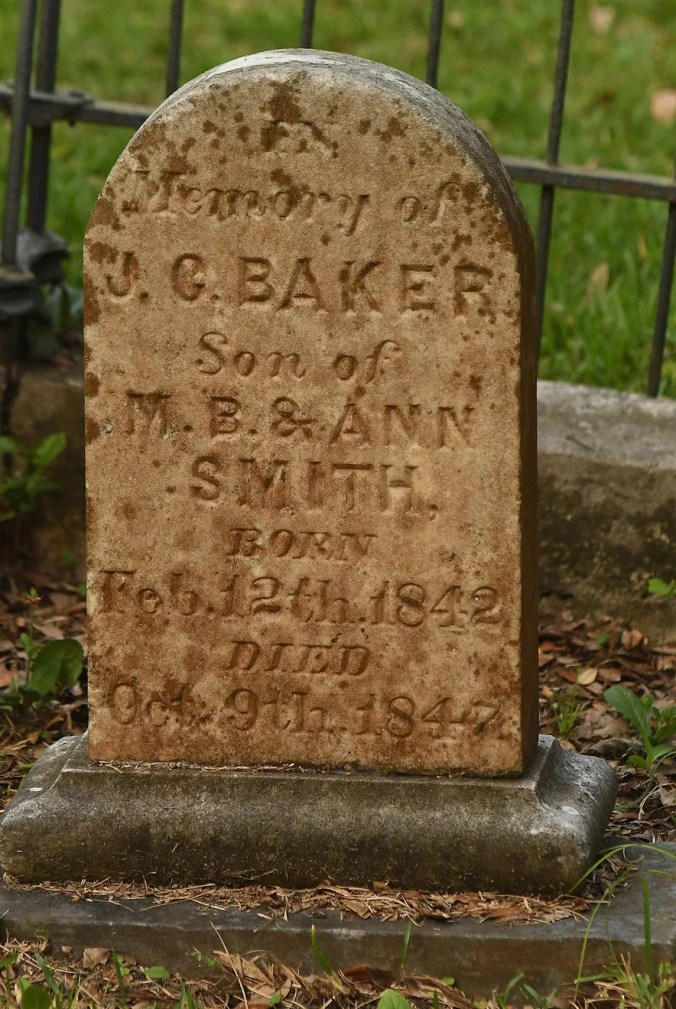
Yet at least on that day, I was affected far more by the graves of all the little children. I know it is a sign of the times in which they came into this world, and how fragile childhood was back then.
But there were just so many of them. The grave markers especially for young children seemed to be everywhere, just a staggering number of them. It was hard not to feel overwhelmed.
* * *
I am no stranger to old cemeteries. I am accustomed to seeing a striking number of little children’s graves in them. And I am not saying there was a greater proportion of children’s graves in the Old Smithville Burying Ground than other cemeteries of that age.
Maybe that day I just noticed the children’s graves more, but they did get to me. I really did feel as if I could not take more than a few steps without discovering a gravestone for a child that never saw its first birthday.
Here are some of those I saw:
Gladys Irene Whitehurst died in 1901, age 5 days. Mary Caldonia Craig passed in 1893, age 7 days.
“Our Baby,” her parents put on Mary’s grave.
The graves of Ann Crapon and her little daughters Mary, Carrie, and Eva, were also there. The girls had just a moment of life, and Ann apparently died when the last, probably Eva, was born.
Two babes were laid in earth before she died,
A third now slumbers at the mother’s side
Another infant, Mary Sellers, died on September 12, 1888. She was 9 months and 16 days old. Her mother and father were so forlorn that they could not even muster words of comfort on her grave marker.
Instead, they had their despair etched into the stone.
The little crib is empty now
The little cloths laid by
A mother’s hope a Father’s job
In death’s cold arm doth lie
Another family’s child, Nellie Manson, was only 6 years old at the time of her death.
“Our Little Nellie”
Yet another little girl, Dora Bowers, died in 1865. She was also six years old. A little girl named Kate Lewis did not make it even a year. She died in her 11th month.
“Darling we miss thee”
For most of the nineteenth century, one in five children in the United States died before their first birthday.
Tuberculosis, scarlet fever, diphtheria, influenza, and typhoid fever were among the diseases that hit children especially hard in those days. Many of those diseases continued to stalk the land well into the 20th century.
Of course, childbirth, too, was far more perilous for children and mothers alike back then.
Old Smithville Burying Ground, Southport, N.C. Photo courtesy, Southport Historical Society
Another inscription at the Old Burying Ground recalled a little girl who died soon after her fourth birthday.
Gussie Morgan
20 September 1898 – 8 October 1902
Daughter of J. W. and A. A. Morgan
Four anxious years sweet Gussie’s smiles were given,
then bade farewell to all on Earth and went to live in Heaven
“Four anxious years.” Gussie must have been sickly for much of her short life, and I suppose maybe all of it.
But those words, “sweet Gussie’s smiles”— what a way to be remembered.
* * *
As we wandered through the cemetery, I did not see as many graves that marked the passing of older children, but still quite a few.
Margaret Payton was one of them. She died when she was sixteen years old. Her marker reminded me of my mother’s stories about going to school in Beaufort in the 1930s.
There were times, my mother said, when a boy or girl in her class or who rode her school bus simply seemed to disappear: there one day, then gone. In almost all cases, she said, it was an infection or an infectious disease that would have been prevented with a vaccine or treated with an antibiotic today.
Another of the older children’s graves marked the loss of a boy, age 14. His parents called him “Our Johnnie.”
Then there were the Prioleau boys, Thomas, age 13, and his younger brother John Brown, age 11. According to the grave marker that they share with their mother, all three of the Prioleaus died of yellow fever.
I imagined that was during the yellow fever epidemic that hit that part of the Cape Fear River so hard during the Civil War. However, I could not be sure: a piece of the gravestone had broken off and had left no date.
Old Smithville Burying Ground, Southport, N.C. Photo courtesy, Wilmington Star-News
The children’s graves seemed to have no end. A little girl named Annis L. Newton lived only four days. Gladys Irene Whitehurst, five days. Kate Stuart Lewis, 11 months. Mary Caldonia Craig, seven days.
“Our Baby”
And there were more: Viola Mazella Weeks, two months. Dallas Newton, five months. George Wilson Davis, seven months. Nellie Manson, six years. Kate Stuart Lewis, 11 months.
“Darling we miss thee”
After a while, I stopped writing their names down. I stopped recording the inscriptions that caught my eye, too. There were just too many of them, and our time was getting short.
Laura and I were bound for Bald Head Island, and we did not have much time left before the ferry.
We wandered about the graveyard a little longer, then walked back to my car and headed off to the ferry landing.
We met my nephew’s mother and father there, and then their daughter and her young son showed up too. They are wonderful people, and it was a lovely little reunion.
The ferry soon headed out. As we began crossing the Cape Fear, half my mind was dwelling on the joy of our togetherness, and the beauty of the river. The other half though was elsewhere: still thinking about all those little boys and girls, and those who loved them, and I am still thinking about them now.
 David Cecelski
Gulp … the heartbreak stretches across time. The few words on the gravestone are all we need to understand.
LikeLike
I am so thankful that modern medicine and especially vaccines have prevented the everyday tragedies you saw in that old graveyard. I pray that the current day vaccine skepticism and unscientific policies do not bring that back to our world.
LikeLike