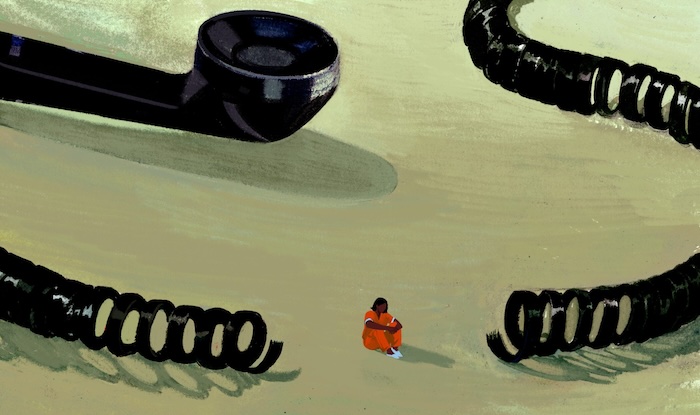
Image courtesy of Bolts magazine
I maintain an occasional correspondence with a journalist, poet, and prison activist named Phillip Vance Smith II who is an inmate at the Neuse Correctional Facility, a medium-security prison in Goldsboro, North Carolina.
Longtime readers may remember that I featured his collection of poems called Learning Instructions for Everyone . . . in prison and out here back in February 2024.
A few days ago, Phillip sent me the news that the on-line magazine Bolts has just published his article “Priced Out of Phone Calls Home.”
In that article, Phillip focuses on a phenomenon that I knew nothing at all about: in many cases, private for-profit businesses specializing in prisoner calls now have contracts for telephone service in the nation’s prisons.
According to his research and his firsthand experience, those companies have routinely used those contracts to extract exorbitant profits for phone calls from inmates.
As Phillip carefully documents, those inflated prices for phone calls have a devastating effect on inmates’ abilities to maintain strong family bonds while they are incarcerated, a situation that comes at a high cost to their marriages and children.
For instance, at the beginning of his story, he introduces us to Amber Nance, whose husband is serving a seven-year sentence in a North Carolina prison.
Nance told Phillip that she spent $300 a month on phone and video visits to her husband, “all so that he could continue fathering their three children while he served out his sentence.”
Phillip also stresses the importance of maintaining those strong bonds with family members because inmates will rely on them to achieve a successful transition to civilian life after they have served their terms.
I found the story to be a truly stellar piece of journalism: well-written, well researched, and very informative– and worth sharing here.
I also believe that Phillip’s article is a model for how a good writer turns a very specific, often seemingly quite small issue into a window for understanding other people’s lives that we might not otherwise see or identify with.
You can read Phillip Smith’s article “Priced Out of Phone Calls” here.
In his article, Phillip also summarizes recent activism by prisoner advocates and the families of the incarcerated to rein in the price of prison phone calls.
In addition, he discusses how, in response to exorbitant rates and fees, the U.S. Congress gave the Federal Communications Commission (FCC) the statutory authority to regulate in-state prison calls.
He goes on to report that the FCC then voted to put a cap on the costs of prison phone calls back in the summer of 2024, but that Pres. Trump’s new FCC chair recently blocked the new rules from being enforced.
Phillip notes that the FCC’s previous commissioner, Anna M. Gomez, responded to the block by saying that the FCC was now “stalling and ignoring both the law and the will of Congress in order to shield a ‘broken system that inflates costs and rewards kickbacks to correctional facilities.'”
At the end of his article, Phillip discusses recent activism and educational efforts that have already led five states and several cities in the U.S. to make all prison phone calls free of charge.
In his story, Phillip also introduces us to a group called Connecting Families NC. Established by women with incarcerated loved ones in the state’s prison system, the group is currently lobbying state legislators for free calls inside North Carolina’s prisons.
You can learn more about Connecting Families NC and how to support their efforts here.
I appreciate you taking the time to read this, and I hope very much that you will take a look at Phillip’s story.
For those in power in the U.S. now, showing empathy– the ability to understand and share the feelings of others– is virtually taboo. In taking that stance, they are showing us the kind of world that they want to build.
To me, we have to show in our words and in our deeds the very different kind of world that we want to build.
I think that helping one another to understand those not like us, those whose voices are rarely heard, is one way to do that. Phillip Smith II’s story certainly did that for me.
Phillip’s words made me feel to my bones the loneliness of those in prison and their loved ones back home, and it made me ache for their children, and for their wives and mothers and fathers, their little sisters and brothers, and all those who love them, waiting on phone calls that might never come.
 David Cecelski
Sad story. Thanks for posting it.
LikeLike
Love reading your stories, but please, leave politics out of it.
Louise
LikeLike
The cruelty and inhumanity of current political powers is, in itself, criminal. Thank you for sharing this.
LikeLike
I hate to think that the government is approving this activity, but it can only be stopped by challenging them.
LikeLike