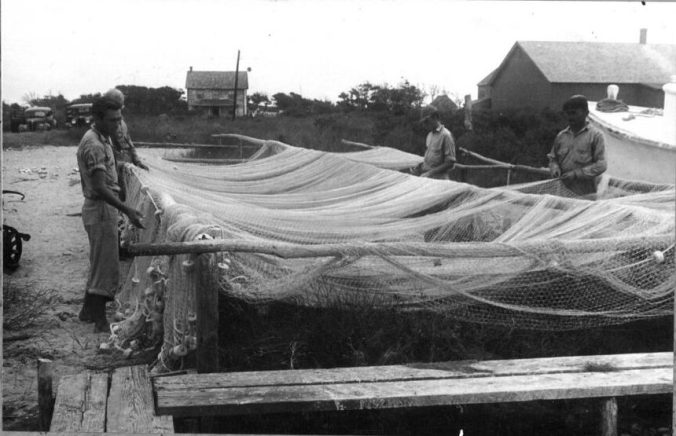
Hatteras, N.C., August 1939. Photo by Bill Sharpe. Courtesy, State Archives of North Carolina
This is the fourth photo-essay in my series “Working Lives: Photographs from Eastern North Carolina, 1937 to 1947.”
You can find my introduction to the series here.
In this photograph, we can see a quartet of Hatteras fishermen getting their gill net ready for fall fishing: patching holes, mending tears. This net looks like one of the old fashioned kind: made of cotton twine, probably in one of the fishermen’s yards or maybe strung across a kitchen.
The kind of thing one did on long winter nights.
The photograph is dated in the early part of August 1939. They are down by the docks in the village of Hatteras, on Hatteras Island. Back in those days, the island was a little different than it is today: no beach homes, no billboards, no state ferry, no bridge, no paved roads.
Lifesaving stations, seven miles apart, still kept a lookout for ships in trouble, their patrols moving up and down the ocean beach.
(They did not yet know that, in only a couple of years, soldiers would be patrolling those same shores, looking for the bodies of those who died in German U-Boat attacks.)
The Great Depression seemed to be fading in a lot of places in America by 1939, but recovery had been slow on the Outer Banks.
Even a decade after the Stock Market Crash, hundreds of men were still enrolled at the local camp of the Civilian Conservation Corps (CCC), one of Pres. Roosevelt’s New Deal agencies.
In exchange for a small monthly salary (most of which was sent directly to their families), the men undertook public works projects. On Hatteras Island, many of those projects were directed at creating the Cape Hatteras National Seashore and the Pea Island National Wildlife Refuge.
In a July 16, 1939 column, a Raleigh News & Observer columnist reported that the average income of local fishermen, never a whole lot, had fallen all the way to a couple hundred dollars a year.
During the Great Depression, many of the Hatteras men had left the island to go in search of jobs elsewhere.
Others, like the four men in this photograph, clung to the old ways and the things they knew: village life, days measured by the tides, not a time clock, and the sea.
According to news reports, they had a good fishing season ahead of them.
That summer the “mullet blow” occurred at Hatteras Island on the night of August 28th.
With the change of the wind, the bluefish, sea trout, and drum were all running, the mullet were on their way, and the men at the CCC camp were reportedly catching all the channel bass they could handle.
-End-
Next up– “On the James Adams Floating Theatre, 1940”
 David Cecelski