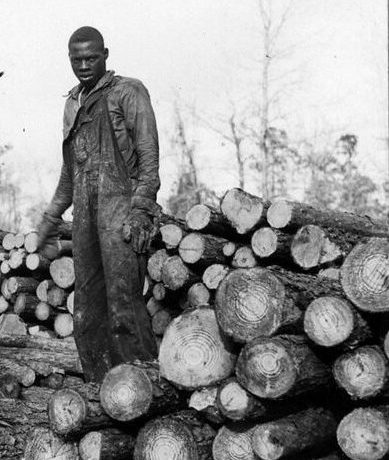
Lockwood’s Folly River, Brunswick County, N.C., March 1943. Photo courtesy, State Archives of North Carolina
This is the 13th photo-essay in my series “Working Lives: Photographs from Eastern North Carolina, 1937 to 1947.”
You can find my introduction to the series here.
In this group of photographs, we see two young black men unloading a truckload of logs onto a barge docked on the Lockwood Folly River in March of 1943. They are in Brunswick County, in the southeast corner of the North Carolina coast. The little town of Supply is about a half mile to the north.
I am not sure, but I believe that they are just downstream of the SR 211 bridge. If that is the case, they were most likely logging up in the river’s headwaters, in the southern part of the Green Swamp.
From that point on the river, a tugboat would tow the barge downstream, bound probably for the big pulp mill in Georgetown, S.C., or perhaps to one of the big mills to the north, on the Cape Fear River.
I would be hard pressed to find a more iconic photograph of North Carolina coastal life in the first half of the 20th century than the one above.
It was a period of massive timbering, the draining of swamp forests on a Herculean scale, and a level of deforestation that was reminiscent of what is happening in the Amazon rain forest today.
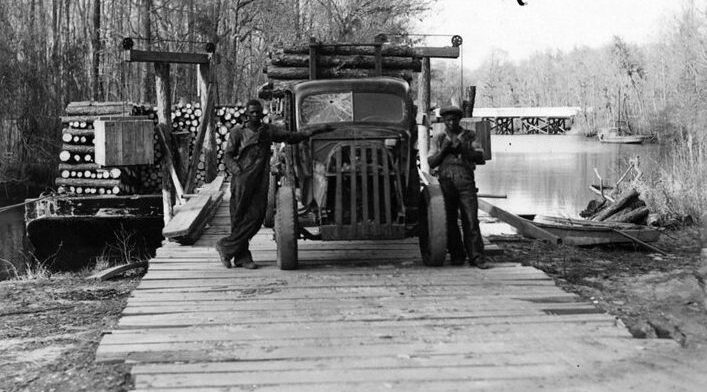
Photo courtesy, State Archives of North Carolina
Untold thousands worked “in the logwoods.” They included a great many of the men in my mother’s family in Carteret County, more than 100 miles up the coast from the Lockwood Folly River.
Many labored in the logwoods or lumber mills year-round; others only in the winter, when responsibilities on a farm were not so heavy.
In those days, logging camps and timber boomtowns seemed to be everywhere. At many times, and at many places, a crowd of lumbermen– especially African American lumbermen– hauling logs, loading barges, and guiding great rafts of logs seemed to be around every bend in every river.
It was hard, dangerous work, and the men that worked in the logwoods were not likely to enjoy a long life. But unlike tenant farming or sharecropping, a man in the timber business– whether felling, hauling, rafting or milling logs– was paid a sure wage every week.
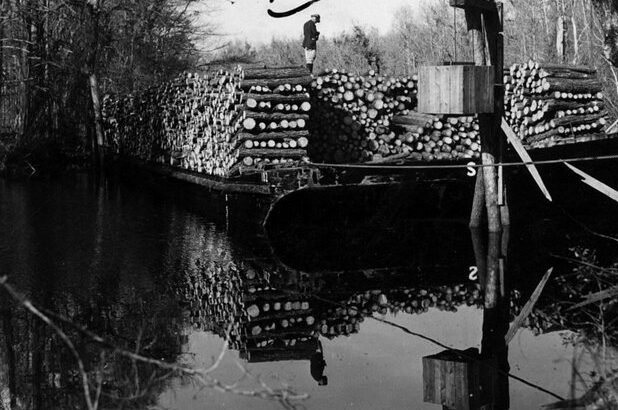
Photo courtesy, State Archives of North Carolina
If he could stay out of debt at the logging company’s store, and if he could avoid that life’s many pitfalls, a man might even save a bit and hope for a better life one day, if not for himself, at least for his children.
-End-
 David Cecelski
This was especially interesting to me because my paternal grandfather, an immigrant from Sweden, was employed as a teamster by a logging company in northern Wisconsin. He was killed when a towering load of logs fell on him en route to a blast furnace in my home town. My father had to drop out of school in the 8th grade to help support his widowed mother. Needless to say the logging industry was a big deal in northern Wisconsin where much of the lumber for houses in the burgeoning cities like Chicago and Milwaukee and Minneapolis came. I’m sure my grandfather was not the only casualty of this very dangerous occupation. I am very much enjoying your series on how people made a living in your neck of the woods back in the day. Regards, Jack Sandberg
LikeLike