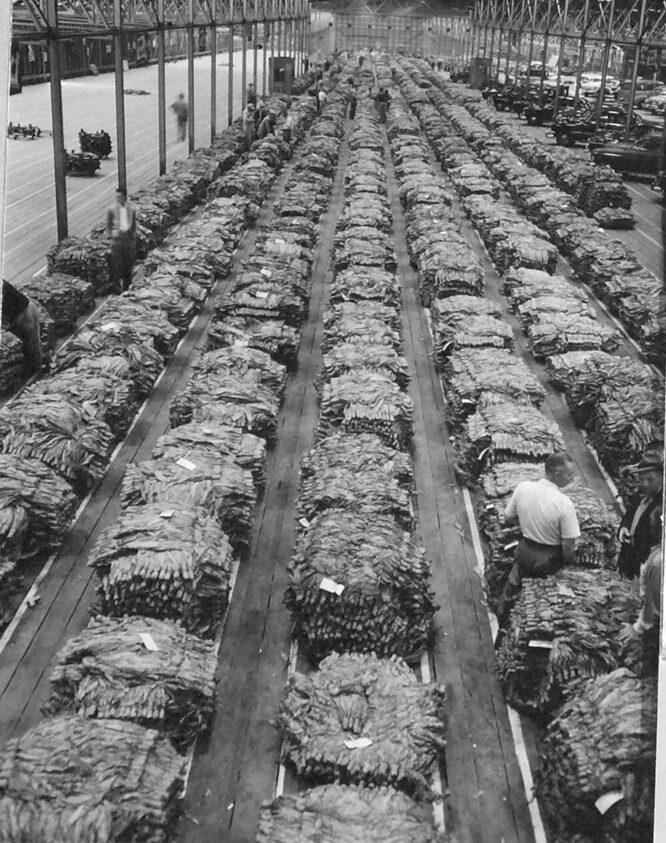
Tobacco auction house, Wilson, N.C., 1951. Courtesy, State Archives of North Carolina
This is a brief coda to my photo-essay entitled “Tobacco Harvest: Braswell Plantation, Battleboro, N.C., 1944.”
You can find that photo-essay here.
I have never seen an account of Braswell Plantation that was written by any of the tenant farmers who worked its land.
I have also never come across an oral history with anyone that was a tenant farmer at Braswell Plantation.
However, nearly 25 years ago, I did an oral history interview with a woman named Sheila Kingsbury-Burt that seems relevant here.
Sheila was an African American social activist and poet who grew up sharecropping about 30 miles from Battleboro.
I featured her story in a piece that I called “The Undercrust of Living Dust.” (The title is a quote from the interview.) It was published in my News & Observer series “Listening to History” on April 8, 2001.
In that interview, I asked Sheila to talk about what her life had been like growing up as a sharecropper in that part of North Carolina.
She was not born until just after World War II, and her family’s experience differed in some respects from life on Braswell Plantation. Nonetheless, I think that her words speak to the history of African American life on tenant farms in Battleboro and throughout Eastern North Carolina in a poignant and insightful way.
This is part of what she told me:
“My grandparents were one of probably five or six families who worked this farm. Everybody had so many acres of tobacco. You worked this tobacco today, you worked that tomorrow, and everybody worked in everybody else’s field for the most part. It was constant work for most of them, so there was a lot of fellowship because they did that work together. They were a family.
“We weren’t afraid of white people. We knew what our place was. And I have to say that of the white people that my grandparents farmed for, they weren’t the meanest white people in the world. I played with their children. If we suffered, we suffered from feelings of inferiority, not from fear of our safety. I was always clear that I was the inferior. That’s what was so pervasive: It locked people into an inability to believe that they could hope for much more.
“Nobody told us different, not even in school. And even if somebody told you different, reality would prove it wrong.
“Like, the books that we had always had somebody’s name in them — white people’s names in them — before we got them.
“Like, that white people had a nice brick school down the street, and we had this little one here.
“Like, the white people live in this nice big house with running water and everything, and we don’t even have a toilet in the house. Remember, none of the people who sharecropped had indoor plumbing or indoor toilets. None of them.
“The truth is, you missed almost as much time out of school as you did going to school because you had to stay out and work the farm. My grandfather never learned to read or write. I remember teaching him to write his name when I was in first or second grade so that he could vote.
“It was a life that you could never get ahead in. There was no getting ahead.
“You got a crop, and the resources for the crop were provided by the farm owner. You worked his farm and your crop.
“When the harvest time came, you ended up with whatever your crop earned, minus the costs of cultivating the crop, minus whatever you had gotten from him to sustain you until the harvest time.
“If I recall any time my grandparents being dissatisfied, then it was after harvest, after tobacco had been gotten in and sold, and they had so little because they owed so much.
“There were times when they would be angry and disappointed. I don’t even have a memory of them being so happy because it was so good and they earned so much, because they didn’t. They never had enough.
“When your money ran out from the sale of that year, you go right back to getting the credit from the farmer till the next year. Always in debt. Always owing. My mother recalls a time that they didn’t have anything to eat except the corn that was fed to the animals.
“Even anything that you got outside of the community, you got in the landowner’s name. Sharecroppers didn’t have credit. The person they farmed with “stood for” the car. If you went and got a TV, he stood for the television. If my grandmother went to Henderson to the place where they sold appliances, and wanted a television, he may call Bobby and say, “Should I let her have this?” And Bobby would say, “Yeah, let her have it.” So that was the system.
“The bottom line is, if my grandparents hadn’t survived the hand that was dealt them, then I wouldn’t be here. If they didn’t have hope. My generation aborted babies in droves, but not my grandparents.
“They had their children, and it was brave of them. They could have said, “No, no, no, no, no, I’m not bringing no children in this world!”
“They could have said that. But they didn’t. They said, we can do it. We’ll be alright. We’ll make it. And they fed them, and they bought them two pairs of shoes a year when they sold that tobacco, and they sent them to school. I admire my grandparents for not killing all their children.
“Even though they didn’t have education, even though they didn’t own land, even though they were sharecroppers, they believed in God and raised their children up to believe.
“There is a knowing that I have inside myself that that is one of the things that kept my whole family from just fading into the fabric of hopelessness. Everything wasn’t fine, but we had adopted, as a people, a religious philosophy that said you need to be content where you are, that said life is more than the material.
“Our government — the one that governs how fast you go down the highway, and what kind of home you live in, and how much money you can make — it all comes out of this other unfair, unreal, false system.
“My grandparents believed that the spiritual is our real government. And I believe that the value of the spirit is what has let us go on.”
-End-
 David Cecelski
I
LikeLike
Hi David. I remember writing to you
LikeLike
Thank you for this coda.
LikeLike