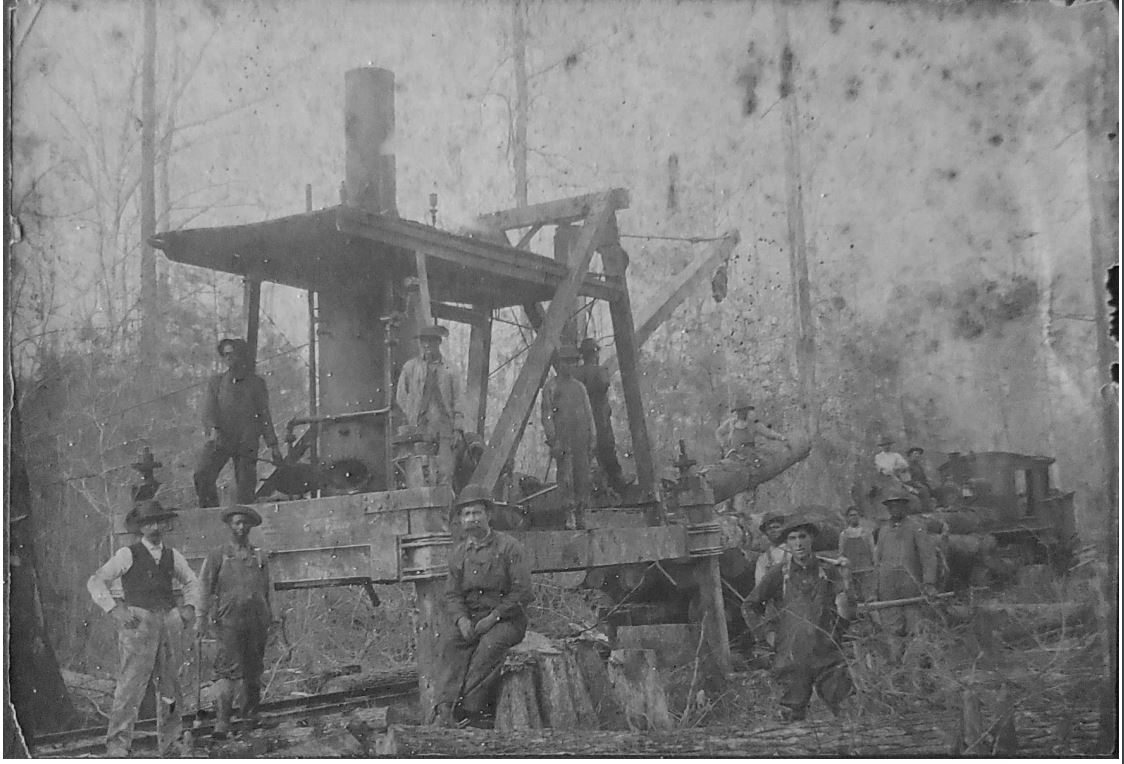
Willis Warren Powell (foreground) and logging crew, Great Dismal Swamp, ca. 1890-1910. Photo courtesy, Josh Powell
Today I want to highlight two photographs of a logging crew that were taken in the Great Dismal Swamp either in the last years of the 19th century or in the first decade or so of the 20th century.
In the first photograph, above, the gentleman sitting on the stump in the foreground is Willis Warren Powell. His family had resided on the edge of the Great Dismal, in Gates County, North Carolina, since the 17th century.
Willis Warren Powell’s great-grandson, Josh Powell, was the one who shared these photographs with me.
A forester with the North Carolina Forest Service, Josh still lives on his family’s ancestral land in Gates County.

Gates County is the fifth least populous county in North Carolina. As of the 2020 census, the county’s population was 10,478. The county seat is Gatesville, population app. 350. Map courtesy, Wikipedia
He and I talked about the two photographs last summer, on one of his breaks from fighting forest fires in Western North Carolina.
Josh told me that his family believes that the photographs were taken on the western side of the Great Dismal, in all likelihood a little east of Hall Pocosin and quite probably in Folly Swamp.
By way of reference, that area is 12 miles almost due west of the Dismal Swamp State Park Visitor Center in South Mills.
The nearest village is Corapeake, a name evidently given the area by the Algonquin people who lived on that side of the Great Dismal prior to the arrival of the first English settlers in the mid-1600s.
To this day, it is still a very rural area: a land of farms, swamplands, and big woods, a village or two here and there.
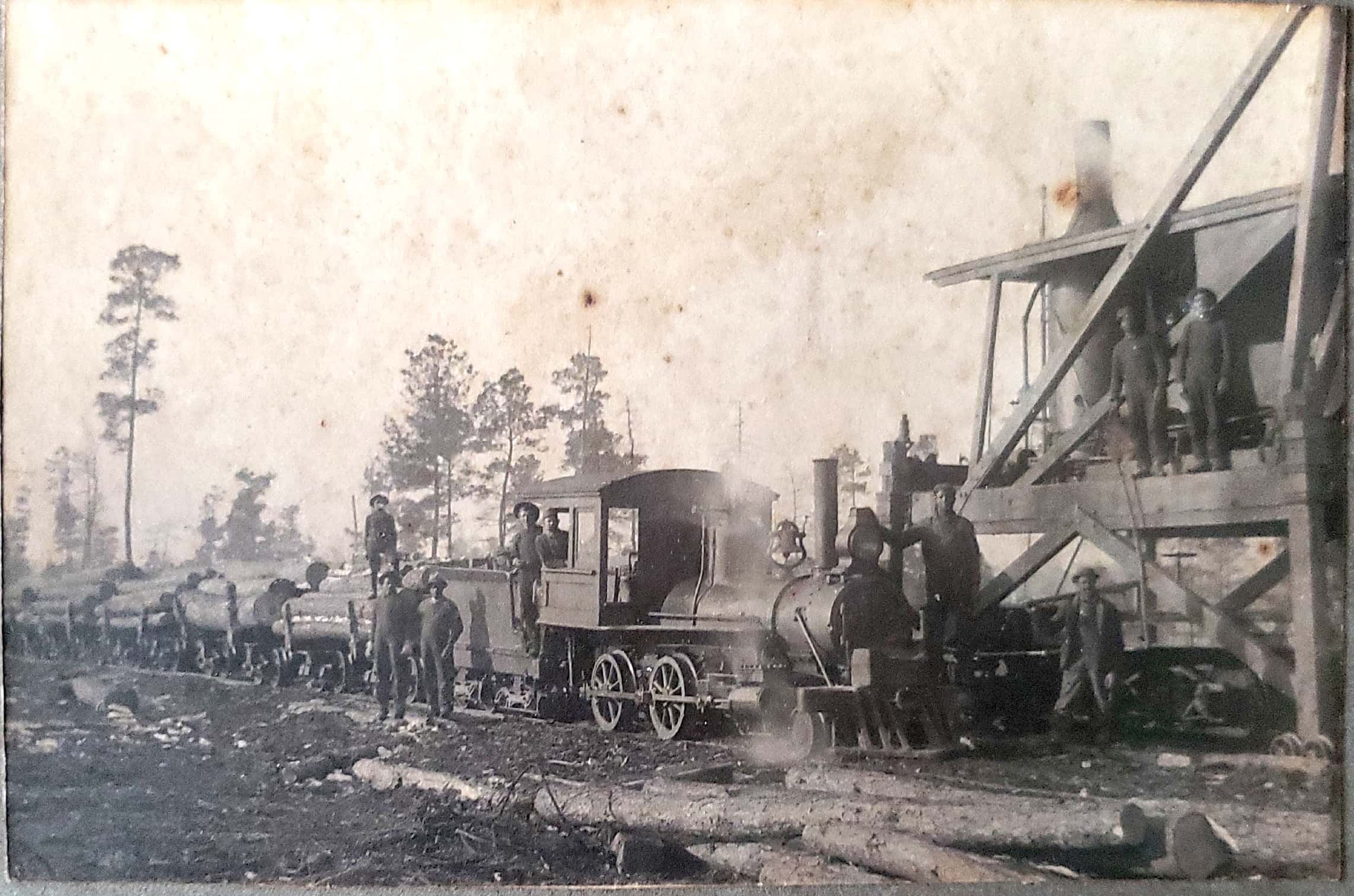
Logging crew in the Great Dismal Swamp ca. 1890-1910. Courtesy, Josh Powell
Josh and his family believe, but are not quite sure, that his great-grandfather had his own logging outfit in the latter part of the 19th century and in the early part of the 20th century.
His great-grandfather may also have operated a sawmill. Josh inherited a circular saw blade that had apparently belonged to his great-grandfather.
That could have been true, even if, as was likely, the family sold most of its logs to the Roper Lumber Company or to one of the other lumber giants that was working in the Great Dismal at that time.
Josh turned the saw blade into a clock that now hangs in his living room.
The two photographs show what was a thoroughly modern logging operation for the time.
They illustrate the technology and methodology that logging companies used to cut down hundreds of thousands, if not millions, of acres of old growth swamp forest on North Carolina’s coastal plain.
The tall, almost frightening looking machine in both photographs is what was called a “donkey engine,” a loud, powerful contraption. It was an early version of a kind of steam-powered log skidder that moved along a narrow-gauge railroad track (called a “dummy line”) laid just for its use.
If you look closely at the lower righthand corner of the second photograph, you can see two of the skidder’s iron wheels.
The loggers would cut a path for the track through the swamp forest, lay the track, then haul the skidder along the track to a desired location. They would then begin taking their crosscut saws to the forests trees within a thousand feet or so of the skidder’s location.
The skidder’s steam engine powered a winch attached to a steel cable, and the loggers attached the far end of that cable to one log at a time. They then used the winch to drag the log through the cutover woods back to the skidder.
You can see the skidder’s winch a little right of center in the first photograph.
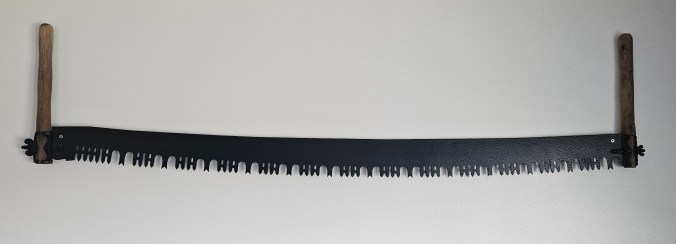
One of his great-grandfather’s two-man, 48″ crosscut saws hangs in Josh’s living room. Photo courtesy, Josh Powell
In that first photograph, we see the skidder’s winch being used to load logs onto train cars. In our second photograph, the train looks ready to take off, bound possibly for the Powell family’s sawmill.
Once the loggers had cleared the forest within reach of the skidder’s cable, new track would be laid, if it had not been already, and the train’s engine would move the skidder to a new section of the forest.
I have seen quite a few historical photographs of logging on the North Carolina coast, but these two photographs really grabbed me.
It was tough work. In a tough place. A kind of work and a kind of place that it is hard to imagine, if you have not been there, or done that kind of work. The two photographs show us a world unseen to most even in that day, much less now– and somehow these photographs, more than many others I have seen, make me feel what it was like deep down.
-End-
 David Cecelski
What a way to make a living.
LikeLike