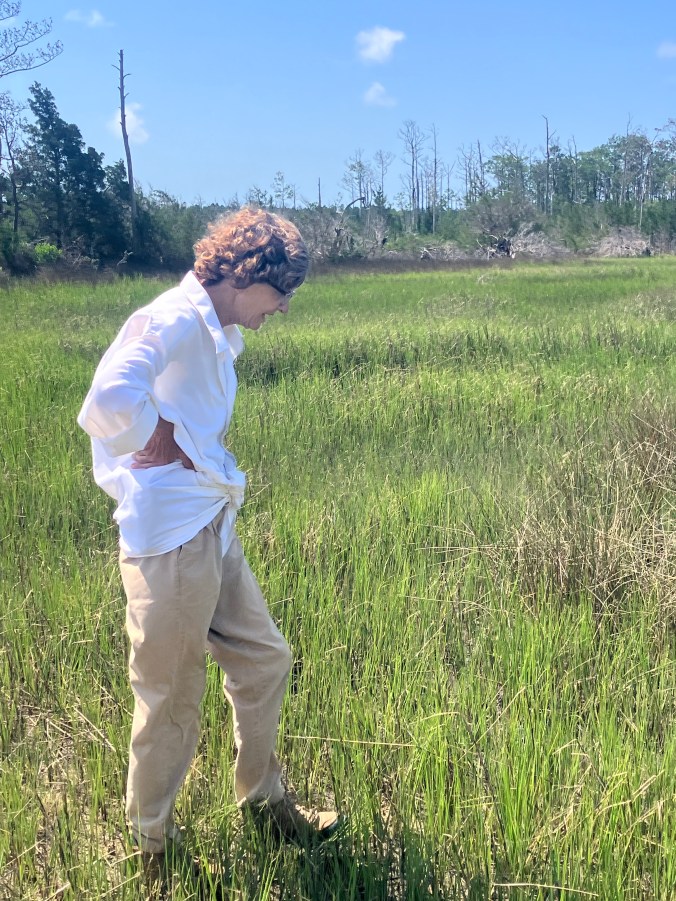
My friend Mary Katherine at Oyster Creek. Photo by David Cecelski
A memory. Today I am remembering a warm sunny morning early last spring, when my friend Mary Katherine and I went looking for the children’s graves down by Oyster Creek.
She had gone there once before, six or seven years earlier, not long after she had moved back home to the farm where she grew up.
One of her neighbors, an older gentleman named Ed Corbett, had taken her there.
She told me that the graves were marked only by ballast stones, brought there when ships from New England were still sailing in and out of the little coves along that part of our coast.
She said that there were supposed to be nine ballast stones, but that day they had found only eight of them. But nine graves were said to be there. Nine children all from one family.
Nine who died of diphtheria during the Civil War, when Death’s hunger seemed to have no end.
When she told me about the graves, Mary Katherine’s voice was filled with a deep sadness. I knew that she was thinking not only about the children, but also about their mother and father.
Mary Katherine is always like that: she is one of those people that feels for all the living and for all the dead.
—
Mary Katherine first told me about the children’s burial place one day on the telephone. She said the ballast stones were arranged in a half circle. She said that they were not much more than a foot high.
The place used to be called the Plum Orchard Cemetery, she said, and when the children were buried there, the cemetery was located on a farm that was next to the shores of Oyster Creek.
She told me that the farm is gone now, and a forest now covers its fields, as well the orchard and the children’s graves.
She also said that we would be on our own if we went looking for the graves. She explained that Ed Corbett was 84 years old now and had grown too frail to take us to them.
She told me that she was not sure that she could find them again without his help. There was no path that led to the little arc of ballast stones, and no glade that gave a hint to where they might be.
But after all Mary Katherine had told me, and how she had told it to me, I still wanted to try to find them.
—
One morning a few weeks later, I met Mary Katherine at her farm. We took a short walk down to the salt marsh and caught up a bit, but we did not wait long before we jumped in her pickup and headed back down toward the dirt road that leads to Archie Hardesty’s.
I knew that I was in good hands. Mary Katherine has always been an unfettered spirit and she grew up exploring the woods and marshes all along that part of our coast.
As a young girl, she was a tomboy through and through, she told me once, and I think that she would say that she is still a tomboy today.
Her mother taught her many things, but it was her father who taught her about the woods and nature’s ways, as well as how to look out for herself in the wild.
As best I can tell, there is not much that Mary Katherine cannot do.
She can hunt and fish, skin a buck, fix anything, work magic with a needle and thread, set a broken bone, find just about anything in a library, and quote the Bible like a preacher.
To quote one of my favorite childhood poems, she is also as brave as a barrel full of bears.
She was Atlantic Beach’s first professional woman firefighter. She ran the children’s section of a public library. She is a mother and grandmother. She loves dolls, and she hates cancer (of which she knows far too much).
As we drove down through her corn fields, I was looking forward to the day.
—
Before we got to the state road, we passed the place where a walking bridge used to run across the marsh to the farm next door.
My mother had told me about the bridge many years ago. She and my grandmother used to come and work in tobacco on the farm next door back before the Second World War.
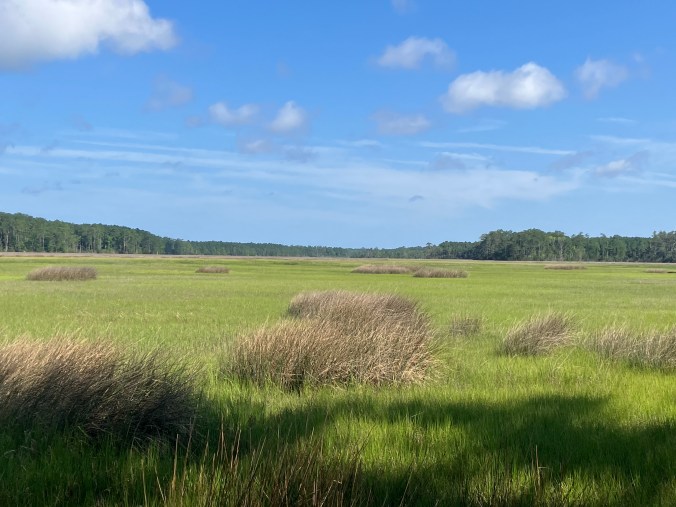
The headwaters of Oyster Creek. Photo by David Cecelski
My mother told me that Mary Katherine’s father, Preston Taylor, and our cousin Glenn Hardesty, who lived on the neighboring farm, were best friends when they were growing up there.
My mother said that the boys built the rickety, but quite serviceable bridge so that they would not have to walk around the marsh to see one another.
My mother always made their friendship sound like something special. She never seemed to mention one without mentioning the other.
As the years passed, and my aging mother reflected back on her childhood, I think that old bridge became to her a symbol of friendship itself.
—
Preston and Glenn both corresponded with my mother during the Second World War. At the time, they were both serving in the U.S. Army. My mother was still living at home.
After my mother died, I found the letters in a closet, along with other letters that she had received during and just after the war.
In those letters, I learned that Preston wrote to my mother from some of the worst battlefields in Italy, France, and Germany.
Glenn served in the army on the other side of the world. He wrote mainly from mountain jungles in the Philippines, but there was also a letter from Hiroshima that I will never forget.
He was in Hiroshima only a few weeks after the atomic bombing, and in his letter, you could tell how shattered he was by what he had seen there, and how heartbroken.
The Glenn I came to know was a kind and soft-spoken gentleman. But whenever I read that letter, I feel as if I can still hear a sobbing wail of what seems like unbearable shock and pain.
I told Mary Katherine about the letters and the bridge that the boys built across the marsh while we drove down to the state road.
Sitting in her truck, we thought of them and wondered how often, while they were off at war, they thought about home and the salt marsh and the bridge they had built between them.
—
When Mary Katherine reached the state road, she turned and headed down toward Archie Hardesty’s house.
I mention Archie’s house partly because it is a local landmark but also because Archie was the grandson of Benjamin and Euphamy Hardesty, the parents of the children buried in the Plum Orchard Cemetery.
According to family records, Benjamin and Euphamy had 11 children in all: the nine who died, a boy named William who was born in 1860, and a boy named Robert who was born after the Civil War.
At the time of the diphtheria, William was only two years old. He apparently got diphtheria too but somehow survived. Robert, the son born after the war, was Archie’s father.
—
Archie was still alive when I was a young, but I do not remember meeting him. I must have met him though: we were distant cousins and I feel sure that I would have seen him at a funeral at the very least or perhaps at one of the church suppers at Core Creek.
I do not remember meeting him, but I do remember how my grandmother spoke of him.
She and Archie were of the same generation—she was born in 1905, he in 1906—and they both grew up in the church at Core Creek.
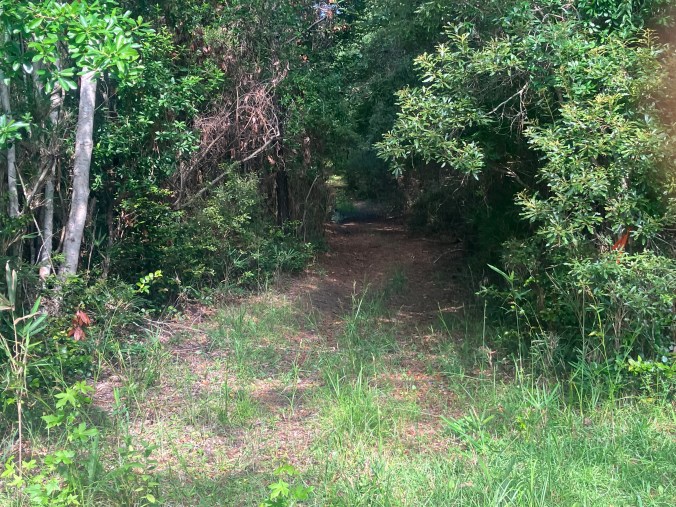
On the path to the cemetery where Benjamin and Euphamy Hardesty are buried. Photo by David Cecelski
In my eyes, my grandmother was the sweetest woman in God’s creation. However, she did not suffer fools gladly, and she was a keen and unflinching judge of people’s character.
That is why it made such an impression on me that she spoke so highly of Archie.
She often said of Archie that he “talked like people used to talk,” a phrase she used sparingly, and which I took to mean that he was honest and true and unreconciled to the ways of the modern world.
—
I guess that I should have known, because we all seem to be related hereabouts, but only that night did it come to me that, if I was related to Archie, I was also related to Benjamin and Euphamy and the children that they buried in the Plum Orchard Cemetery.
The family tie is distant, but I guess not too distant: I had a great-grandmother who was a Hardesty from Core Creek. When I checked my family tree that evening, I saw that she was Benjamin Hardesty’s niece, the daughter of his brother.
That meant of course that my great-grandmother was first cousin to all the children buried at the Plum Orchard Cemetery.
My great-grandmother was born in 1863, a year after the diphtheria. If Benjamin and Euphamy’s children had lived, she would have grown up around them, gone to Sunday school with them, maybe started school with one or two of them.
—
Archie’s house stands like a citadel overlooking fields and river and marsh. Mary Katherine told me that the house is even older than the one where she grew up (now long gone), which was built soon after her ancestors settled there on Harlowe Creek in 1826.
She and I both knew that, if Archie’s house was that old, it is one of the few houses left that was built when the Quakers were still there.
There had once been Quaker settlements all along that part of the river: down to Black Creek, at least as far east as Russells Creek, and north all the way to the other side of what we now call Mortons Millpond.
I have read that many of the Quakers first came there from Rhode Island to cut lumber to supply shipyards back home.
For a time, they prospered there. But eventually they decided that they could no longer live in a land of slavery.
They began leaving in the 1790s. Within a few decades, they were all gone, most of them to Ohio or to one of the other states that had just been carved out of the Northwest Territory.
Mary Katherine told me that way back, a windmill had stood next to Archie’s house, the kind that had cloth sails that caught the wind and made the grindstones turn.
—
Just before we got to Archie’s house, Mary Katherine turned onto a smaller dirt road. She wanted to show me the place where Benjamin and Euphamy Hardesty had been laid to rest.
Mary Katherine drove between two fields. Then she began to go around a curve toward the river, but instead she quickly veered off the road onto what looked like an old cart path.
She followed that path down through the woods as far as she could go. When the path got too narrow for her pickup, she stopped and parked and we got out and walked the rest of the way.
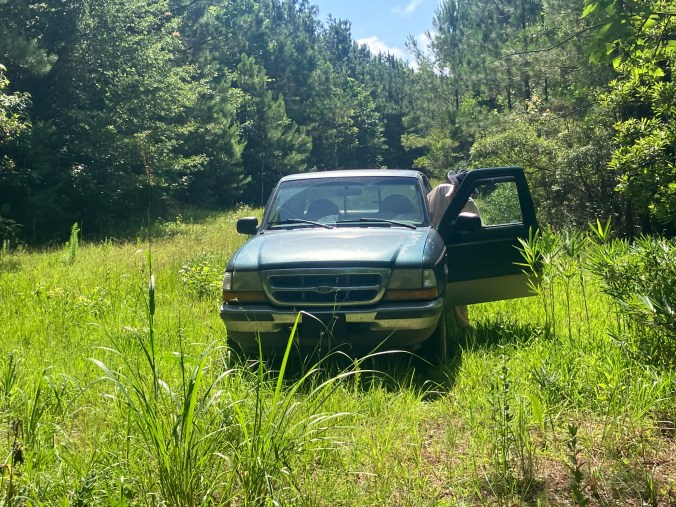
Mary Katherine and her truck on the old cart path to the graveyard where Benjamin and Euphamy Hardesty are buried. Photo by David Cecelski
The path ended in a clearing on a little knoll next to the marsh. In the clearing, we found the ruins of an old chimney and a cluster of gravestones that dated to the last half of the 19th century.
We quickly found Benjamin and Euphamy’s gravestones. The inscription on Benjamin’s grave said that he had died in 1885, at the age of 68. Euphamy had died a decade later in 1895, also at the age of 68. She was 10 years younger than her husband.
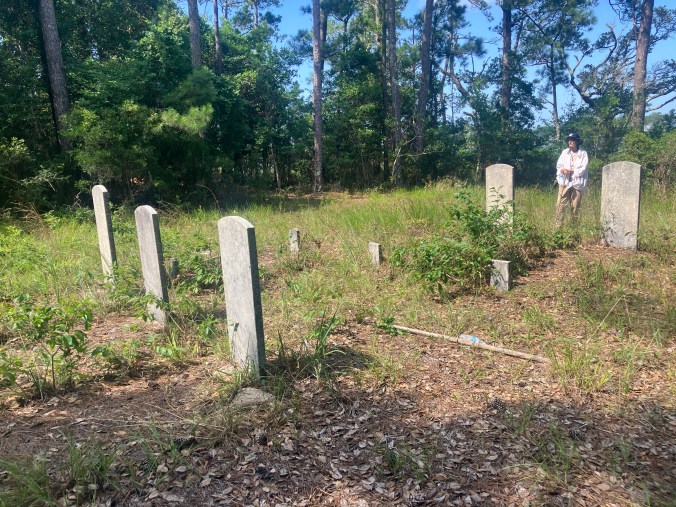
Mary Katherine at the graveyard. Photo by David Cecelski
Mary Katherine and I wondered why Benjamin and Euphamy were not buried with their children. “Must have been a good reason,” is all she said, just matter of fact.
We stood there a long while, looking out over the cemetery and up the creek toward her place, both of us, I think, imagining what it must have been like for them in those last years of the war.
—
Mary Katherine and I had located three accounts of what happened to Benjamin and Euphamy’s family in 1862.
According to those accounts, Benjamin and Euphamy’s oldest son Micajah was with the Confederate forces at Fort Macon when he contracted diphtheria early that year.
Fort Macon, now a state park, is on an island six miles due south of Oyster Creek. During the Civil War, the fort’s cannons guarded the inlet, and whoever controlled the fort was master of Beaufort and its harbor.
Confederate troops occupied the fort for most of a year at the beginning of the war, but Union forces drove them out in April 1862.
Micajah had apparently fallen ill just a few weeks before the Union warships began their siege.
By the time the fort fell, Micajah had been sent home ill. I am sure unbeknownst to him, he had brought diphtheria back to Oyster Creek with him. He and eight of his younger brothers and sisters died over the next 21 days.
Today, modern vaccines have made diphtheria rare in the United States, but they did not exist yet at the time of the Civil War.
Even as late as the 1920s, thousands of Americans died of diphtheria every year. Most were children.
A death from diphtheria is not a kind death. My wife Laura, who is a physician, told me that it is like being slowly strangled to death. Your throat closes little by little until you are gasping for air, and then the swelling continues until you cannot breathe at all.
—
I remember reading a Civil War diary kept by a nurse who was stationed at a Union army hospital near Beaufort. The hospital was located on Bogue Sound, no more than five miles from Oyster Creek if you go by water, though more than 20 miles if you go by land.
In the diary, the nurse wrote that she could barely keep from crying when she walked through the refugee camps along that part of the coast, so great was the want and the squalor and the suffering.
The refugees had come from many different places. Some had fled the villages on the islands east of Beaufort. Others had come from Plymouth, after the massacre of black troops there.
Still others had fled from Washington, a riverport overrun by Rebels and burned by retreating Union soldiers. Many more were enslaved African American laborers— men, women, and children— who had escaped from plantations inland and come to the coast in search of freedom.
Of course, war and disease go hand in hand. A child would fall ill in one of the refugee camps, or a soldier in his barracks, or a sailor on a gunboat in Beaufort Harbor, and soon the whole town would seem to be in mourning.
Some died of diphtheria like the children at Oyster Creek, but diphtheria was not the worst of the plagues that visited that part of our coast during the Civil War. A host of diseases were bad, but it was smallpox, yellow fever, and dysentery that filled the hospitals and graveyards.
—
After standing a while by the salt marsh, Mary Katherine and I left the little cemetery where Benjamin and Euphamy Hardesty are buried and walked back up the cart path to the pickup.
Mary Katherine turned around and drove out to the main road, then turned away from Archie’s house. She passed the road to the site of the old salt works, then turned again, this time onto a sand and gravel road that led to Oyster Creek.
We passed the stretch of woods where we would soon go look for the Plum Orchard Cemetery, then drove a little further up the road. Mary Katherine stopped the pickup on the banks of the creek, and we got out and stood there, looking out across the salt marsh.
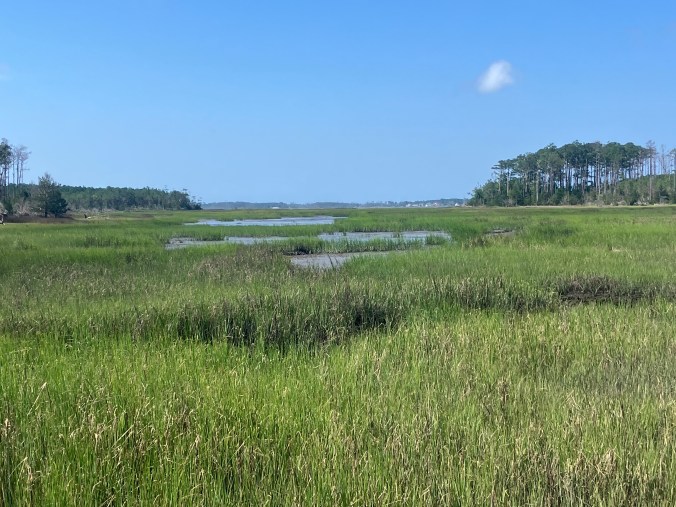
Oyster Creek looking toward the river. Photo by David Cecelski
After a while, she asked me if I had ever been some place where I got a strange feeling.
I did not know what she meant and I asked her, “What kind of strange feeling?”
“Like about the people that lived there,” she answered. “Like you can feel their grief or their hurt?”
She did not say anything for a time, then said, “Like maybe those things stay around sometimes after the people are gone.”
She said, “Like sometimes, when I am in a cemetery and I come up on somebody’s grave, I just break out in tears and I have no earthly reason why I am crying. I just feel something. In my heart, I just know something bad happened to them.”
“You think I’m crazy, don’t you?” Mary Katherine said.
—
At that moment, I was not able to find words to answer Mary Katherine, but I remember what I was thinking: I was wondering if it was only grief and hurt that linger here.
I was wondering if maybe tenderness and the love we feel for one another, and maybe a little of what we know of life’s sweetness, might also stay here on this earth when we are gone.
—
The salt marshes of Oyster Creek are incredibly beautiful. Mary Katherine and I stood there awhile longer and just breathed in the salt air and the feeling of the marshlands bursting with life.
Then we returned to the pickup and headed back up the road. We only had to go a few hundred yards before she stopped and parked on the edge of the woods.
She told me that that was where she and Ed Corbett had parked when they visited the Plum Orchard Cemetery.
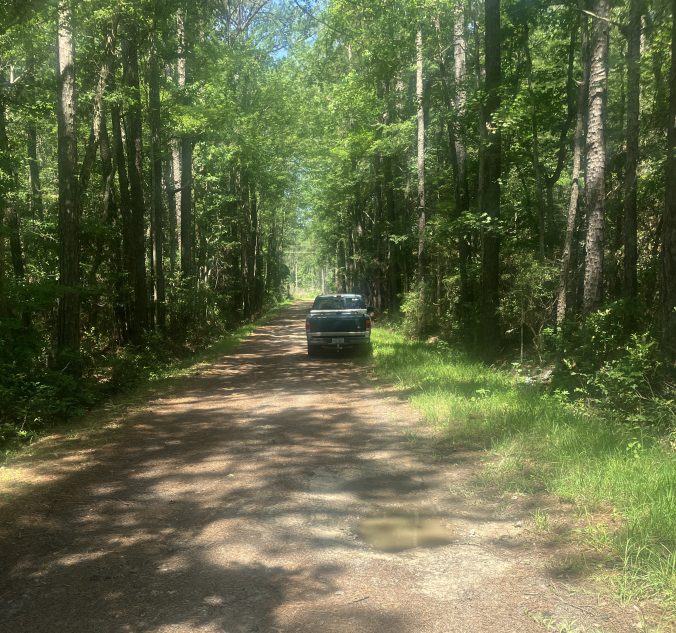
On the road to Oyster Creek. Photo by David Cecelski
As we headed off into the woods, I thought about the fields and pastures and the orchard that used to be there.
It must have been a lovely spot for a cemetery. I imagined the stones in the middle of the plum orchard in the springtime, when the trees were blooming and the wind scattered their blossoms.
For the first time, I also thought about how Benjamin and Euphamy had chosen to mark their children’s graves with ballast stones and how they had arranged them in a half ring.
I have never seen or heard of anything like that anywhere else on the North Carolina coast before.
By that, I mean the unmarked, unworked stones, the absence of names and dates of birth and death on the stones, and the lack of any Bible verse or any words of comfort or grief on them as well.
I mean also the way that, as Mary Katherine described them to me, the stones stood next to one another, not in a line but in a half ring.
As we walked further into the woods, I thought a lot about this and how it might have come to pass that Benjamin and Euphamy buried their children in that way.
The only time I had seen anything like it was some years ago, when I visited the Orkney Islands of Scotland.
Laura and I, and my brother and his wife, had gone there to see the place where my grandmother’s family, the Sabistons of Core Creek, had lived before they came to America.
The islands are home to the oldest Neolithic ruins in Europe, and some of the stone rings and other cairns there have more than a passing resemblance to the half ring of ballast stones that Mary Katherine described to me.
The cairns on the Orkney Islands are older than the pyramids in Egypt. They stand by rocky, windswept shores, and they are said to be both memorials for the dead and places both sacred and magical.
—
Mary Katherine and I never did find the Plum Orchard Cemetery. We looked and we looked and we looked, but we never found the ballast stones.
We might have walked within a few yards of them, but in the tangles of vines and briars, the trees taken down by storms, and the drifts of fallen leaves we failed to see them.
We finally gave up and walked back out to the road. I put my snake stick in the back of Mary Katherine’s truck and moved into the passenger seat. For a time, I just sat there, disappointed, but exhilarated too.
Mary Katherine, as always, was undaunted. “We’ll come back and try again and next time we’ll find them,” she said.
—
As we drove back to Mary Katherine’s, I thought about the day and how much I enjoyed it. I thought about the pleasure of my friend’s company, and the joy of getting to share the day with her.
Of course, I would have liked to find the Plum Orchard Cemetery. But in a way, I was not sure that the graves could have been any more real than Mary Katherine’s stories had made them or that they could have had more meaning than she had given them.
The whole day had felt like a rite of remembrance, as if walking through the woods and listening to the old stories and talking about what is remembered and what is not was itself a kind of prayer.
We had not found the old ballast stones, but after my day with Mary Katherine I felt almost as if I could see the lichen growing on them and touch the moistness of the moss where they met the earth.
I saw them so clearly that I almost believed that I could run my fingers across the smooth hardness of the stones, feeling where and how they were worn and the long scars of weather and time.
I could as well see the plum orchard the way it used to be. And in the middle of the trees, I could see two figures, their hearts full of sorrow, laying out the ballast stones in the shape of the rising sun.
 David Cecelski
Thank you, David, for writing and sharing this riveting account of your journey—with Mary Katherine—in search of the six gravestones at Oyster Creek. You wrote it with such vivid detail and tenderness that I felt I was tagging along with the two of you. And, oh, the history and portraits of people that you covered. Remarkable. I learned a great deal as I journeyed with the two of you: about diphtheria; the Quaker settlements in that part of NC; what brought the Quakers to that region and what caused them to leave; the refugee camps along the coast; the stone rings in the Orkney Islands of Scotland; and so much more.
And the way ended this story was deeply moving—testifying to your sense that love & tenderness, as well as grief and hurt, may very well still radiate from the cemetery
Again, thank you,
Melanie
Melanie S. Morrison
Website: http://www.melaniemorrison.net
Author of Becoming Trustworthy White Allies
(Duke University Press)
Author of Murder on Shades Mountain:
The Legal Lynching of Willie Peterson
and the Struggle for Justice
in Jim Crow Birmingham
(Duke University Press)
It is in the telling and hearing of formerly silenced
stories that communities can re-create themselves.
~ Sherrilyn Ifill
LikeLike
Thank you so much Melanie. Your words mean the world to me.
LikeLike
Very moving story. Robert Kennedy, Jr. and friends should read it. Regards, Jack Sandberg
LikeLiked by 1 person
Many thanks Jack. And Amen to that.
LikeLike
Thank you for your beautiful, meaningful writing. Reading your work is a treat, a blessing.
Also, I carry a snake stick in the woods too 🙂
LikeLike
Thank you so much, Jessi. I guess you can tell this one meant something special to me…. Always so good to hear from you.
(Glad to hear you’re ready for the snakes!)
LikeLike