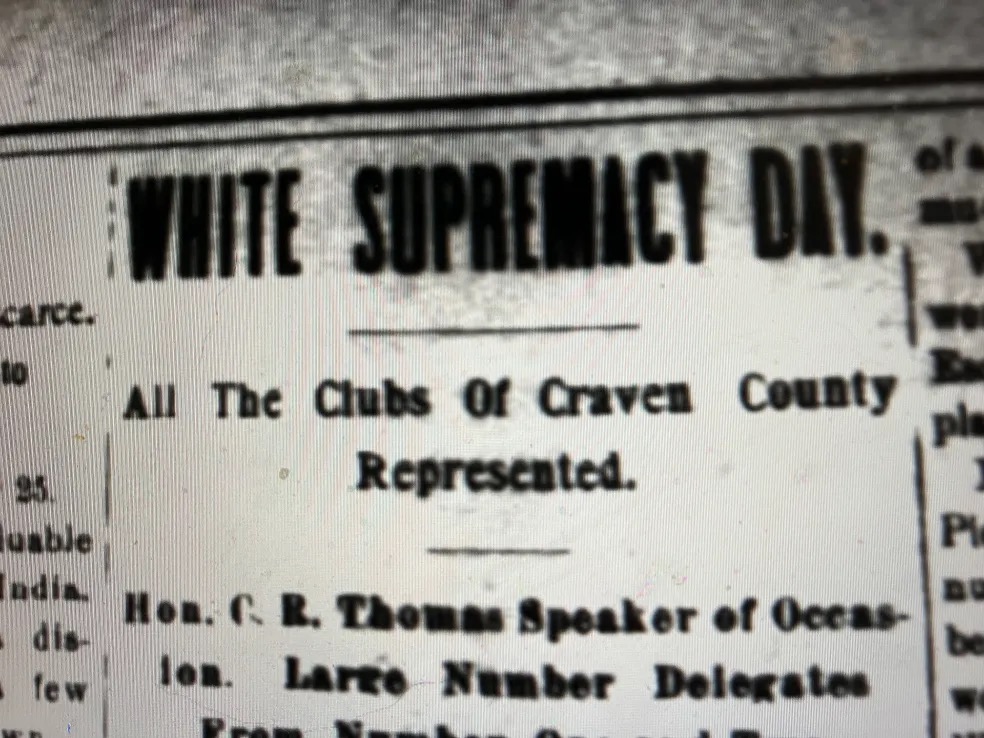
The leaders of the white supremacy movement declared July 26, 1900 to be “White Supremacy Day” across North Carolina. Businesses closed and untold thousands of the state’s white citizens gathered at picnics, barbecues, and other assembles to build support for a state constitutional amendment that would abolish black voting rights. From New Bern Weekly Journal, 27 July 1900.
A few weeks ago, I gave a lecture at Duke Law School on the history of the white supremacy movement of 1898-1900 and how it shaped our political system, our society, and our legal system here in North Carolina.
I always have to brace myself a bit to give that lecture: it is grim tale, one of the darkest chapters in my home state’s history, and I do not think that anyone could find a silver lining to the story.
Nonetheless, I rarely decline an invitation to give that particular lecture: the subject is just too important.
By almost any measure, the white supremacy movement of 1898-1900 is the most important event in North Carolina’s history over the last 150 years.
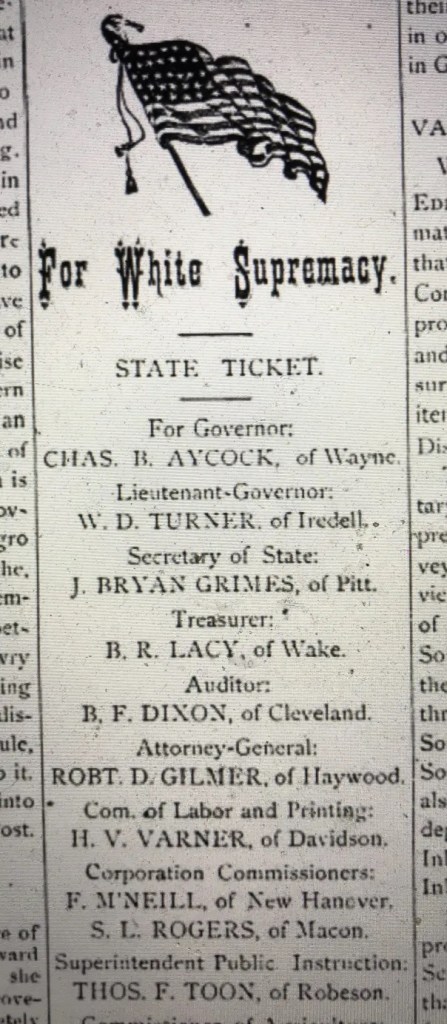
From The Eastern Courier, June 1900.
No event did more to shape our 20th century. None has done more to shape the world in which we live today.
None tells us more about why so many people today feel so helpless to mend the brokenness in our society.
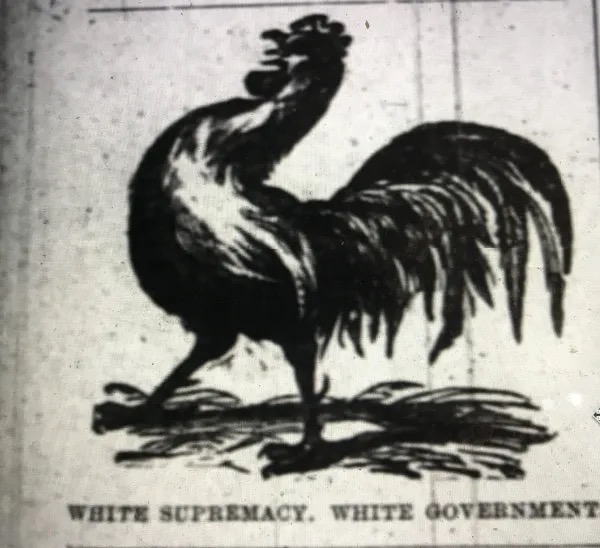
The Weekly Economist (Elizabeth City, N.C.), 11 Nov. 1898. This symbol and motto appeared in newspapers across North Carolina in both 1898 and 1900.
None has more to teach us about how and why we, as a people, have come to feel so torn asunder and divided from one another.
None that I can think of speaks more directly to why so many working people today, of all races, find themselves so shunted aside.
And yet, despite its central role in the state’s history, the white supremacy movement of 1898-1900 remains largely unknown to the vast majority of North Carolina’s citizens.
To my knowledge, no book, documentary, or museum exhibit has ever focused on the white supremacy movement of 1898-1900 as a whole.
Neither does any historical marker tells its story. Nor does any monument or memorial stand as a warning to us today.
With few exceptions, our schoolchildren are not taught about it.
In much the same way as I was at their age, our students are kept in the dark about one of the chapters in North Carolina’s history that they most need to understand if they are going to have a chance to make a better world than they have inherited.
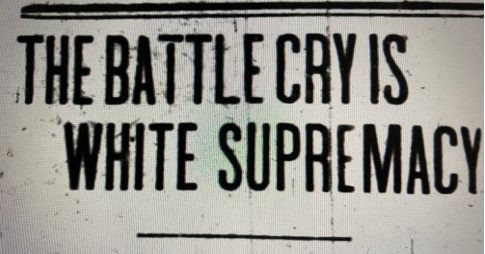
From the Raleigh News & Observer (8 April 1900)
-2-
In the last few years ,I have given one version or another of my lecture on the history of the white supremacy movement of 1898-1900 at colleges and universities, high schools, community centers, book clubs, and Sunday school classes.
I am always surprised how people respond to it: if you grew up in North Carolina as I did, you were not taught anything at all about the white supremacy movement of 1898-1900.
At most, we were taught a thing or two, probably incorrect, about what we now call the Wilmington Massacre of November 10, 1898.
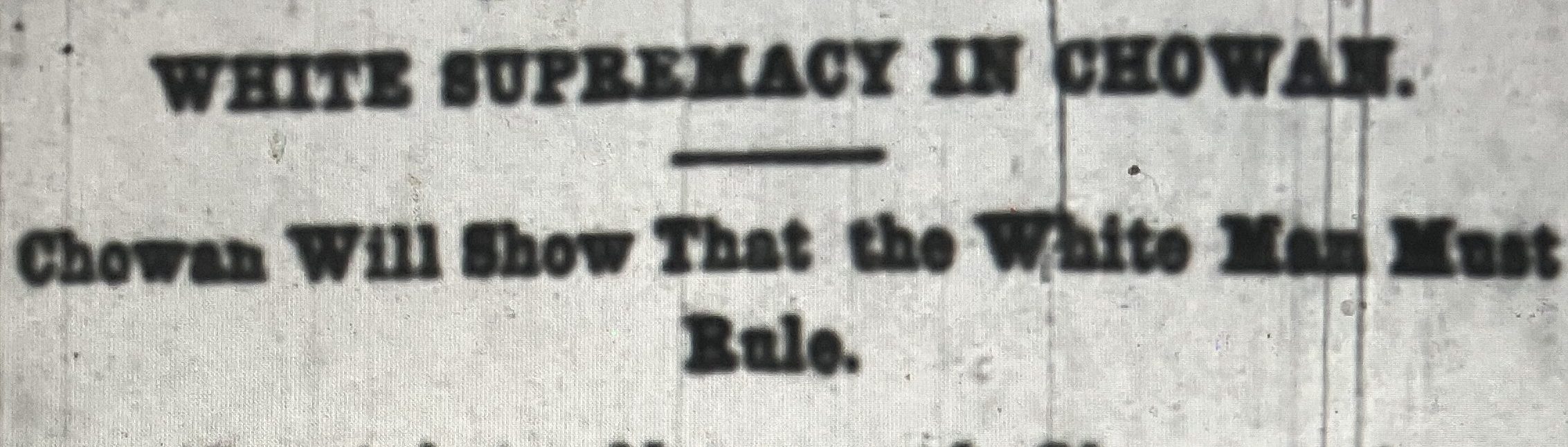
From the Raleigh News & Observer, 29 July 1900
The Wilmington Massacre was the worst atrocity committed by the white supremacists. However, the murder of so many of Wilmington’s black citizens and the takeover of the city’s government was only a small and in some ways far from central chapter in the state’s white supremacist movement.
The white supremacy movement of 1898-1900 did not arise in Wilmington.
None of its most important instigators came from Wilmington. Few of the wealthy bankers, industrialists, and attorneys who were its leaders and principal financiers came from Wilmington.
The white supremacy movement of 1898-1900 also drew only a small percentage of its supporters from Wilmington.
As a case in point, the white supremacists organized more than 900 “white supremacy clubs” in North Carolina in the spring and summer of 1900.
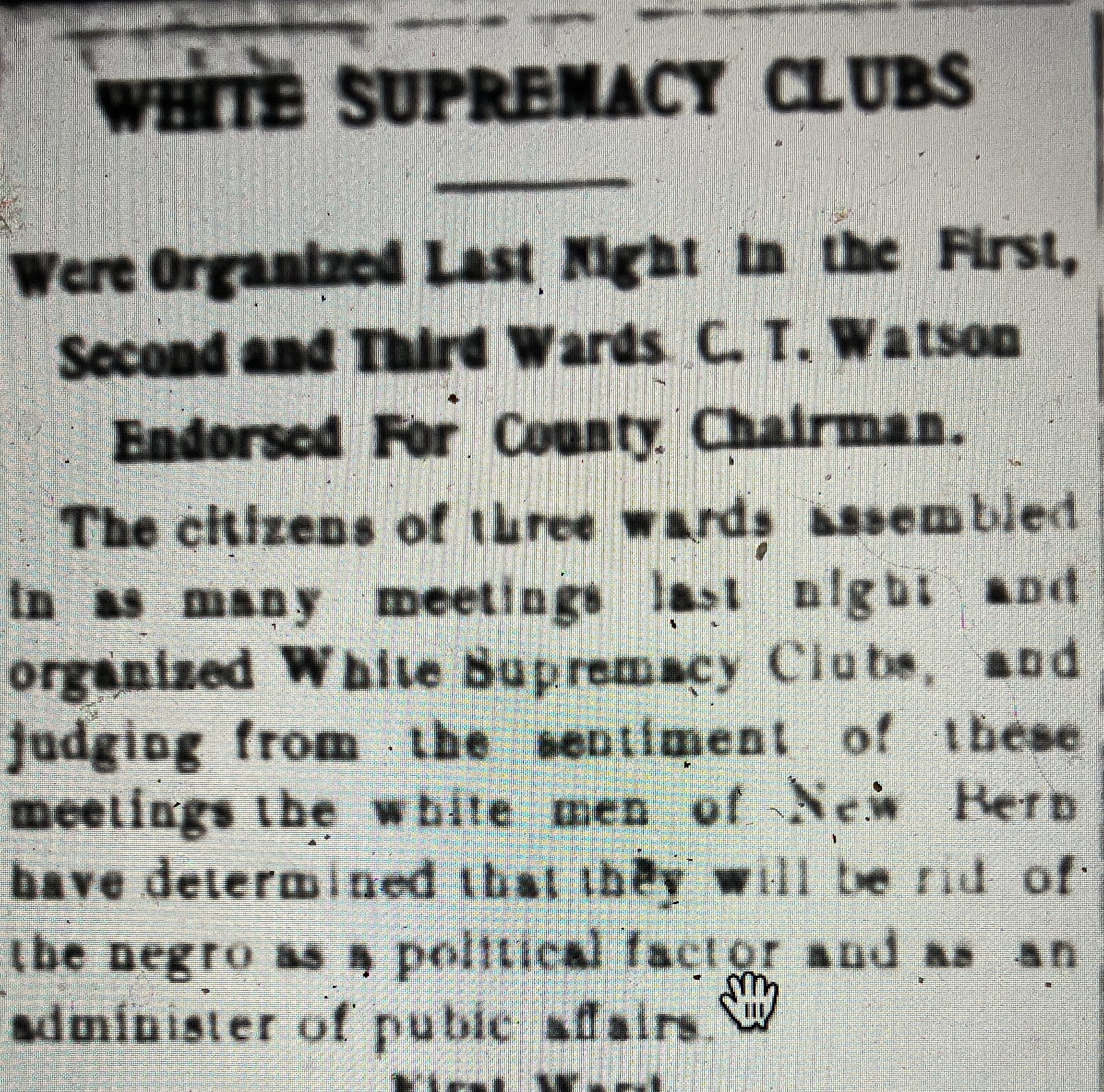
North Carolina’s white citizens organized more than 900 “white supremacy clubs” in the spring and summer of 1900. The leaders of the clubs included many of the state’s leading industrialists, bankers, and attorneys. From the New Bern Weekly Journal, 9 March 1900
This is the mission statement of the white supremacy clubs as written by one of the movement’s leaders, an attorney and future United States senator named Furnifold Simmons, in the winter of 1900:
“The purpose of the organization shall be to fully restore and make permanent in North Carolina the SUPREMACY of the WHITE RACE and to develop in the state’s citizens a belief in the necessity of establishing and maintaining WHITE SUPREMACY, as the only hope for the preservation of our civilization.”
Not more than one percent of those “white supremacy clubs” were organized in Wilmington.
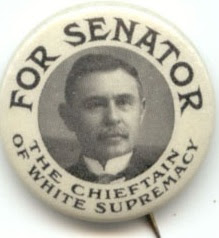
Furnifold Simmons served in the United States Senate from 1901 to 1931. Courtesy, Museum of History, Raleigh, N.C.
In that same summer of 1900, at least two dozen white militia groups called Red Shirts operated in North Carolina. They were the militant wing of the white supremacy movement, and they terrorized both black voters and white citizens who stood with black voters.
At most, only one of the Red Shirt militias was based in Wilmington.
Similarly, In 1900, the white supremacy movement’s leadership organized a speakers bureau that included more than 100 individuals.
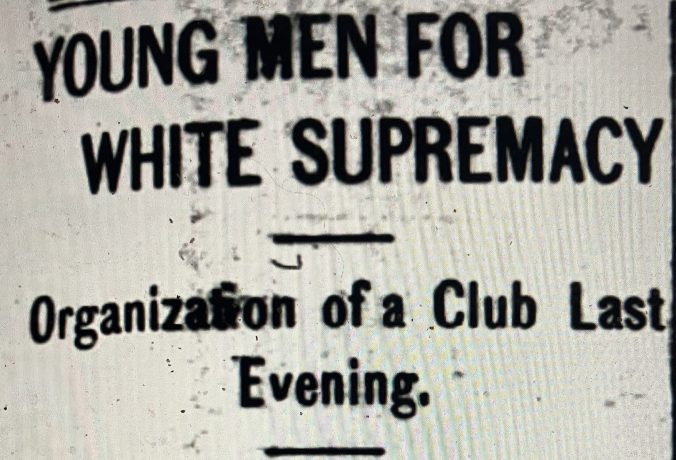
From the Asheville Citizen-Times (Asheville, N.C.), 27 June 1900
If an individual volunteered to be part of the speakers bureau, he– they were all men– would accept assignments to speak at white supremacy rallies and at meetings of local white supremacy clubs.
Those speakers included past and future governors, several former and future U.S. senators and congressmen, and a large contingent of former and future district, superior, and state supreme court judges.
None of the white supremacy movement’s most popular orators were from Wilmington.
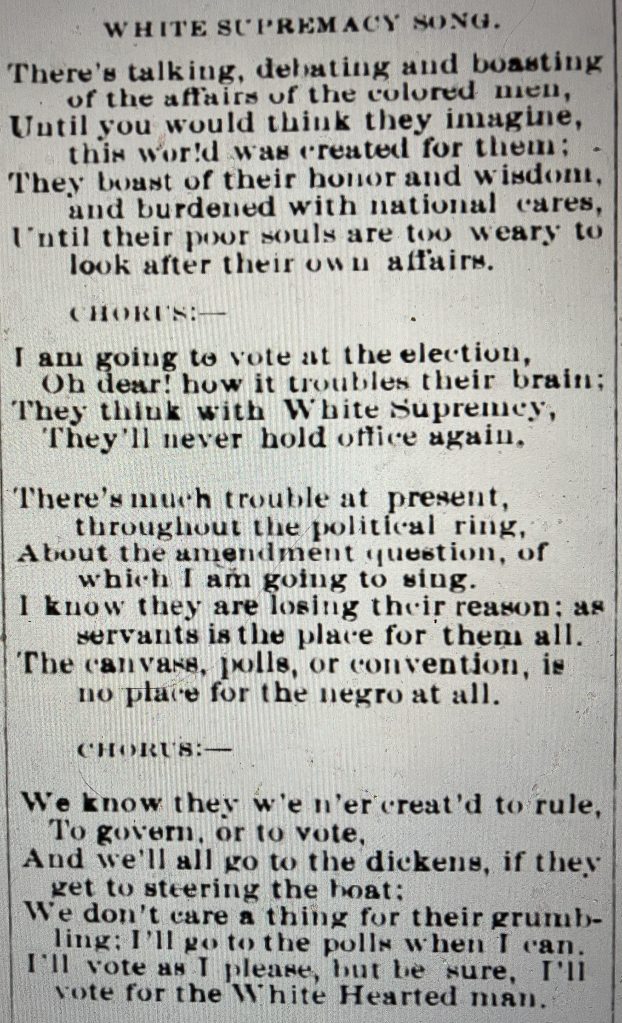
This “White Supremacy Song” was penned by a young woman in Bath, N.C. At that time, she was still in high school. Her song was among many musical and poetic works written to extoll white supremacy in the months prior to the 1900 election. From the Washington Progress (Washington, N.C.), 9 August 1900
All of which is to say: we cannot say too much about the Wilmington Massacre. Its story was silenced for too long.
But at the same time, we have to keep our eyes on the prize, which to me, in this case, means focusing on the white supremacy movement of 1898-1900 overall and how it shaped our state then and now.
We have to remember something that we were not taught, but know now: in 1898-1900, white supremacists took over the State of North Carolina.
They took control of its legislature, its governorship and all its state agencies. They took over its judiciary, its towns and cities, and every one of the state’s public colleges and schools.
As you can tell from the illustrations that I am featuring here, these were not people to whom I am retroactively applying the term “white supremacy.” These were people who referred to themselves as white supremacists.
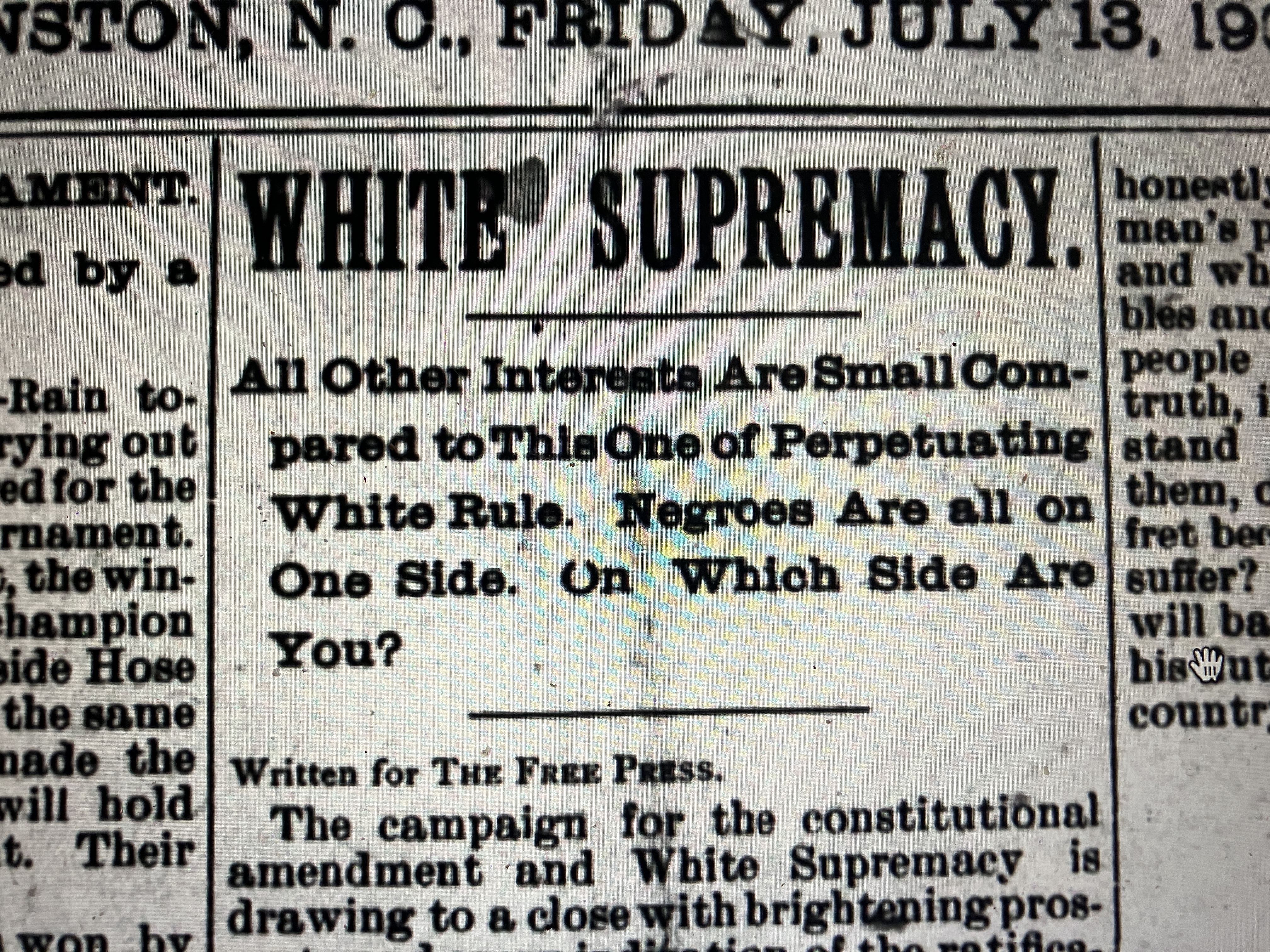
From The Daily Free Press (Kinston, N.C.), 13 July 1900
Who ran on the “White Supremacy Ticket.” Who joined “white supremacy clubs.” Who sang the “White Supremacy Song.”
Who celebrated “White Supremacy Day.”
Who carried white supremacy flags, wore white supremacy political buttons, and marched with banners proclaiming “White Supremacy.”
Whose leaders said things like:
“The Anglo Saxon planted civilization on this continent and wherever this race has been in conflict with another race, it has asserted its supremacy and either conquered or exterminated the foe. This great race has carried the Bible in one hand and the sword [in the other]. Resist our march of progress and civilization and we will wipe you off the face of the earth.”
William A. Guthrie, Oct. 28, 1898
Once in control of the state, the white supremacists methodically set about embedding the primacy of white supremacy and a deep distrust of fair elections and the democratic process in our municipal, county, and state government institutions and policies, as well as in our state’s economic and civic life.
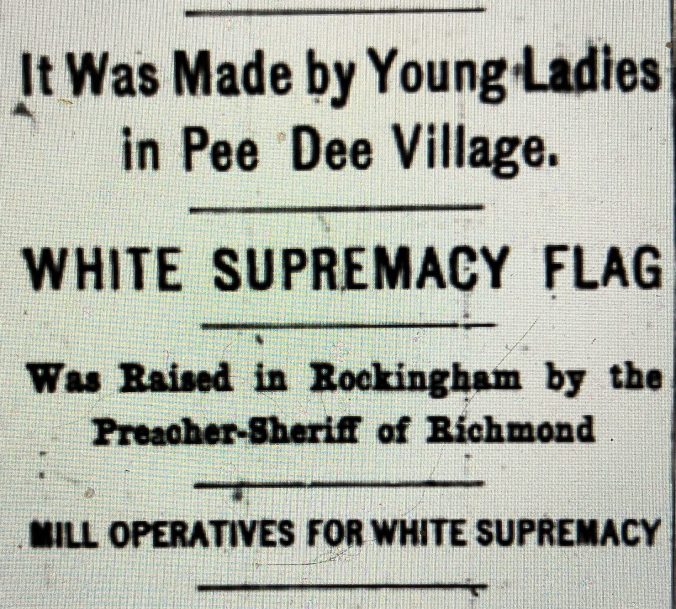
From the Raleigh News & Observer, 20 March 1900.
As I discussed with the Duke law students, that is one of the reasons that attorneys played such a central role in the white supremacy movement in 1900– after taking power in 1898, the movement transitioned from taking power to institutionalizing white supremacy in North Carolina’s laws and civic life.
Writing the laws of white rule, revising the electoral process, and centralizing control in Raleigh, rather than at the local level, was the work of attorneys.
The white supremacists were extremely successful.
They were so successful, and the breadth of their success was so great that, in the following decades, dissent was almost unheard of. In the decades after 1900, I have yet to find historical evidence of a single one of our state’s political, business, or religious leaders, on any end of the political spectrum, who raised their voice against white supremacy.
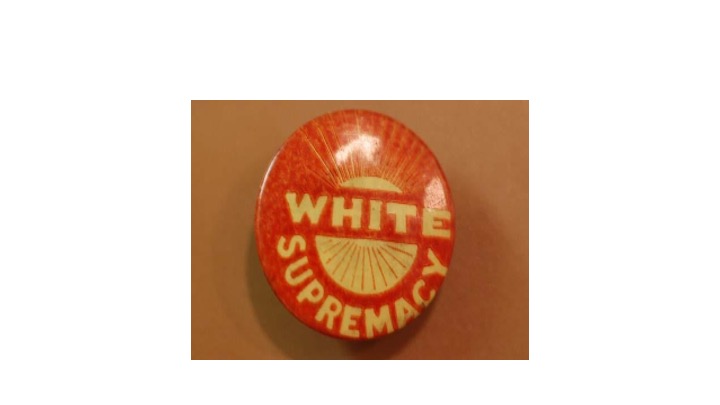
White Supremacy Button, probably 1900. Courtesy, North Carolina Museum of History
In fact, the leaders of the white supremacy movement of 1898-1900 became our heroes. North Carolina’s leaders built statues to them. They named college buildings after them. They dedicated historic sites in honor of them.
Over time, and the passing of the generations, their way of thinking about the world, and the divisions they erected between us and our neighbors, began to be taken for granted. We could not remember a different kind of life. We lost sight of the possibility that a person’s race one day might not matter or that there might be a better way to treat one another.
We could not imagine that there could be a different kind of world than that into which we were born.
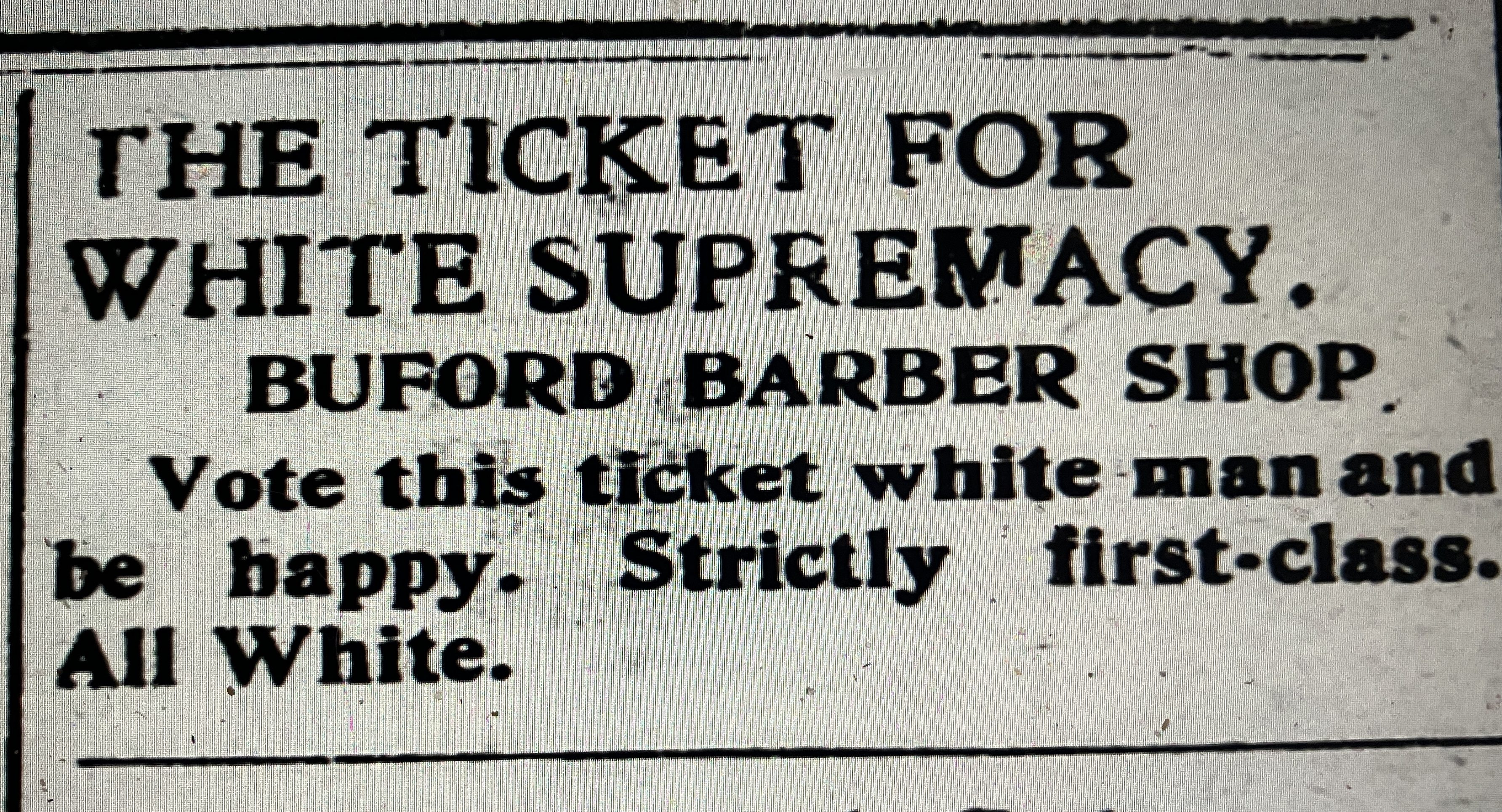
Advertisement from The Charlotte News (Charlotte, N.C.), 5 April 1900
We forgot that we do not have to be so scared of one another. That we do not have to be so fractured.
We did not even dream anymore that we could be the kind of people that look out for one another and are there for our neighbors, no matter who they are or where they were born or who or how they love.
We could not imagine that we are all in this hard, hard life together, and that we might have been put here to help one another get through it.
-3-
The students at the law school were wonderful. They were engaged, curious, serious, and kind-hearted.
One even seemed to be worried about me. She wondered if I found it hard to study and talk about such dark moments in our history.
I do not. I am far too old for that. But I appreciated her thoughtfulness, and I found it very endearing.
Inevitably, the students were astonished and perhaps somewhat shaken by the similarities between the white supremacy movement of 1898-1900 and what is happening in America today.
I have come to see that as only natural. When I give this lecture, I do not draw explicit comparisons between the past and the present. However, the similarities are so striking that, on learning about 1898-1900, people of all ages inevitably see parallels between that time and ours.
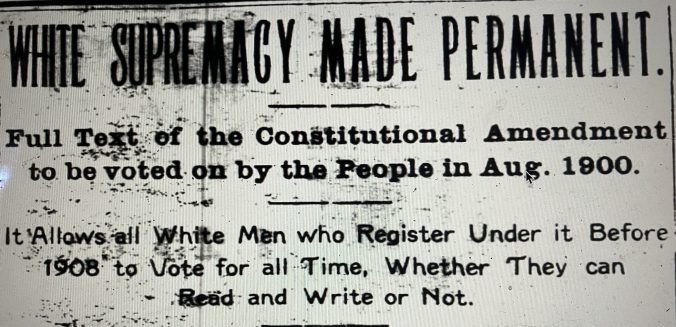
From the Washington Progress (Washington, N.C.) 13 April 1899
Sometimes, like when I gave a version of this lecture at a Raleigh high school a few weeks ago, I can literally feel the sudden change of mood in the room as it dawns on the students that this is not just a history lesson but is about their lives and the struggles that they have ahead to make this a better world.
At those times, I can feel a kind of breathlessness in the room. Everything gets more serious.
Sometimes students who had not done so take out their notebooks and start taking notes for the first time in the lecture.
Then we can really get down to work. Then we begin to put our heads together and go beyond what I know.
That is when it gets really interesting and exciting for me.
The young people often see things that I do not, and they often make connections that I had not previously made.
Many times, they find far more lessons in the past that bear on our lives and our struggles to make a better world today than I had ever imagined.
At those moments, I am filled with hope. Their intellectual seriousness, their moral courage, and their refusal to accept an America that seems to have given up on being good or noble lift me up.
And even if none of us by ourselves has all the answers– I certainly do not– I find every gathering where people come together to consider how we got here, and how we might contribute to making a better future for our children and grandchildren, tremendously uplifting.
I find that to be true whether I am in a crowded college auditorium, a high school classroom, or a table for six at a senior center.
It is always worth doing.
As James Baldwin famously said, “Not everything that is faced can be changed, but nothing can be changed until it is faced.”
-End-
 David Cecelski
Thank you, David. Signed, a woman from Samuel H. Vick and Josephus Daniels’ hometown.
LikeLike
Thank you…. I so love what you do. I’m still dreaming of a tour of your hometown with you as a guide!
LikeLike
Inspiring as always. I am pleased to report that a black man won the primary election for sheriff of Dare County last Tuesday against three other white Republicans despite some very nasty opposition on social media. During my 40 years in Nags Head (1970-2010) I can think of only one other black person who served in an elected position in county government so this is encouraging. Keep giving that lecture. Regards, Jack Sandberg
LikeLike
Dear Dr. Cecelski, I look forward to reading each and every post on your blog site. My parents grew up in New Bern and my family in Eastern N.C. go back to colonial times. I have learned so much about the state’s coastal history from your detailed and loving descriptions, and posting of archival photos. You’ve helped me see it in a new light and fall in love with its creeks, marshes, swamps, rivers, sounds, and ocean all over again. But my greatest debt to you is your piece on the “other coup,” New Bern 1898. I suspected my great grandfather Owen Haywood Guion was a participant. You later confirmed my suspicion when you located and published the names of the local white supremacists who attended the meeting at the Craven County courthouse on February 8, 1898. Furnifold Simmons recruited O.H. Guion into his law practice as an apprentice and praised his oratory skills. No doubt Guion was one of the men recruited to address white supremacy clubs and gatherings throughout the region after the Coup. Guion passed the State Bar and followed Simmons as head of the Craven Co Democratic Party when Simmons was elected to the Senate. This was a stepping stone to election to the General Assembly. Guion was chosen Speaker during his second term. After this he was appointed judge in the N.C. Supreme/Superior Court. So he was in a position to write, promote, and uphold the first Jim Crow laws in the state. I have used my connection to my great grandfather to tell the story of the New Bern Coup, rise of white supremacy, Black disenfranchisement, and flight of Black New Bernians north. I also offer heartfelt apologies to all who suffered from my ancestors’ actions. I’ve met Alex Manley’s g g grandson Kieran. O.H. Guion also apprenticed w Gov. Manley’s nephew (who shared a practice w Sen Simmons). Guion took over this practice after retiring from serving on N.C.’s Superior Court. Anyway – I will continue to use my connections to add a personal/family connection to this devastating state history. Here’s what I don’t have and, I fear, lack the skills to access it: The General Assembly Jim Crow bills introduced and championed by my great grandfather and court cases that he oversaw in the early 20th century that upheld and codified. Suggestions? Connections?
Because Owen Haywood Guion is not a name that’s found its way onto UNC-CH buildings, high schools, major thoroughfares and the like, most state residents – and my family – know nothing of the lasting damage he did. That’s my message to fellow descendants: do not embrace plausible deniability when it comes to ancestors’ roles in the rise of white supremacy, Jim Crow, violence of the Red Shirts and KKK in our state. Look into you lineage. I am seeing the history of The Old North State through a new lens. My family offers a through line from colonialism, slavery, Tuscarora people’s land theft and banishment to white supremacy, Jim Crow, and, in my case and my parents’, commitment to racial justice and equality. I would appreciate correspondence or a phone call to help further my research, public education, and continued reckoning.
Gratefully yours,
Lee Guion she/her guionlr@gmail.com 415-350-5292 San Francisco, CA
Not everything that is faced can be changed, but nothing can be changed until it is faced. – James Baldwin
LikeLike
Hi Lee, gracious, your great-grandfather really was in the thick of it all. His ties to the Simmons law firm intrigues me. It seems like Simmons’ law partners were behind an astonishing amount of the planning and execution of the white supremacy movement especially in 1900. As best I can tell, no group of men was more central to the white supremacy movement. At times, it feels as if they held every important job– the jobs that really mattered, I mean. As for tracking O.H. Guion’s impact on state laws and court decisions– the General Assembly’s laws of course are published and available on-line by the session in which they were passed. You should be able to find them with no problem. Court cases are tougher if you don’t have names of the cases, but doable– I’ve done that kind of research, but I always have to re-learn it and I almost always end up going back to the wonderful archivists at the State Archives to remind me how to go about it– which I would recommend you do as well. I always try to give them as much background on my project and what I’m after as they can bear– often they see angles of pursuit that I had not seen. I have found following the Raleigh newspapers during General Assembly sessions is also often helpful– on newspaper.com or a similar online database. For many aspects of this research, I suspect it will be difficult to separate out your great-grandfather’s contribution to the institutionalization of white supremacy and the contributions of others. Everybody was on board, you know. Hope this helps a little! I love what you’re doing!
LikeLike