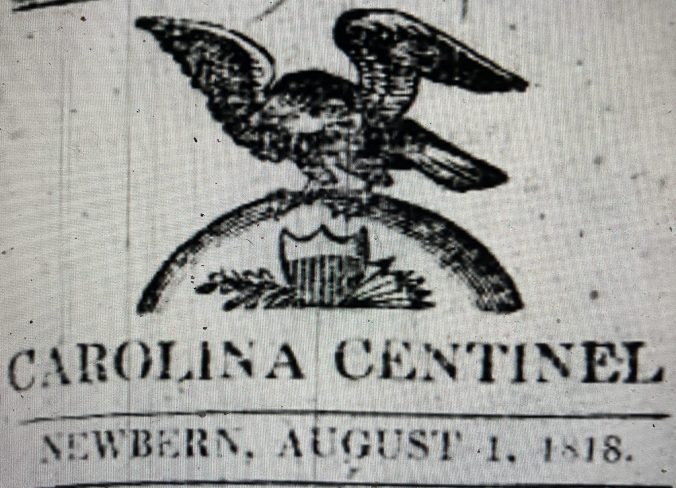
I do not believe that I ever seen more runaway slave notices in a single issue of a newspaper than in the Carolina Centinel of August 1, 1818. While researching the maritime trades on the North Carolina coast in that era, I ran across that issue and it kind of stopped me dead in my tracks.
The Centinel was a small, weekly newspaper published in New Bern, N.C., near where I grew up, between 1818 and 1837.
In that one issue of the Centinel, I found bounties offered for the capture and return, usually alive, but in one case dead or alive, of 11 different black men, four black women, and two black children.
It was just one day, but that single issue of the newspaper seemed to me to offer a penetrating look at what life on the North Carolina coast was like in the early 1800s.
Today I would like to share those runaway slave notices with you and look at what they reveal to us about our coast’s history.
A Woman Named Amy
The first of the Centinel’s runaway slave notices that caught my attention concerned “a negro woman named AMY” who had escaped from Joseph Hatch’s plantation in Jones County.
In the Sentinel, Hatch offered a $10 bounty for Amy’s capture and return.
To help bounty hunters and slave patrols identify her, Hatch described Amy’s physical appearance. He said that she was “tall and stout built, Yellow Complexion, about 40 years of age, with several scars on her cheek and the back of her neck.”
Hatch indicated that she had escaped from him at least once previously but had been re-captured.
In the Centinel, Hatch indicated where he believed Amy had been sheltered on that earlier escape attempt. He evidently suspected that she might be found in one of those places again.
At the slave quarters on a plantation on the Neuse River, Hatch wrote, Amy “was harbored by a fellow [an enslaved man] by the name of SAM, belonging to General Thomas A. Green….”
He continued: “Then she went to General Simpson’s plantation, where she was harbored by his negroes…”
Finally, he writes, Amy “crossed over Neuse and was harbored by Mr. Patrick’s and William Bryan’s Negroes.”
Then, and always, other enslaved men and women were the most important protectors for all those who escaped coastal plantations and slave labor camps and were fighting for survival.
A 15-Year-Old Named Mima
The second slave notice I read in the Centinel concerned a teenage girl named Mima. She had escaped from Joseph Hooten’s plantation in Lenoir County.
The reward notice said very little about Mima. It indicated only that she was 15 years old and was “stout made and dark complected.”
Hooten had heard rumors that Mima had been seen in the vicinity of Stoney Town Creek, a stream that originates in the northern part of Lenoir County and flows southeast into the Neuse River.
According to the North Carolina Gazetteer, the creek was “first called Stoney Town Creek in the 1730s because it was near an Indian town on a hill with outcroppings and sandstone.”
I do not know anything more about Mima. But I assume that she was running from sexual assault and/or physical abuse.
I find it very unlikely that a girl her age would have fled by herself and risked her life on her own if she was not running from a very great evil.
A 15 or 16-Year-Old Named Charles Emery
The third escaped slave that I found in that issue of the Centinel was also hardly more than a child.
His name was Charles Emery. According to the reward notice for his capture, he had escaped from William P. Moore’s plantation on the Trent Road, two miles south of New Bern.
In that reward notice, Moore described Emery as “light complexion, 15 or 16 years old [and] five foot four or five inches high.”
He went on to say that Emery had “a brother that belongs to Capt. Dempsey Wade in New Bern, by the name of Bill Emery, a sister that belongs to Mr. Isaac Taylor, by the name of Matilda, and a brother living with William Holland Esq. on Clubfoot’s Creek.”
As was the case with most of the enslavers who posted reward notices in the Centinel, Moore also warned “all Masters of Vessels from carrying him away under the penalty of the law.”
Those were two common themes in the runaway slave notices published in the Centinel: escaping slaves looked first to their families for shelter, no matter how far the auction block had separated them, and if they dreamed of lasting freedom, they looked to the sea.
A Man Named Harry
The fourth escaped slave that I saw in that issue of the Centinel was a man named Harry. He had managed to escape from a planter named John Y. Bonner near Washington, N.C.
In the Centinel, Bonner offered $100 for the capture and return of Harry, dead or alive.
The first line of the reward notice read: “The subscriber having legally outlawed his Negro man Harry, offers the above reward for his head, or the same if delivered alive to me.”
Having Harry declared an “outlaw” meant that a slave patrol or bounty hunter could kill or maim him without being liable, as would otherwise have been the case, for Bonner’s loss of “property.”
Enslavers “outlawed” runaway slaves for several different reasons. In many cases, they did so because the escapee was inciting other slaves to flee or was believed to be fomenting a broader rebellion.
In other cases, enslavers “outlawed” runaway slaves either out of fear for their own safety or because they feared what a renegade slave might do to their crops, barns, and livestock.
A Man Named Isaac
The fifth runaway slave notice that I found in that August 1, 1818, edition of the Carolina Centinel concerned a man named Isaac.
Earlier that year, Isaac had escaped from John Reel north of New Bern. By the time that Reel posted a $20 bounty for his return, Isaac had been gone for three months.
Reel described Isaac as being “22 years of age, six feet high, tolerably stout made, and of a black complexion.” He suspected that Isaac had found refuge somewhere near Swift Creek.
Eight Men and Women from the Trent River
In that same issue of the Centinel, a planter named Benjamin Hatch offered bounties for the capture and return of eight black men and women who had all left his plantation together.
The plantation was apparently located on the Trent River, a little south of New Bern.
The first Hatch listed was a man named Joe who “has lost some of his toes by the frost.”
The second was man named John “who was branded on each cheek with the letters E.H.”
Those letters were probably the initials of one of the men who had enslaved him. It was not unusual for enslavers to burn their initials on the faces of enslaved blacks who were rebellious.
“When spoken to, [he] is apt to give rather an impudent answer,” Hatch said of him.
A third escapee was a woman named America who, “when spoken to, appears to be rather embarrassed.”
A fourth was a man named Andrew. Hatch described him as having “a large round face, and . . . a large scar on his left foot, occasioned by the cut of an axe.”
The fifth was a man named Charles, “a black fellow … who swings himself when walking, something like a seaman.”
A sixth was a man named Kit who was “about 35 years of age … and a carpenter by trade.”
A seventh was named Ben, who, Hatch wrote, was “38 or 39 years of age … and has a large scar across his nose.”
The last of the eight was a woman named of Suck. Hatch described her as being tall, 21 or 22 years of age and having “large full eyes, and some of her fore teeth rotten.”
—
With their scars, branded faces, and toes lost to working in ice or snow, those eight brought the total number of the enslaved who were at least momentarily free on that 1st day of August 1818, to thirteen.
—
A Preacher Named Mingo
I found a fourteenth runaway slave notice next to the one for those eight that fled from the Trent River.
This one referred to a man named Mingo who had escaped from William Mitchell in New Bern five or six months earlier.
He had evidently been in hiding ever since.
According to the reward notice, Mingo “was about 45 years of age . . . and [was] well known as a Preacher.”
A Man Named Isam
A notice for a fifteenth runaway slave was also in the Centinel. That offer of a bounty concerned a man named Isam who had escaped from Wiley Mosely in Lenoir County.
In the pages of the Centinel, Mosely offered a $20 reward for Isam’s capture and return.
Mosely described Isam as being “about 25 years of age, dark complexion, stout built, and looks fierce out of his eyes.”
He believed that Isam had either found refuge there in Lenoir County or had traveled east to Washington, a river port that did a great deal of trading with the West Indies in those days.
The name “Isam” is of Arabic origin and is still in common use in North Africa and the Middle East.
Two Men Who Escaped from Limestone Bridge
The sixteenth and seventeenth runaway slave notices concerned two men whom their enslaver called Sampson and Joe.
Their enslaver’s name was Easler Killpatrick. He had held Sampson and Joe as slaves near a place called Limestone Bridge, just north of Beulaville in Duplin County.
Killpatrick referred to the two escapees as Sampson and Joe, but it is unclear what they called themselves. In the Centinel, Killpatrick indicated that they “will probably assume the names Samuel Brown and Joe Ferrell and will probably have free passes.”
I do not know if those were their real names but Killpatrick did not acknowledge them, or if they were simply aliases that they used to help them to make their escape.
Killpatrick described Sampson “as 50 years of age.” He said that when Sampson escaped, he was wearing a “white, woolen homespun jacket” and a tarpaulin hat of the kind that sailors and fishermen wore.
Killpatrick said that Sampson’s companion Joe was “about 30 years of age, 6 feet high, slender built [and] very black.”
Joe had lost a middle toe on one foot, and he was much scarred from smallpox.
By the time that Killpatrick posted the reward notice, Joe and Sampson—or Samuel and Joe—had already managed to avoid capture for eight months.
Killpatrick believed that they had been “lurking on the seaboard somewhere between Swansborough [Swansboro] & Norfolk.” He had gotten a report that they were bound for Edenton.
If they were headed to Edenton, the two men may well have been planning to stowaway on a ship there or to use their aliases and pose as free men to join a ship’s crew.
The stars would have to align for them, but if they did, they might have sailed to freedom.
—
That was a single day in the life of the North Carolina coast in 1818. Or at least one window into that single day.
Of course, it was not a small window: in 1818, coastal North Carolina’s economy was grounded in enslaved labor.
The centrality of those enslaved people to the state’s coastal history is hard to overestimate.
Just to give some sense of that: in 1818, when these runaway slave notices were published, there were more people being held in slave labor camps just within 30 miles of Wilmington than there were free people living on the Outer Banks and in all the state’s seaports combined.
-End-
 David Cecelski
Wow! This is awesome. All those people. Your work is so compelling. Thank you. C. Catherine W. Bishir cate902@yahoo.comCary NC919-377-0020 h919-744-7746 c
LikeLike
“…in 1818 …there were more people being held in slave labor camps just within 30 miles of Wilmington than there were free people living on the Outer Banks and in all the state’s seaports combined.”
Daham.
LikeLike
Out of curiosity, I took a look at the 1820 census. The age categories list people by race and age category. For white females, 16 seems to be a cutoff between a child and a young woman, and for free black females, I think it’s 14. Youo might want to take a look via Ancestry.com. I’d never looked at that angle before. Make of it what we will……. C. Catherine W. Bishir cate902@yahoo.comCary NC919-377-0020 h919-744-7746 c
LikeLike
Scars and missing toes are quite telling. Slaveholders may claim differently, and may sometimes be correct, but missing toes and scars or markings, on back, shoulders, face, often resulted from abuse–which some “owners” referred to as “correction”.
LikeLike