Courtesy, State Archives of North Carolina
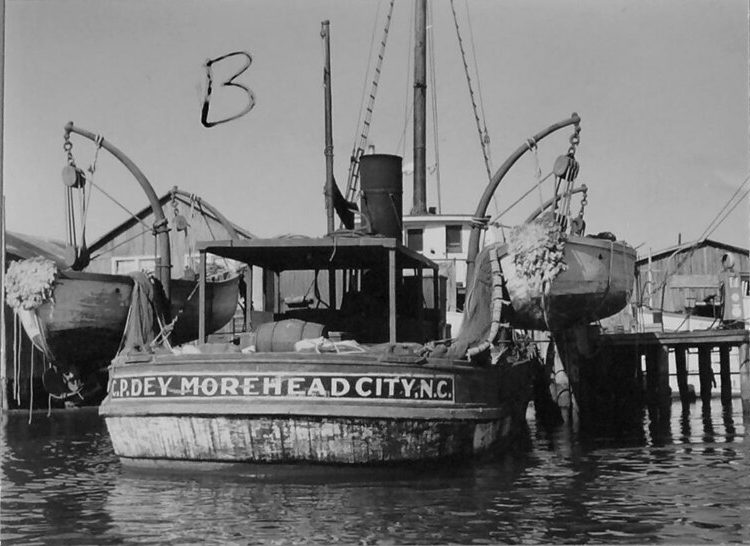
In this unfortunately rather blemished photograph, we see the menhaden fishing boat C. P. Dey at the docks in Morehead City, N.C., looking well-used but tidy, her purse boats in good view, November 1942.
Built by the Meadows Shipyard Co. in New Bern in 1930, the Dey was, at 105 ft., the largest boat in the fleet of Dey & Brothers, one of the oldest menhaden companies on the North Carolina coast.
She was named for the company’s founder, Charles Pittman Dey, who is often credited with establishing the first successful menhaden processing factory in the state of North Carolina.
A native of Newark, New Jersey, Dey came south and built the plant at Lennoxville Point, just east of Beaufort, in 1881. The next year, he began processing the menhaden into fish oil and fish scrap, the latter bound at first largely to the Navassa Guano Co.’s fertilizer plant on the Cape Fear River.
Other entrepreneurs in the menhaden industry soon followed. Within a few decades, menhaden were the basis of the state’s largest saltwater fishery.
As on nearly all menhaden boats, African American men made up the bulk of the Dey’s crew. In all likelihood, every fisherman on the Dey, except the captain and perhaps the engineer and pilot, was African American.
At the time of these photographs, African Americans had few rights on the North Carolina coast– or anywhere in the state. They could not vote. They could not serve on a town council or school board, and they were not permitted to serve in law enforcement or the judiciary.
In the towns where menhaden factories were located, nearly all aspects of daily life– schools, neighborhoods, trains and buses, waiting rooms, beaches, cemeteries, and all else– were segregated by race.
Neither could the African American fishermen who worked on the C.P. Dey come ashore and eat at any of Morehead City’s waterfront cafes, including a now-famous seafood restaurant called the Sanitary Fish Market that had opened just a few years before this photograph was taken.
The Sanitary’s original building, by the way, was owned by Charles Wallace, the menhaden factory owner I featured in my last post. One of the restaurant’s co-founders, Tony Seamon, once reflected back on that first building, saying it resembled “an oversized outhouse set out over the water.”
Yet African American fishermen–including African American captains– were the backbone of the local menhaden industry throughout the 20th century, and their labor was the source of other men’s fortunes.
On the Dey, they fished the local waters, but they also followed the fish as far north as New Jersey and as far south as the Gulf of Mexico.
A few years after this photograph was taken, on September 27, 1946, for instance, The Beaufort News reported that the Dey returned to Beaufort after a fishing trip to the Gulf of Mexico.
Working out of Cameron, Louisiana, Capt. Charles Styron and his crew had caught approximately 10,000,000 menhaden in only 24 days of fishing.
According to that issue of the News, they sold their catches that trip to a new menhaden factory in Cameron owned by the Gulf Fish Products Co. The factory had just been built, and it was said to be the first menhaden factory anywhere on the coast of Louisiana.
At that time, menhaden fishing on the Gulf of Mexico was in its infancy. (The Gulf is now the center of the nation’s menhaden fleet.) Not surprisingly, many of the Gulf fishery’s pioneers came from the East Coast, where the modern industry had existed since the early 1800s.
In the case of the Gulf Fish Products Co., its headquarters was back in Morehead City.
Cameron was a thousand miles from the North Carolina coast, but I would expect that many of the company’s captains, fishermen, and factory workers also came from Morehead City.
No doubt some of those men and women eventually stayed and made their homes in Louisiana or Mississippi.
However, many would go back and forth, generation after generation, working the menhaden season on the Gulf of Mexico, then returning to work out of Beaufort for the fall and into the winter.
For Carteret County’s menhaden fishermen, it was the beginning of a kind of life that would become almost second nature over the next half century– a life in which they had a foot in two worlds, one back home in Carteret County and the other on the distant waters of the Gulf of Mexico.
* * *
This is the 21st photograph in my photo-essay “Working Lives”– looking at how people made their livings on the North Carolina coast just before, during, and just after the Second World War. The photographs all come from the N.C. Department of Conservation and Development Collection at the State Archives in Raleigh.
Tomorrow– another photograph from the menhaden industry in Beaufort and Morehead City.


When living in Nags Head, 1970 thru 2005, I often watched menhaden boats from Virginia working offshore accompanied by zillions of gulls. Quite a sight. It’s a wonder there are any menhaden left on the planet. Very interesting piece.
LikeLike