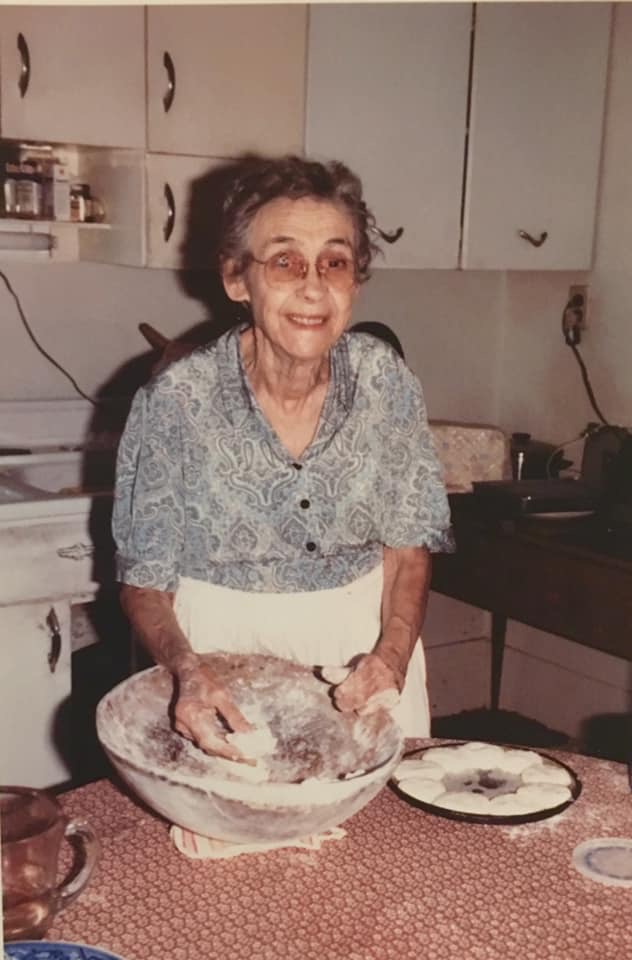
Beatrice Dickinson Mason making biscuits at her home in Harlowe, N.C. Courtesy, Pam Diffee
Many years ago, there used to be a little settlement called Oyster Creek down on the north side of the Newport River, not far from my family’s homeplace. My grandmother’s neighbor Beatrice Mason— we called her “Miss Beadie”—told me about it long ago.
I remember the day that she told me about Oyster Creek. We were sitting on her front porch swing. It was a Sunday afternoon. Miss Beadie was looking as radiant as ever. We were listening to the whippoorwills and talking about what things were like when she was young.
Miss Beadie was born in 1899. She was nearly 100 years old on the day that I am remembering.
I cannot recall what led me to do so, but that afternoon I had asked her what kind of woman her mother was.
Her mother, Challie Jane Dickinson, lived from 1859 to 1929. Miss Beadie was the youngest of her eight children.
When I asked about her mother, Miss Beadie grew unusually quiet. She was remembering things, I could tell, walking paths and seeing loved ones from another time.
For a moment, it felt as if time had frozen. We just sat there together, not saying anything, rocking slowly on the swing and listening to the whippoorwills calling back and forth.
Then Miss Beadie began to tell a story. The story was about her mother and a place called Oyster Creek.
I knew where Oyster Creek was: it is a secluded little bay three or four miles east of where we were sitting. It is a lovely spot, but nobody lives there, no roads lead there, and, from the water at least, I have never seen anything there except woods and salt marsh.
That day on her front porch, Miss Beadie told me that Oyster Creek had not always been that way. She said that there used to be a little settlement of people on that part of the river.
That was when she was a small child, she said. She told me that, in those days, people around there referred to the community as Oyster Creek, same as they do that little cove now.
Miss Beadie went on to say that, when she was young, an outbreak of some terrible disease had ravaged the families that lived in Oyster Creek.
I believe she said it was cholera, but I might be misremembering. Back then, I guess it could have been a lot of things.
Miss Beadie said that the cholera, or whatever it was, showed no mercy to the people of Oyster Creek. Few were spared, and so many fell ill that nobody was left to look after the sick and dying.
Miss Beadie told me that the community’s neighbors wanted to go and help, but they were afraid to go. Terrified, I guess, that what was happening in Oyster Creek would happen to them.
Her mother, she said, was the exception. Miss Beadie’s family lived a few miles to the north and east of Oyster Creek, close to where the bridge over the Intracoastal Waterway is now.
Despite the danger, her mother still went to Oyster Creek.
As she told me the story, I understood what Miss Beadie was doing: she was using the story to tell me what kind of woman her mother was.
At Oyster Creek, Miss Beadie told me, her mother nursed the sick and dying and consoled the grieving. She comforted the children. She washed and cooked and cleaned and did whatever had to be done.
There was nothing else to Miss Beadie’s story, or at least nothing else about her mother.
When she finished telling me the story, she just gave a little sigh, full of sadness, I took it, for the people at Oyster Creek, but I think also because the memory made her miss her mother.
And that was it. We sat there in the quiet for a while, then moved on to talk about other things.
Later that afternoon though, just before I had to go, I did ask Miss Beadie what had become of the people at Oyster Creek.
She told me that, by the time the cholera or whatever it was had passed, not much was left of Oyster Creek.
There were not enough people left to plow the fields, haul the fishing nets, or cook and clean and care for the children and the elderly.
Eventually, she said, the survivors drifted away, until nobody at all was left there.
Then time passed: first years, then decades, then generations. For a while, I am sure, people told stories about the people at Oyster Creek, but then the stories were gone too.
I understand that: it was hard for the memory of a little place like Oyster Creek to survive the 20th century.
So much changed. So many people were uprooted, moved, migrated. So many towns and villages disappeared, and there were so many wars, so much upheaval, so much, well, everything.
Even when Miss Beadie told me this story, I wondered if she was the last person alive who remembered Oyster Creek or knew anything at all about what became of the people there.
I thought it likely. After all, she was almost 100 years old then, and her memory, unlike some others, was untarnished by age.
Now, because she told me, I sometimes wonder if I am the only one left that remembers Oyster Creek ever existed.
I hope that is not the case. I hope that somebody else, somewhere, has held onto the memory of Oyster Creek, and hopefully knows more than the little bit that I know of the people who lived there
But just in case I am the last to know that there was once a community at Oyster Creek, I wanted to write this.
I do not think I have the words in me to explain why remembering Oyster Creek matters so much to me. It just does.
For me Miss Beadie’s story is still very much alive. I think about the people at Oyster Creek whenever I go anywhere close to that part of the river.
At those times, I imagine probably more than I should: their nets drying in the sun, mothers walking by the shore with their children, the cottages, spare but tidy, looking out across the river toward Crab Point.
On those occasions, I also think of Miss Beadie’s mother, and what kind of woman she was, and I think of Miss Beadie too, and what kind of woman she was. If I close my eyes, I can almost feel her sitting next to me on that old porch swing, the gentle rocking back and forth, the whippoorwills calling in the distance.


The Frank Harvey family was living on Oyster Creek in 1889 when their youngest son Thomas died. They moved to Harlow after this. Frank and Cornelia Jane Foreman had five children. Their great grandson invented and started selling the Crab Pot Christmas Trees in Carteret County.
LikeLike
that’s wonderful to know– thanks!
LikeLike
In fact I just noticed they lived next to Joseph and Shallie Dickerson on the census.
LikeLike
David – this is so beautiful. You are a wonder!JJulie Mooney919.698.7722Sent from my iPhone
LikeLike
You are too kind, Julie– but thank you. Means a special lot coming from you.
LikeLike
David, what a wonderful piece you have written! I have never heard it before and I feel it is such a gift… I miss Mimmie so, especially the older I get and the value of her stories becomes more and more apparent. I was lucky enough to be sitting in her porch swing many a languid summer day listening to her soft and slightly gravely voice relay tales of her past and the different ways of life “in her day”. She was very nostalgic about her childhood and family. She loved to talk to us grandchildren! She would sit in her old wooden chair with an enamel pan of field peas to shell and we’d chat all afternoon about anything and everything. Nothing in this world was better than getting to sleep with her in her old feather bed. My siblings and I used to fight for the spot… she would rub our backs and tell us more family stories until we fell asleep. I can honestly say that was the best sleep I ever had to this day, and the most content and loved. Thank you for writing this. She spoke of you often, so I know she thought a lot of you.- Pam
LikeLike
Oh so nice to hear from you Pam! And I’m so glad you liked the story! Best thing about writing it was the chance to remember your Mimmie! I used to love listening to her and my grandmother Vera talking on the phone when they were both a bit too old to walk across the fields and visit with one another much. They would talk about growing up in Core Creek and people they had known back then– and my grandmother would say that sometimes “it just felt good to talk to somebody who speaks the same language.” We were lucky to have them in our lives!
LikeLike
Yes, we were so blessed!
LikeLike
Thanks for documenting this, and for the memories of sitting on the swing with “Mimmie.”
LikeLike
Thanks Jeff! hope to see you 7/12!!!
LikeLike
Ms Beattie was the best. She loved to talk of the old days. I remember her telling me about the brick in her bed. I asked her what that was for she said well to keep my feet warm of course. A true southern belle.
I bet we have old deeds here for the property.
LikeLike
Such a beautiful and powerful story. Thank you for sharing it. You are such a gifted writer.
LikeLike
This was a beautiful story; of course it makes me think about the brave folks who stepped up when COVID was at its worst. What it means to know that a consistent part of the human soul is moved and driven to help others in the face of danger and suffering. Now I see a bit more into where Miss Beadie came from . . . and those divine sweet potato biscuits taste better than ever!
LikeLike
You, my dear, would have been right there by the side of Miss Beadie’s mom, I have no doubt about that. And Miss Beadie’s recipe in hand, you are my sweet potato biscuit queen!
LikeLike
David, i always enjoy your writing. Wonderful story! My son used to duck hunt in oyster creek and we have caught shrimp there in the mouth of the creek. right now i can see the creek from our home.
LikeLike
Many thanks! And lucky you to have a view of Oyster Creek! One of my friends on Hardesty Farm Rd. took me up to the creek’s headwaters the other day– beautiful place!
LikeLike