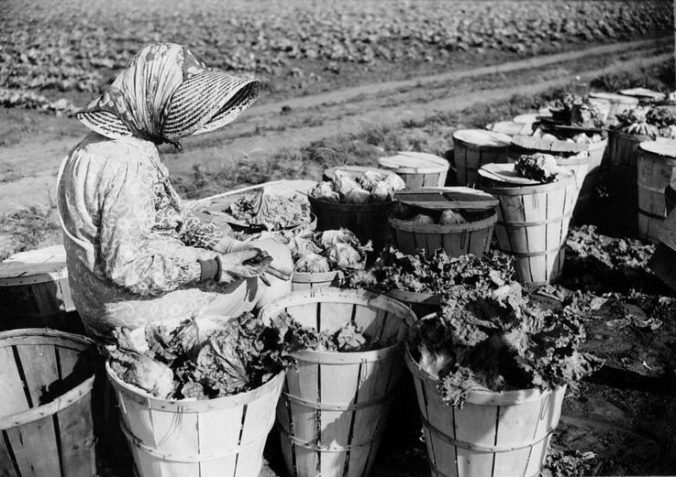
Photo courtesy, State Archives of North Carolina
This is the 14th photo-essay in my series “Working Lives: Photographs from Eastern North Carolina, 1937 to 1947.”
You can find my introduction to the series here.
This is a portrait of an unidentified woman sitting on the edge of a lettuce field in Castle Hayne, N.C., in the spring of 1943. As you can see, she is surrounded by baskets of freshly harvested lettuce.
They will be packed in ice later that day and shipped to the great produce markets of New York City, Philadelphia, and Baltimore.
Beginning in the late 19th century and continuing into the 1950s, Castle Hayne was among several farming communities near Wilmington that were especially well known for growing lettuce.
Frequently started in cold frames late in the winter, the lettuce crop was usually ready to harvest in the first weeks of spring.
Lettuce was a labor-intensive crop, and Castle Hayne’s farmers relied on large numbers of workers every spring to harvest it.
Early in the 20th century, Castle Hayne was something of a rural melting pot. Italian, Dutch, Polish, Austrian, Czech, and Ukrainian immigrants were all among the area’s first lettuce farmers.
They were among the farmers that had settled in a group of experimental farm colonies that were established in New Hanover, Pender, and Columbus counties beginning in 1905.
During World War II, when this photograph was taken, local African American families, German POWs, and hundreds, if not thousands, of migrant laborers harvested most of the region’s lettuce crop.
According to an article in the Wilmington Morning Star (12 March 1945), many of the black men and women who worked in the lettuce fields during the war came from Wilmington, 10 miles to the south.
Others, for reasons I do not know, came all the way from Rockingham, a town 100 miles to the west.
Some of those who came from Wilmington and Rockingham, and other workers recruited in South Florida, stayed in a government-run labor camp in Castle Hayne during the lettuce harvest.
Worried that the wartime shortage of farm labor would leave their crops to rot in the fields, local farmers had petitioned a federal agency called the Farm Security Administration (FSA) to build and operate a publicly-funded migrant labor camp in Castle Hayne early in the war.
In that spring of 1943, the FSA opened that camp– one of eight established in Eastern North Carolina during the war– primarily to provide laborers to local lettuce farmers at harvest time.
Originally inspired by the ideals of the New Deal, the FSA’s migrant camp program provided housing for thousands of itinerant farm workers that was very different than the typical migrant housing that local farmers provided.
The FSA housing was sound, the sanitation was up to public health standards, and parents did not have to worry about their children being hurt by hazards such as exposed nails and broken glass.
Many of the FSA camps also provided amenities unknown in the private sector, such as daycare and on-site medical care.
During the war years, Castle Hayne’s farmers found it especially challenging to recruit enough workers to harvest their crops.
Many of the men and women who usually picked lettuce had gone to war. Those who stayed home had unprecedented new work opportunities created by the country’s participation in the war.
Two sprawling military installations near Castle Hayne were among them. One was a massive new shipyard in Wilmington; the other was Camp Davis, a colossal army base 25 miles northeast of Castle Hayne.
Thousands of civilian workers were needed to build them, and thousands more to keep them running.
We can only imagine then the life story of the woman in this photograph.
She may have lived in the area all her life. If she was African American, her grandmother and grandfather may well have been forced to work on that same land when they were enslaved before the Civil War.
On the other hand, she may have been one of the seasonal field workers that had come to Castle Hayne from Wilmington or Rockingham.
In that case, she and maybe her children might have only come to Castle Hayne for the lettuce harvest. Then, after the harvest, she would have returned home, possibly to prepare for planting time on her family’s farm.
The woman in our photograph might also have been one of the Dutch, Ukrainian, or other immigrants who settled on local farms earlier in the century.
If that was this woman’s case, she might have been born on some distant shore, perhaps a village in Silesia or a town in Sicily.
She may also have been one of the migrant laborers that local farmers recruited in South Florida, usually just north of the Everglades. During the winter months, untold thousands of laborers came together in that part of South Florida to work on truck farms and in citrus groves.
Those men and women came to South Florida from a hundred places, as close as the Georgia piney woods, as far as Cuba, Puerto Rico, and the Bahamas. Then, early in the spring, when there was no more work in South Florida’s fields, some of them came to the lettuce fields of Castle Hayne.
The woman in our photograph might have been one of them.
I wish I knew more about her. But even more, I would like to know how she was treated here: was she– a fieldworker, maybe an immigrant, probably a stranger to Castle Hayne– treated with respect here?
Was she treated kindly or spurned? Was she helped if she was in trouble or in need, or did people turn their backs on her? Was she made to feel big or small here, and did she feel safe here or did she live in fear?
These are the kinds of things that tell us about ourselves, of course, not her.
They are the kinds of things too, as I see them, that reveal what kind of people we really were back then, and for me, they will one day tell future generations what kind of people we are today.
-End-


Very informative and timely article. Thank you for recognizing the humanity of the millions of unappreciated laborers.
LikeLike
I am intrigued by the stories you write, especially since I am from New Bern, NC. Maybe someone who is also a fan of your work will know something about this lady. I would like to know.
Keep up the good work. Too much of past history is in danger of being erased.
Thanks,
Darlene Badger
LikeLike
I enjoyed seeing that. It reminded me of my Mama, In my early childhood, very few women wore trousers, even for field work. They wore dresses and a sun bonnet of some kind. My grandmother did not think women should even do field work but when the first 5 children were 4 girls and one boy, Mama did not think a skinny little boy, smaller than most of his sisters , should have to plow all by himself, *Grand Daddy held down a day job black smithing for a lumber co. So Mama would slip around to the field & help her little brother with the plowing.
LikeLike
I love your Mama’s story about going out in the field with her little son…. Says a lot about her and the times! And yes, I remember my grandmother talking about how strange it was to see women wearing slacks when she got a job at the machine shop at the Cherry Point MCAS during World War II– it was her first job off the farm and not at all what she was used to back home! Thanks for writing!
LikeLike
David, hi,
A quick note of thanks for this, which i am only now reading. With misty eyes.
You are one of a very small number of historians who challenge us to confront our own selves, who we are, how we got here, how we will be judged–so thanks seems far too small a word.
I knew nothing about this part of life in that time and it was only around Y2K that I even knew we had a German POW camp in Whiteville.
I also first read your Charles Branford piece this week, with its war-time echo of our caste system then and, mostly, now.
Pretty darn sobering, both pieces. But essential.
Warmly,
Susan
LikeLike
Thank you so much, Susan. Your notes always mean the world to me– fells nice to be, well, recognized, as a person, not just as a historian– and you do that. So a special thank you. Happy Thanksgiving to you and yours!
LikeLike