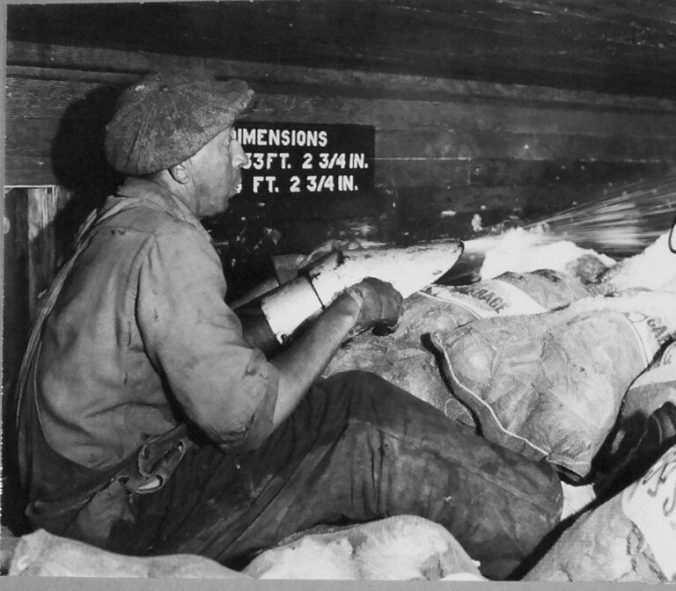
Beaufort, N.C., 1942. Photo courtesy, State Archives of North Carolina
This is the 16th photo-essay in my series “Working Lives: Photographs from Eastern North Carolina, 1937 to 1947.”
You can find my introduction to the series here.
In this photograph, we see a gentleman spraying ice on bags of cabbage in a refrigerated rail car at the train depot in Beaufort, N.C., sometime in the early spring of 1944.
With its long growing season and sandy loam soils, Carteret County had long been recognized for being good cabbage growing country.
At the time that this photograph was taken, local farmers were growing cabbage especially in Wildwood, Otway, Gloucester, Marshallberg, and Harlowe, as well as in the fields just outside Beaufort.
However, cabbage had not become an important cash crop in Carteret County until the advent of refrigerated rail cars– practical models of which were not available until the 1880s and ’90s– and the establishment of the Beaufort Ice Company, maker of manufactured ice, in 1910.
According to a local farm agent quoted in the Raleigh News & Observer (March 2, 1936), the first railroad shipment of cabbage from Carteret County occurred in the spring of 1917.
Even though it was a Depression year, only 13 years later, in 1930, the N&O reported that the county’s farmers had still shipped out 171 railroad carloads of cabbage that spring.
That was roughly equivalent to 37,200 crates of cabbage.
The work of harvesting cabbage was no picnic. Later in the century, much of the process would be automated, but when this photograph was taken, it was still a laborious job.
Gangs of workers moved up and down the rows, grasping one cabbage at a time and slicing off the stem close to the ground with a sharp knife, then quickly trimming any dead or wilted outer leaves.
That crew left piles of cabbage in their wake, and another crew followed behind them, each man or woman grabbing two cabbage heads at a time and putting them into wooden boxes.
That crew or a third crew would then load the boxes on a truck, which carried them to the railroad depot.
They worked in all weather, spent hours bent over, and, as they were being paid piece-rate, picked as fast as they could.
In the 1930s, a hefty part of the county’s cabbage was still shipped north by rail, but a growing percentage was being carried north by truck. In 1930, for instance, local agricultural agents estimated that truckers had carried 15 to 20,000 crates of cabbage out of the county, as much as half of the total.
That raised the total number of crates shipped out in 1930 to well over 50,000.
By the Second World War, when this photograph was taken, the county’s acreage in cabbage had doubled again.
Among the county’s cabbage growers at that time was my great-uncle George Ball, whom I wrote about earlier in this series. According to news reports, Great-Uncle George and his brother Raymond raised 20 acres of winter cabbage at their farm in Harlowe in 1944.
A number of my cousins in Harlowe also “hauled cabbage,” as they used to say, back in the 1940s and ’50s.
My mother’s first cousin Edsel Bell, for one, often told me how he would occasionally help out a local farmer by driving a few truckloads of cabbage to New York City.
Edsel remembered driving all night to reach the Washington Square Market in New York City at dawn. Located at the site of what was later the World Trade Center, the market was said to be the largest produce market in North America in the early 20th century.
-End-
 David Cecelski
As a young teenager, i spent some very cold days working in these cabbage fields. The rows were extremely long. It was back breaking work that required consistently bending the entire day using a sharp knife to cut heads of cabbage. The cabbage were thrown into carts pulled by a tractor. when the carts were full they were driven to a shaded area, dumped on the ground. From that location, the cabbages were packed into crates and ready to be loaded on trucks to be transported to various cities, and even states. I worked to help buy school supplies and purchase Christmas gifts for my family. This work helped to build a great work ethic for me and my siblings. We survived doing field work after our father passed away at a very young age, leaving 12 children. Eight of us were still in school or had not started school. We survived those days by working to help supplement our mother’s income. We were a proud family who never resorted to government assistance. Blessed with a Godly mother and 13.5 acres of land, we lived a simple but decent life in rural North Carolina.
LikeLike
I cannot thank you enough for sharing your family’s story– thank you so much. It’s one thing to see a picture– it’s another to hear the words of someone who lived it. You’ve made it real for me and all who might read this. Thank you again– and many blessings to you and your family
LikeLike