Today I want to share a little photo-essay about my recent trip to Corolla, out on the far northern end of the Outer Banks, and to several other towns and villages along that part of the North Carolina coast.
For me the trip had a bit of everything: historical discoveries, nature, a visit with a chef I adore, a special gift from an old friend in Currituck, and a kiss at the top of a lighthouse.
They were days of joy, especially because my wife Laura was with me, but also because we were getting to visit people and places that have been dear to us for as long as I can remember.
We went from Corolla to Duck, Pine Island to Nags Head Woods, the Scuppernong River to Plymouth and Tarboro.
This is a collection of photographs that I took along the way. Beneath every photograph, I have written little descriptions of what stands out to me in the people and places you see in them.
I think that you will be able to tell that these photographs show people and places that mean a lot to me.
I hope that they will mean something to you too, and maybe remind you, like the trip did me, of how important it is to get one’s feet back on the ground now and then in a place you know and love.
We began our trip on Currituck Banks, the sea on one side of us, the broad waters of Currituck Sound on the other.
* * *
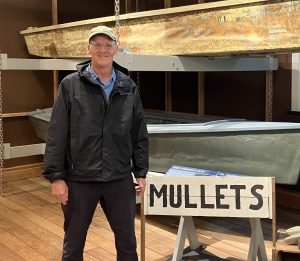
Our first stop was at the Currituck Maritime Museum, in Corolla, a wonderful new museum that highlights the maritime heritage of Currituck Sound. In this photograph, I am standing next to the museum’s mullet fishing exhibit. I grew up among mullet-loving people on a different part of the NC coast and it was nice to discover some serious affection for jumpin’ mullet (as we call them) along that part of the coast too. For much of the 19th century, the salt mullet fishery on the NC coast was the single largest saltwater fishery anywhere in the American South. On large parts of the coast, salt mullet were in every pantry, a keg of them was found in every little country store, and barrels full of salt mullet were shipped everywhere from the West Indies to New York City.
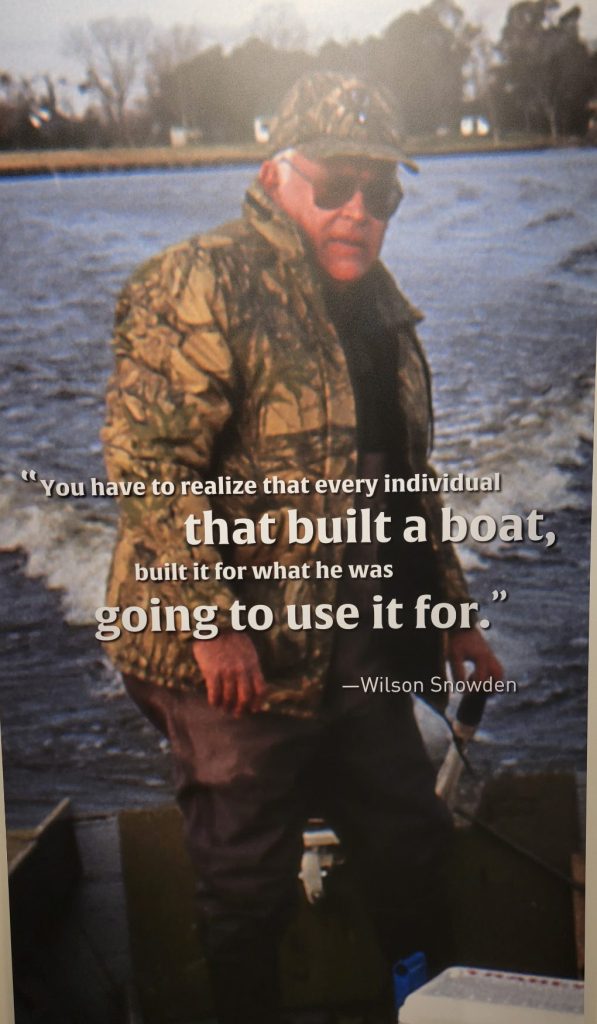
At the Currituck Maritime Museum, I discovered a poster of my old friend Wilson Snowden just the way I remember him: guiding his skiff into the open waters of Currituck Sound. Wilson passed away just a little more than 3 years ago, and I am one of many, many people who miss him. Few people know more about the maritime heritage of Currituck Sound than Wilson did. Seeing the poster brought back many a memory, including an unforgettable morning that he loaded my whole family into that skiff and took us out into the North River Marshes and Coinjock Bay. I still remember the wild, exuberant joy on my children’s faces that day, as well as the sight of Wilson, standing in the skiff’s stern, looking like he was right where he was meant to be.
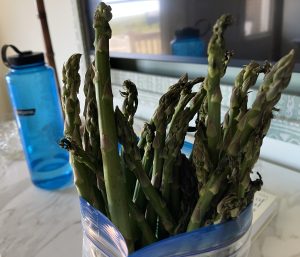
This time of year, asparagus grows so abundantly on the mainland side of Currituck Sound that you can tromp off into the ditches along the side of the road and pick it. This bouquet of asparagus was a gift from Barbara Snowden, Wilson’s wife, who remembered my affection for this springtime treat. Barbara resides in the village of Currituck, on the other side of the sound from Corolla and Duck. For many years, Barbara was a legendary history teacher at Currituck High School and she remains, for me, the first and last word on Currituck County’s history.
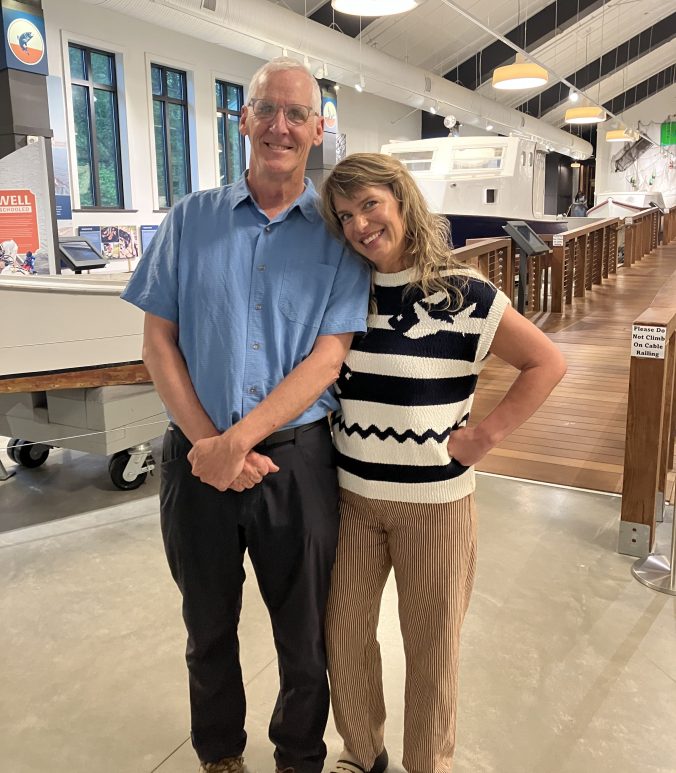
At the Currituck Maritime Museum, the acclaimed chef, restauranteur, and cookbook author Vivian Howard and I taped a segment for her wonderful new PBS show, Kitchen Curious. Our visit reminded me of the last time that Vivian and I did anything like that, which was for an episode of her show A Chef’s Life. For that episode, my daughter Vera joined us and we made pear preserves using a recipe I learned from one of my grandmother’s neighbors in Carteret County. I will never forget how much fun it was to cook and tell stories with the two of them- they are both an endless joy to be around. I won’t give away the subject of the segment we taped this time, but I believe it will be airing sometime in the fall.
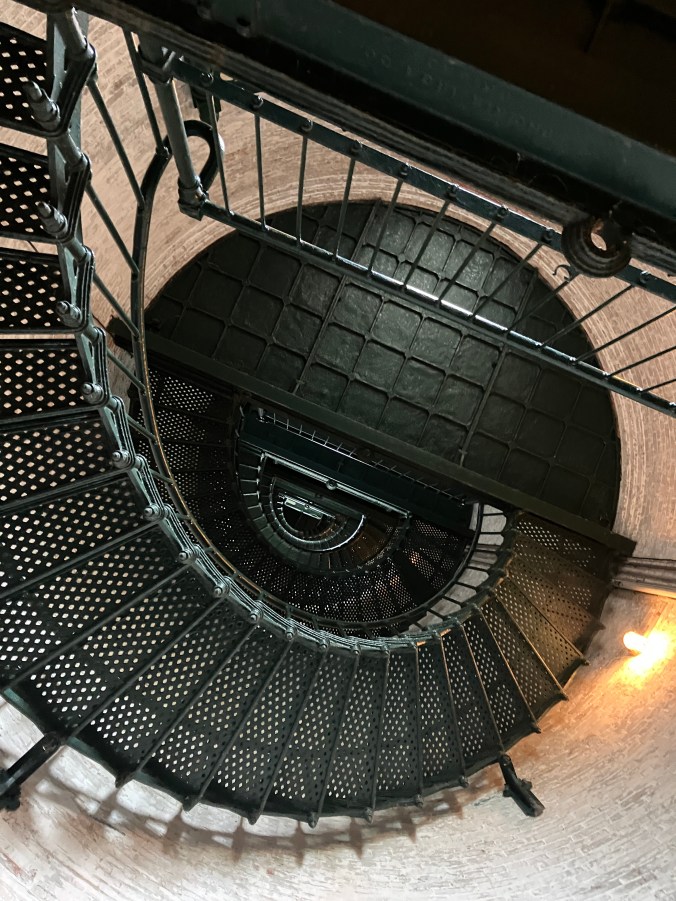
On the afternoon after our PBS shoot, I visited the Currituck Beach Lighthouse, which is right next to the Currituck Maritime Museum in Corolla. (Later that evening, I also finally got to meet the lighthouse’s keeper– the brilliant and amazing Meghan Agresto.) Rain was coming down pretty hard while I was at the lighthouse, but it was totally worth it: the historical artifacts on display were fascinating, the climb up the circular staircase was exhilarating, and the view across Currituck Sound and the Atlantic was spectacular.
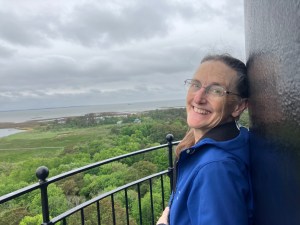
Best of all, at the top of the lighthouse, I discovered a mysterious and beguiling woman whose beauty took my breath away. (Just like it did 48 years ago, when I met her for the first time on the first day of freshman orientation at Duke.) Laura can’t often join me on my rambling days, but this time she was able to get away from her duties at the hospital for a bit.
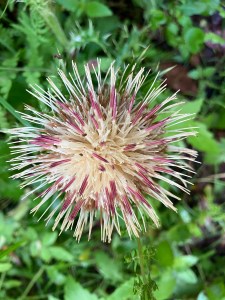
The next morning we headed to Plymouth, where I was due to give a lecture at the Roanoke River Lighthouse and Maritime Museum that evening. Along the way, we stopped at the Pine Island Audubon Center and Sanctuary in Corolla. While Laura was entranced by the song birds– that woman loves an indigo bunting– I took this photograph of a flowering wild thistle.
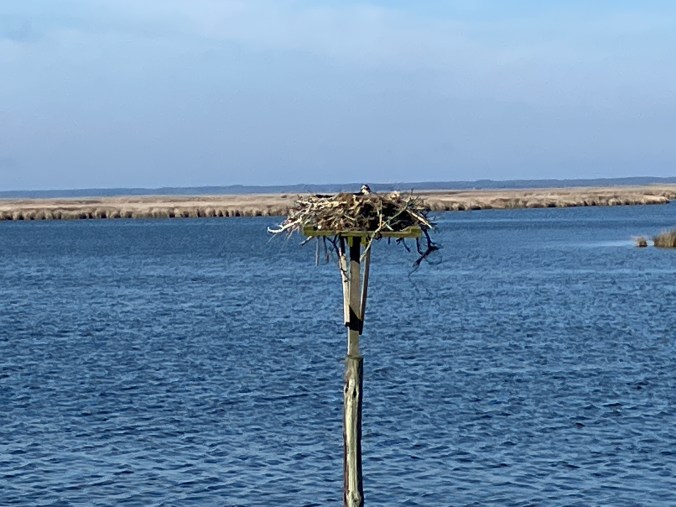
One of the Pine Island Audubon Sanctuary’s trails led down to a perch where we could look eye to eye with an osprey in its nest.
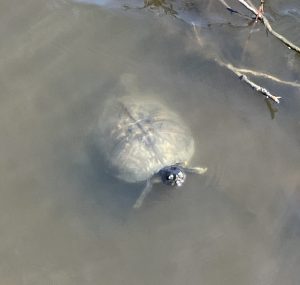
A little later further down the road, we stopped and took a walk at the Nags Head Woods Preserve in Kill Devil Hills. A project of the Nature Conservancy, the Preserve is one of the largest maritime forests in the United States. The path that Laura and I took began in a live oak grove on the sound side of Bodie Island, then led down to a freshwater pond and a tidal creek, which is where we found this handsome yellow-bellied slider looking up at us.
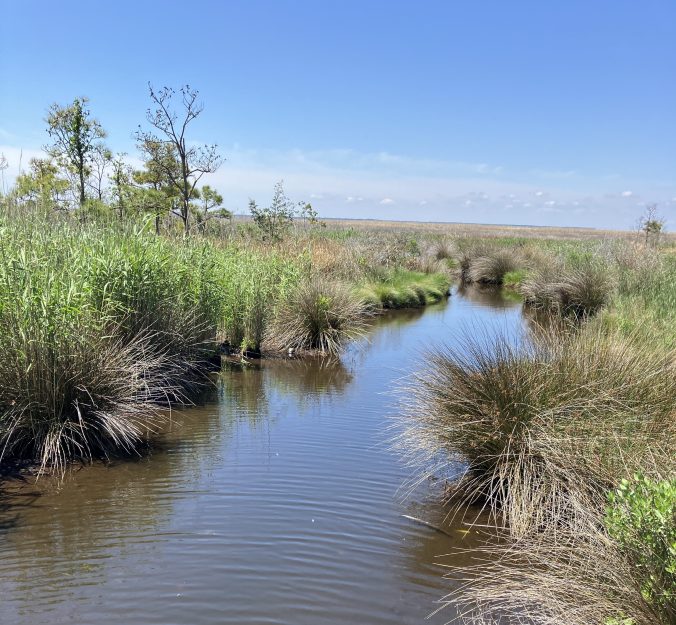
Our visit to Nags Head Woods reminded me of another day, quite a few years ago, when Outer Banker Miles Midgette took me there to see an old family cemetery where a crowd of his ancestors are buried. The cemetery was in the deepest shadows of the forest, at the site of a village of seagoing people that faded away in the early 20th century. Miles’ stories about those islanders made me feel like we could still hear their voices, so real did he make them seem.
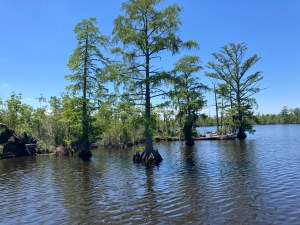
As we drove on toward Plymouth, we took a short break at the Pocosin Lakes National Wildlife Refuge Visitor Center in Columbia. The Visitor Center stands just opposite this cypress grove on the banks of the Scuppernong River.
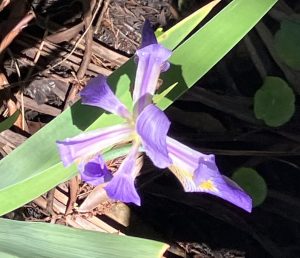
While we were there, we saw a host of these wild irises, a native species called southern blue flag (Iris Virginia), blooming along the Scuppernong.
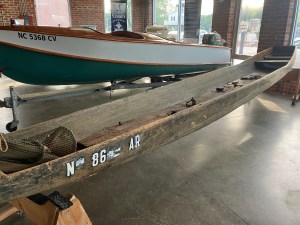
That night I gave my lecture at the Roanoke River Lighthouse and Maritime Museum in Plymouth. My topic was the history of the local herring fisheries. It was a nice evening, and I enjoyed talking with so many people who remembered the days when herring were still a staff of life on the Roanoke. The museum was full of interesting artifacts, but this hand-hewn dugout was the star attraction for me. It is a classic kind of wooden workboat that fishermen used on the Roanoke for many a generation: perfect, by the way, at least in capable hands, for drift-netting for herring.
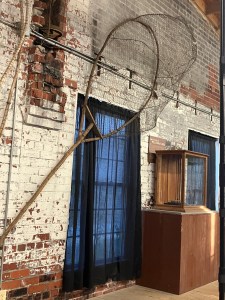
This is one of a pair of bow nets that is on display at the Roanoke River Lighthouse and Maritime Museum. Typically made out of green ash, bow nets were long one of the most common ways of catching herring on the Roanoke. If you ever have the chance to see a seasoned fisherman or woman handling one, don’t miss the chance: it is a thing of beauty.
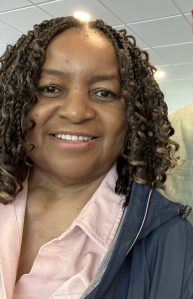
On the morning after my lecture, I was very excited to visit with Wanda Small Hymen (above) at a coffee shop in downtown Plymouth. A mutual friend had connected us after Wanda told him that she had inherited the minutes that her mother, Ms. Chester Small, had made when she was the secretary for the local branch of the Southern Christian Leadership Conference in the 1960s. To me they are a treasure– any firsthand account of the civil rights movement that swept through that part of Albemarle Sound in the 1950s and ’60s is precious. I was very grateful to Wanda for sharing the SCLC minutes with me– and I am hoping to write more about them sometime soon.
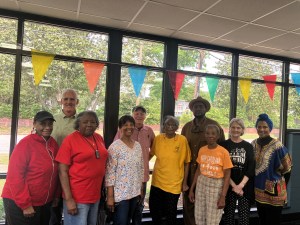
Our last stop was a visit with the Phoenix Historical Society at the Edgecombe County Public Library in Tarboro. For 25 years, the PHS has been honoring the voiceless and remembering the black men and women and the working people of all races who played such central, but usually unsung roles in Edgecombe County’s history. The group’s members had invited Laura and me to stop by on our way home and, as always, it was a great pleasure to see them and to hear about all the good work they are doing.
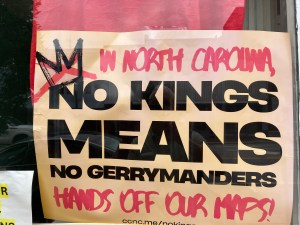
A sign of the times: I saw this poster in a shop window in downtown Tarboro. I think many people in Tarboro are finding that the recent gutting of the Voting Rights Act of 1965 by the U.S. Supreme Court and the state legislatures in the Old Confederacy has brought back haunting memories of Tarboro’s own history. In the last part of the 19th century, Tarboro was the epicenter of the “Black Second,” a majority-black congressional district where all black citizens had the right to vote taken away from them by the white supremacy movement that took power in North Carolina in 1900. Up to that time, the town had had black mayors, black aldermen, and many other black elected officials. George H. White, the only black congressman in the United States at that time, also lived in Tarboro. This line from White’s farewell speech to the U.S. House of Representatives on January 29, 1901 is the inspiration for the name of the Phoenix Historical Society: “This, Mr. Chairman, is perhaps the Negroes’ temporary farewell to the American Congress; but let me say, Phoenix-like he will rise up some day and come again. These parting words are in behalf of an outraged, heart-broken, bruised, and bleeding, but God-fearing people, faithful, industrious, loyal people—rising people, full of potential force.”
* * *
As Laura and I drove the rest of the way home, we had a lot to think about, and a lot to talk about.
We talked about the coastal roads that we had traveled, the people we had met, the wondrous things we saw, the stories that we had heard.
The good things we had seen, but also the hard times we had seen.
All the same, it felt good to be on those roads again. And it felt even better to remember our kiss at the top of the lighthouse.
-End-


David, Interesting trip Look forward to seeing you at HCHGS meeting in October
LikeLike