John Parker is the son of Guy Parker, the legendary barbecue pit master and restauranteur from Goldsboro, N.C.
John got in touch with me recently after reading my essay on the life of the Rev. Adam Scott, probably the most famous and influential barbecue pit master in Eastern North Carolina’s history.
The Rev. Scott began catering barbecues in Goldsboro in or about 1917. He opened his first restaurant in Goldsboro in the 1930s.
John’s father, Guy, learned the art and craft of barbecue from the Rev. Scott and was his pit master for 18 years before he and his family opened their own barbecue restaurant in Goldsboro in 1962.
I was excited to hear from John. Like the Rev. Scott, his father is an iconic figure in Eastern North Carolina’s barbecue history and I remember his family’s restaurant well from my younger days.
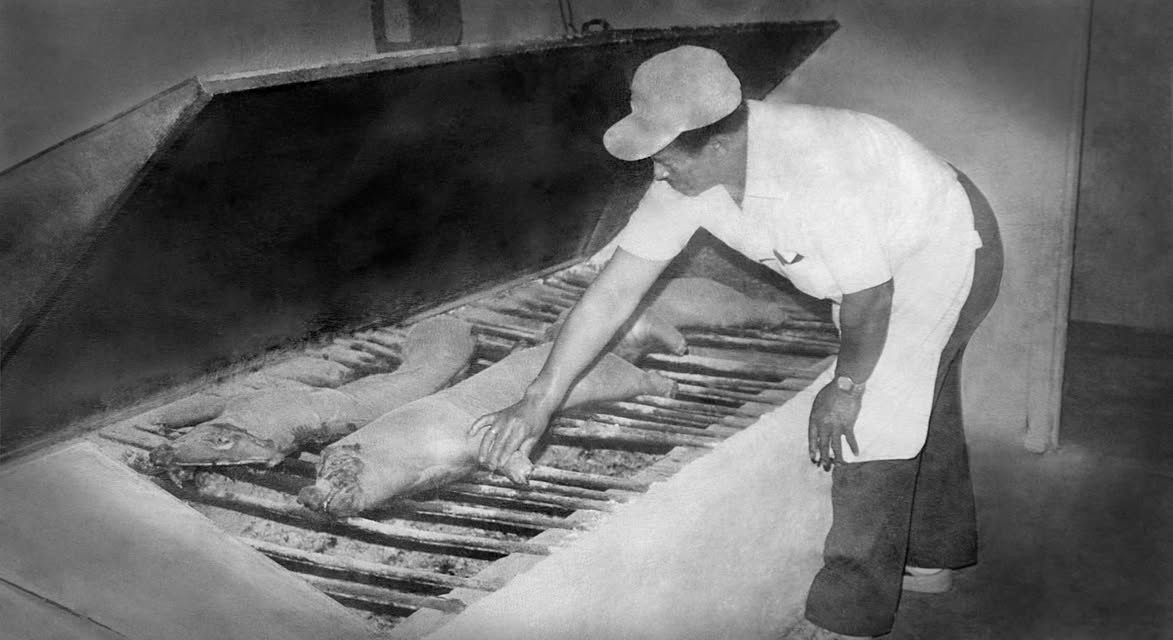
Guy Parker tending the pit at Guy Parker’s BBQ in Goldsboro, N.C., undated. Photo courtesy, John Parker
I remember how good the ‘cue was, and I remember how all kinds of people– overalls and suits, saints and sinners, the well heeled and the down and out– were welcomed there.
I think John got in touch with me mostly just to say that he appreciated my story on the Rev. Scott and was glad to see that that chapter in Goldsboro’s illustrious barbecue history was not forgotten.
But of course I was interested in John’s father and his restaurant too. So when John and I talked on the phone, we got to talking about his dad and his mom and the whole history of Guy Parker Barbecue.
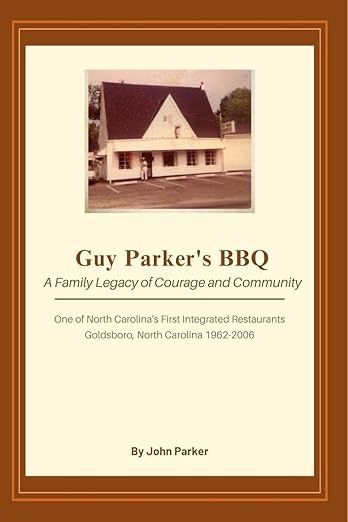
Just last year, John Parker published a very enjoyable memoir about his family and Guy Parker BBQ. You can order copies of Guy Parker’s BBQ: A Family Legacy of Courage and Community here.
-2-
John told me that his father was born in Beaufort, N.C., near where I grew up, on Christmas Day 1925. He came from a fishing family.
Guy Parker’s father– John’s grandfather– had worked in the sprawling menhaden fishing fleet that sailed out of Beaufort and Morehead City in those days.
Back then, the menhaden fishing industry was both towns’ life blood. Menhaden fishing boats lined the waterfront, and especially in Beaufort the smell of the menhaden factory workers rendering the fish into oil and fertilizer often blanketed the town.
Guy Parker’s mother– John’s grandmother– also grew up in Beaufort. Her name was Annie Geneva Parker.
When we chatted, John told me that his father left Beaufort for the first time during the Second World War. He was one of the first African Americans to serve in the United States Marines.
After finishing boot camp at Montford Point, he, like my father, served with the Marines in the Pacific Theater.
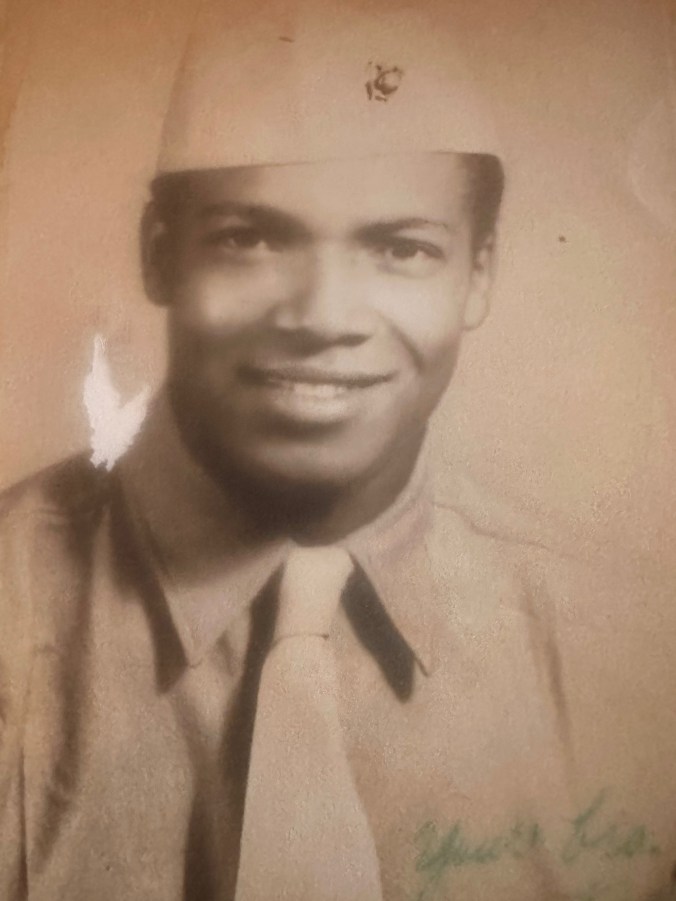
Guy Parker while serving in the U.S. Marine Corps during World War II. Photo courtesy, John Parker
(Just a few months ago, Guy Parker was posthumously awarded the Congressional Gold Medal, the highest civilian honor awarded by the U. S. Congress. He passed away in 2006, at the age of 80.)
To my surprise, John told me that his father’s introduction to the art of slow cooking whole hog barbecue was not in Goldsboro but was while he was a Marine serving in the Pacific.
He was in Hawaii at the time. John does not know if his father was briefly stationed there or whether he was just there for a little while on his way to the South Pacific or perhaps on his way home.
However he got there, Guy Parker one day observed native Hawaiians preparing a barbecue while he was there.
It must have made an impression on him. Years later, he told John that the Islanders cooked the pig outdoors in a hand-dug pit.
According to his father, they laid a bed of wet banana leaves down on the hot coals, placed the pig and maybe some vegetables on top of it, and then covered it all with sand.
They would let it cook long and slow, maybe even all night, he remembered.
That was not exactly how it was done back home in Eastern North Carolina, but the essentials were all there: whole hog, slow cooking, a hardwood fire, and a spirit of community.
For Guy Parker, at least as his son tells it, it was a revelation.
-2-
Sometime soon after the war, Guy Parker visited friends in Goldsboro. While he was there, he met the Rev. Adam Scott, who convinced him to stay and work for him.
Rev. Scott and his family’s main restaurant was in their home. They served the ‘cue in a dining room that was– for white customers– entered through their back door.
(Black and white people could not dine together in those days. Rev. Scott’s black customers had either to come in the front door and eat in the family’s personal dining room or had to go to a second cafe that the family operated at another location and which only served black customers.)
People made pilgrimages to the Rev. Scott’s from far and wide. Guests include governors, senators, and the state’s leading industrialists, and Rev. Scott catered events all over that part of the country.
In the early 1930s, Rev. Scott had even catered a barbecue for President Franklin D. Roosevelt in the White House’s Rose Garden.
I wonder if, by the time that Guy Parker moved to Goldsboro, the Rev. Scott was ready to spend less time in the heat and smoke. By then, he had already been cooking pigs and serving barbecue for more than 25 years.
-3-
Working in the cookhouse behind the Rev. Scott’s home, Guy Parker learned the art of making Eastern North Carolina-style barbecue and was the older man’s pit master for 18 years: rising long before first light to lay the hardwood, prepare the pig, and tend the fire.
It was hard, hot work, but he learned from the best and, as John Parker tells it, his father enjoyed working there.
He and the Rev. Scott became good friends, and Guy Parker met John’s mother Yvonne while he was working there. She was a waitress at the restaurant.
In his book Guy Parker’s BBQ: A Family Legacy of Courage and Community, John notes that his mom came from Dudley, south of Goldsboro. She began working for the Scotts soon after her high school graduation.
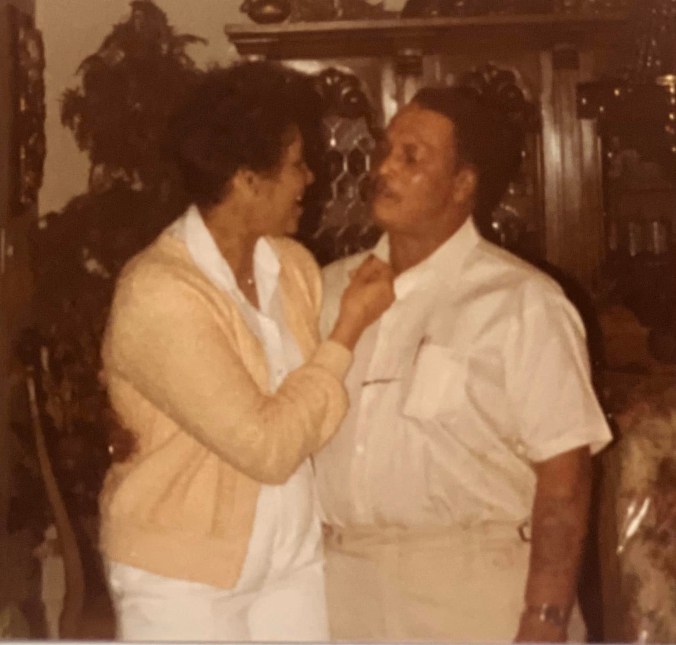
Yvonne and Guy Parker. Photo courtesy, Duke Cox (one of their grandsons)
They were married in 1950 and would have three children together.
Clifton was the oldest. A Vietnam veteran, he passed away in 2002. Annette, who came next, still lives in Goldsboro. And John, the youngest, now resides in Greensboro.
John remembers his father as a quiet, dignified man, generally not outspoken, but always ready to talk about hunting and fishing.
He was also very artistic– he painted and drew and loved music.
He also remembers him as a hardworking man. “He had the best work ethic of any man I have ever known,” John told me.
When Guy Parker left Scott’s and opened his own restaurant on August 12, 1962, he worked night and day.
John told me that, in the early years, his father worked six days a week. He would rise at 4 AM and go till midnight, get a few hours sleep, wake up and do it again the next day, day after day.
In the restaurant’s early years, his father only took off Thanksgiving and Christmas.
When John was growing up, his father and the family also began to close the restaurant for two weeks in the summertime.
During the first week, John told me, they would do a deep clean at the restaurant, paint, and make repairs. In the second week, they would sometimes take a trip.
In many respects, Guy Parker built on the Scott family’s tradition of cooking and serving barbecue.
But times were changing and John’s father did one thing that neither Adam Scott or any other restaurant owner in town had ever felt that they could do: he welcomed black and white people to sit down and eat together.
And the world– at least the world in Goldsboro– decided that it was ready to do that, at least for the sake of barbecue that good.
“I know my dad and mom weren’t Martin Luther King, Jr. and Rosa Parks, but black history means everybody,” he told me.
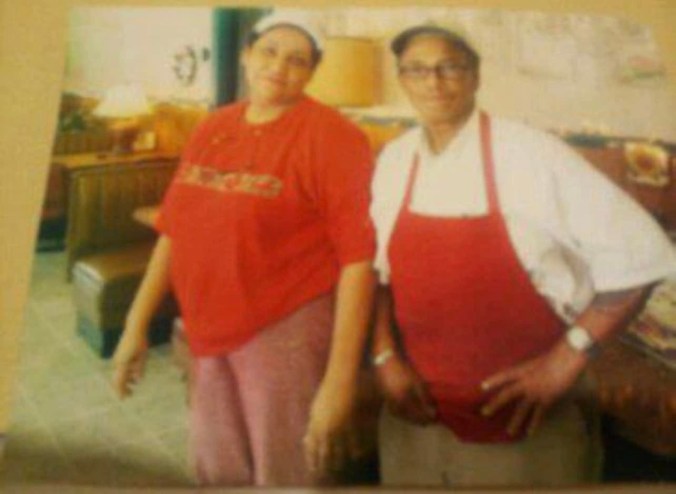
John’s mother and father at Guy Parker’s BBQ, undated. Photo courtesy, Duke Cox
To quote John’s book: “Guy Parker’s BBQ had only one bathroom for men and one for women. Both races used the same restrooms. Everyone sat in the same general dining area, at different tables or together, as they chose. There were no separate sections, no back door service, no signs designating where people could or couldn’t sit based on the color of their skin.”
It might seem like a small thing today, but in a little southern town like Goldsboro in 1962, it was a whole new world.
-4-
Guy Parker Barbecue was open for 44 years. John remembers the restaurant like it was yesterday.
He told me that the restaurant seated maybe 50 or 60 customers.
“You have the mechanic, the lawyer, the doctor, the sanitation workers– everybody came to Guy Parker’s,” John recalled.
He remembers the restaurant having a piccolo– jukebox– and a cigarette machine, both signs of the times.
The cookhouse was out back. It was built out of cinderblocks and had two pits and a walk-in cooler.
Sometimes his father’s older friends would sit outside and visit with his dad while the pigs cooked.
John said that his father started cooking the pigs at 4 AM six days a week. He cooked whole hogs over hardwood, took his time, and preferred smaller pigs, never more than 60 or 70 pounds.
He let the pig and the fire speak for themselves. He did not baste the pig while it was cooking. At Guy Parker’s, you added the family’s secret version of the region’s classic vinegar and red pepper sauce at the table if you so desired.
The whole family helped out. His father was always the pit master, but everybody had a job.
In Guy Parker’s BBQ: A Family Legacy of Courage and Community, John wrote, “My mother was my father’s rock.”
At the time, Yvonne Parker had a good state job. But her husband told her, “Bill”– that’s what he called her– “I believe I can make it if you come with me.”
She did so, and she remained with Guy Parker BBQ from the beginning to the end.
For his part, John eventually moved away from Goldsboro to go to school and start his own career, but when he came home, he would still sometimes cook a pig or two for his dad.
That was when his father was up in his 70s and had begun to appreciate a little help around the fire.
The restaurant closed when his father passed away in 2006, at the age of 80.
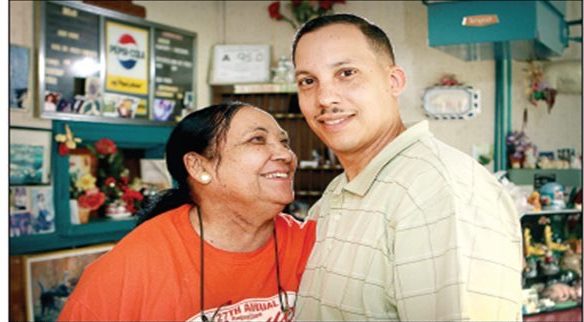
John’s mother Yvonne Parker smiles up at him back in 2012. By that time, John had moved away from Goldsboro but he was still in charge of marketing the family’s barbecue sauce across the country. Photo courtesy, 27 May 2012.
-5-
Guy Parker Barbecue has been gone for 20 years now, but it is still fondly remembered and has become a lasting part of the storied history of barbecue in Eastern North Carolina.
As for me, I have to confess that I am rather old fashioned when it comes to my barbecue. I still like it whole hog and slow cooked over hickory or oak coals, like Guy Parker did it and like the Rev. Adam Scott did it before him.
For that reason alone, I am a bit sentimental about John’s family and the way that they went about their business.
But what really gets me from what John Parker told me, and what I saw when I was young and visited his father and mother’s restaurant, is the way that they created a place that brought people from all walks of life together.
They served us some really great ‘cue, made us feel like brothers and sisters, and reminded us just how sweet life can be.
What could be better than that?
-End-


I’m drooling. I never got to taste Parker’s Q but this did bring back memories of a treasured establishment called Simp’s on highway 64 between Nags Head and Greenville that served the best Q I have ever tasted. They also kept a cooler of the little 8 oz. bottles of Coke that were the perfect accompaniment. Alas Simp’s went out of business back when 64 was modernized into a divided four-lane interstate and by-passed the restaurant. I still think about it fondly. Great column. Thanks. Jack
LikeLike
Oh I had forgotten about Simp’s! That was a great place! Loved the vibe, loved the ‘cue!
LikeLike
Dear Mr. Cecelski,
Thanks. I always love a good Barbecue story. My mother’s family was from Lexington so I grew up with Barbecue. Almost every vacation, Thanksgiving and Christmas visit included eating some barbecue. My memory is that my uncle Bus Hunt grew up on a local farm and always at Thanksgiving his brother Arvil who still lived on the farm held a Hunt family reunion, slaughtered a hog and cooked it all da, over a dirt pit with the hog resting on a piece of wire mesh, usually with the help of a black tenant farmer, my uncle and I being white, and the pig shared with both families. A select group of the men would arrive in the morning long before the dinner to go rabbit hunting always with a pack of 5 or 6 beagles and the dinner would be in the afternoon with all of the families, women and children.
It was of great interest to read your mention of cooking over hickory. My memory and childhood perception is that all the BBQ restaurants in the 50s and 60s proudly advertised that they cooked over hickory and that hickory cooked BBQ flavor was much of what distinguished barbecue in our state. Now you never hear of that and at age 83 I have no one left to ask of that and wonder if my memories are correct. Yet it is such a distinctive flavor. As distinct as the mesquite used in Texas. Did we cut all the hickory forests? Or did it just become too expensive to use? Did they use it in the eastern part of the state as well? I think they did. I would love to know. I do miss it.
I wonder if you have any memories of hickory cooked barbecue and of it being one of the defining features of our Cue.
I still have the recipes for the Lexington barbecue dip and their red barbecue slaw that I got from my aunt and love as much as I love the barbecue.
Thanks from an old Durham Coot, Coke Ariail
>
LikeLike
Dear Durham Coot (a.k.a. Coke), I loved hearing from you and hearing your barbecue memories! And yes indeed, I have heard many a pit master talking about the virtues of hickory wood for cooking good ‘cue– and when my buddy and I cooked a pig for his son’s wedding, you bet we used hickory! That said, I’ve also heard old timers talking about using other hardwoods. Rev. Adam Scott always said he liked using oak– preferably what he called black oak. And not often, but every now and then, I’ve run across some mighty fine ‘cue cooks that liked to mix it up with persimmon wood and things like that. I’m willing to try them all for the sake of scientific inquiry! Thanks again for writing! David
LikeLike
Another great story. I love it! Darlene Badger If you fail to plan, then you plan to fail.
LikeLike
I really enjoyed this story. I had never heard of Guy Parker BBQ. So thank you for sharing it. Nothing any better than Eastern NC BBQ.Sent from my iPhone
LikeLike
You’re talking this Bertie County girl’s language here. Actually, all your posts do this !
LikeLike