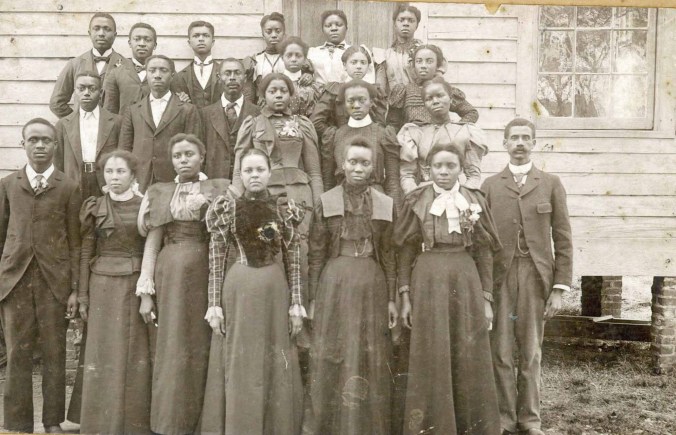
Principal Peter W. Moore (far right) and students of the Elizabeth City State Colored Normal School (later Elizabeth City State University) ca. 1894. In the beginning, the school held classes in rented space at the Roanoke Institute, a private school sponsored by a black conference of Missionary Baptists. (Even earlier, a pioneering African American educator, Rooks Turner, had run a common school there.) Later, the State Colored Normal School moved to another temporary locale on what is now Herrington Road in Elizabeth City, then moved to its current home in 1912.
A few nights ago, I gave a lecture at the Walter N. & Henrietta B. Ridley Student Center at Elizabeth City State University.
For me it was a joyful evening, and I hope it was for all those who attended.
I so enjoyed getting to know so many remarkable students, and it did my heart good to observe the strong and loving bond between the students and the university’s faculty and staff.
I was on campus most of the day. From start to finish, as I visited with the faculty, and saw how they interacted with the students, I kept telling myself, “These are the kind of professors that I wish every college student could have.”
I also had the great pleasure of meeting Dr. S. Keith Hargrove, Sr., the university’s new chancellor. Chancellor Hargrove’s Installation would occur a few days after my visit, but I could already feel the excitement in the air.
I did not have a great deal of free time, but while I was on campus I could not resist taking a little time to explore the University Archives.
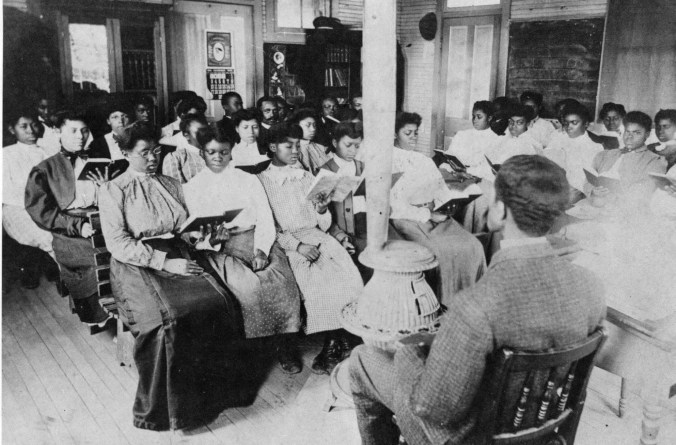
Dr. Moore and students at a class in one of the early temporary locations for the State Normal School, ca. 1894-1911. Born near Faison, N.C., in 1859, Moore had worked his way through Shaw University by tenant farming and working in a brickyard and foundry. After graduating from Shaw, he taught school in Bertie County, then served as assistant principal of the State Normal School in Plymouth, N.C., and was then named principal and first president of what is now Elizabeth City State University. Photo courtesy, University Archives, Elizabeth City State University
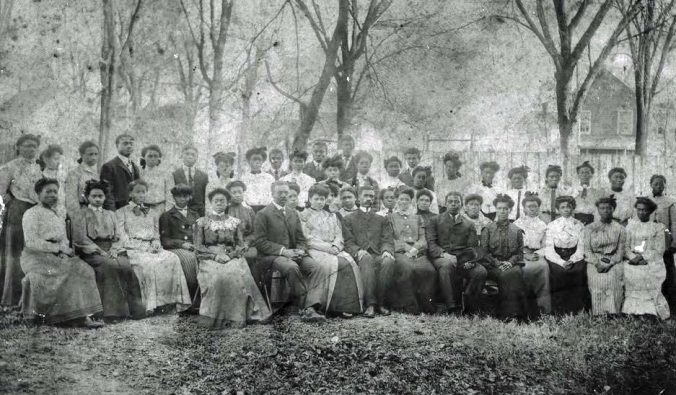
Students and faculty arrayed around Principal Peter W. Moore, apparently on Commencement Day. Before the permanent campus opened in 1912, local churches hosted the State Normal School’s commencement ceremonies. Courtesy, University Archives, Elizabeth City State University
I had never visited the University Archives and its extraordinary collection of historical manuscripts, photographs, and artifacts before.
But Paige Hendrickson, the university archivist, gave me a wonderful backstage tour of the archives’ holdings.
Seen through her eyes, the University Archives is a place of a thousand stories.
Located on the second floor of the G. R. Little Library, the collection reaches all the way back to the university’s founding in 1891.
Originally called the Elizabeth City State Colored Normal School, ECSU began its illustrious history as a training school for African American teachers.
I found the historical treasures in the University Archives to be incredibly diverse and fascinating. They speak to every part of the university’s past, and they are also a unique window into the history of Elizabeth City and that whole northeastern part of North Carolina.
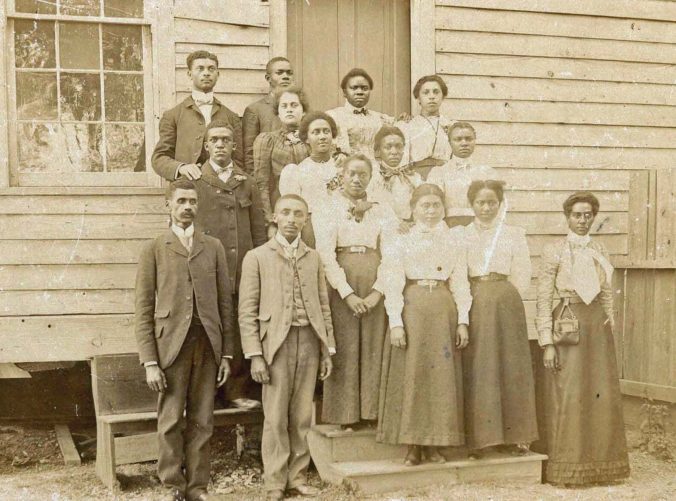
Principal Peter W. Moore (front row, far left) and the second year class at the State Normal School, Elizabeth City, N.C., 1900. The legislation for establishing the school was introduced by an African American member of the state’s House of Representatives, Hugh Cale, on March 3, 1891. House Bill 383 called for the creation of a normal school for “teaching and training teachers of the colored race to teach in the common schools of North Carolina.” Photo courtesy, University Archives, Elizabeth City State University
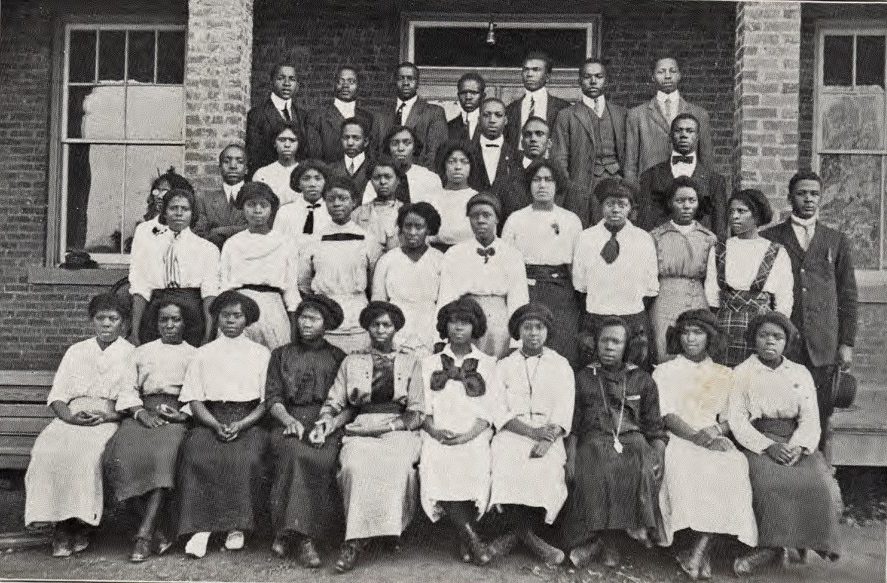
The State Normal School’s graduating class of 1914 posing in front of the school’s administration building. Courtesy, University Archives, Elizabeth City State University
I have been thinking about some of the old photographs that are preserved at the University Archives’ holdings ever since that visit.
These and other photographs from ECSU’s University Archives can be found here at DigitalNC.
The photographs date to the period between 1892 and 1914 and feature some of the university’s first students and faculty.
I think that I was so moved by them because, over the years, I have repeatedly encountered historical accounts that refer to the school’s graduates teaching in the small towns and villages of Eastern North Carolina.
They were in the truest sense missionaries of knowledge. Many were destined to teach in the region’s towns and cities, but far more were bound for remote rural communities where books were rare and precious things.
I have seen historical accounts of the school’s graduates teaching in logging camps and lumber mill towns deep in the swamps.
I have seen historical accounts of them teaching the children of field workers in one and two-room schools surrounded by miles of cotton fields and where it was considered an act of defiance to send your children to school instead of into the fields to work.
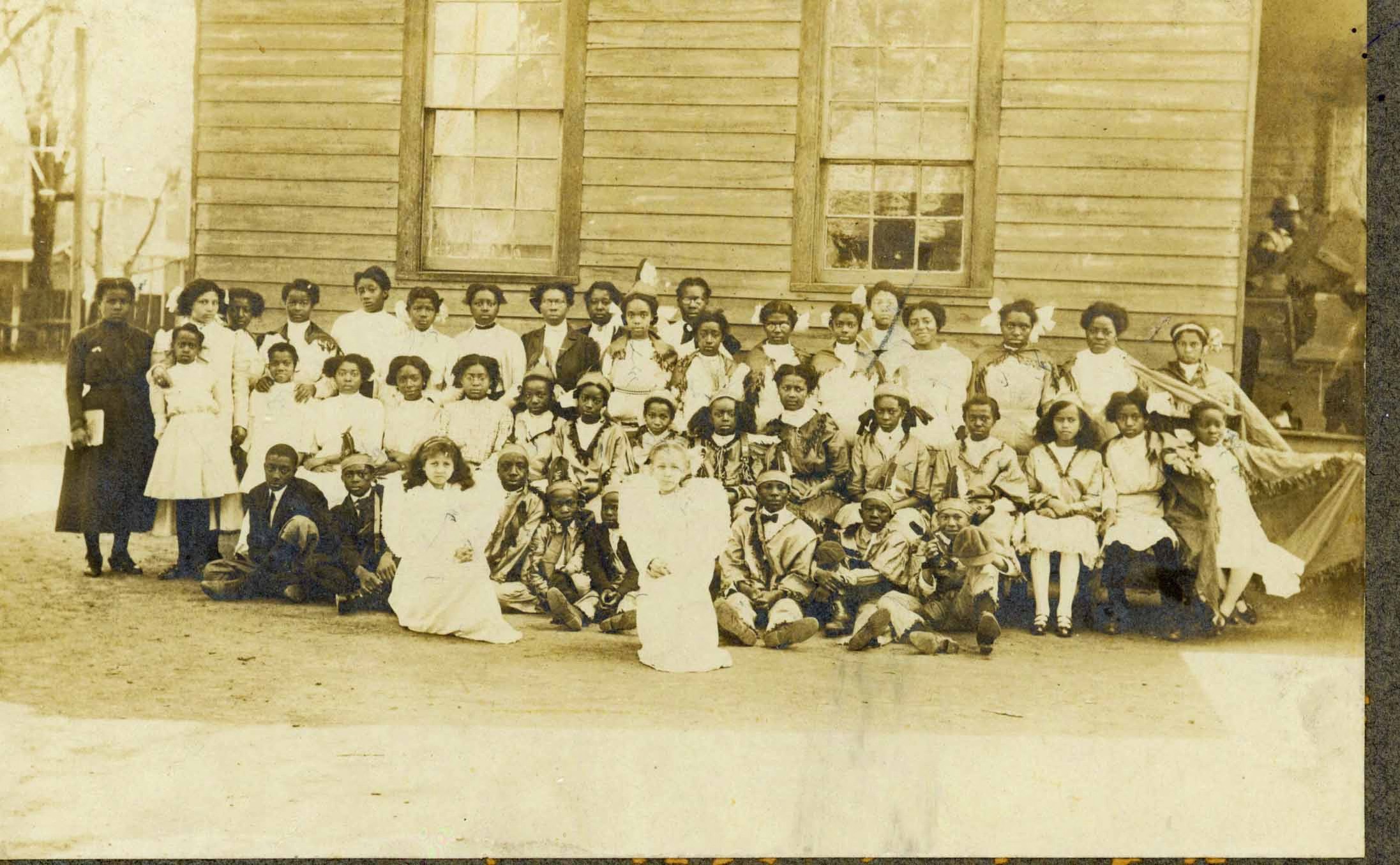
Teachers and children (some in costume) after a Christmas pageant on the grounds of one of the temporary school campuses, sometime prior to the school moving to its current location in 1912. Courtesy, University Archives, Elizabeth City State University
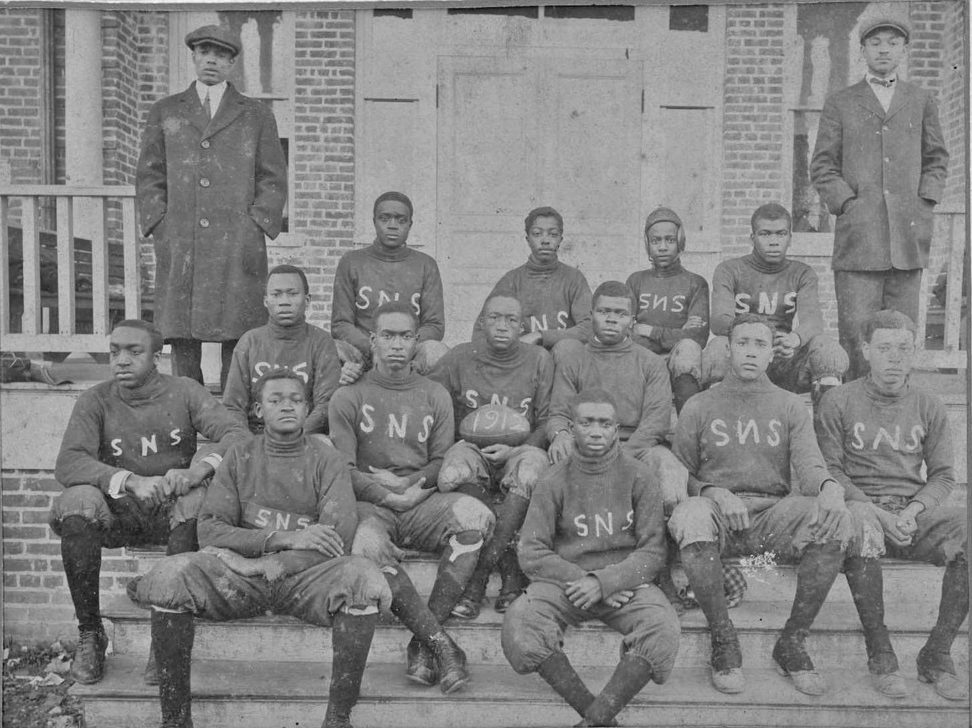
The State Normal School football team, ca. 1912-14. The school fielded its first baseball team in 1909, its first football team in 1912. Photo courtesy, University Archives, Elizabeth City State University
Similarly, I have seen historical accounts of Elizabeth City’s graduates teaching on remote, windswept islands and on the edge of tidewater rice fields.
In those early days, wherever they were, the school’s alumni were paid far less, given far fewer books and equipment, and were required to teach far more students in far worse buildings than their white counterparts.
Yet again and again, I have seen in historical records, they found a way. Not just to make do, but to enlighten, lift up, and inspire their students and often the local community as well.
In such places, the teachers who came out of the State Normal School, as ECSU was called then, often boarded with local families and were, in the truest sense, never really off work.
As symbols of knowledge and learning, they were caretakers of body, mind, and spirit. In community after community, children and adults alike looked to them for guidance and tutelage– and as role models.
In these old photographs, those early teacher trainees look so incredibly young and innocent, barely out of school themselves.
Yet when I look at them, I see all those places they went and taught, and the good they did, and all the children whose lives they changed for the better, and all the possibilities they opened up for those young people.
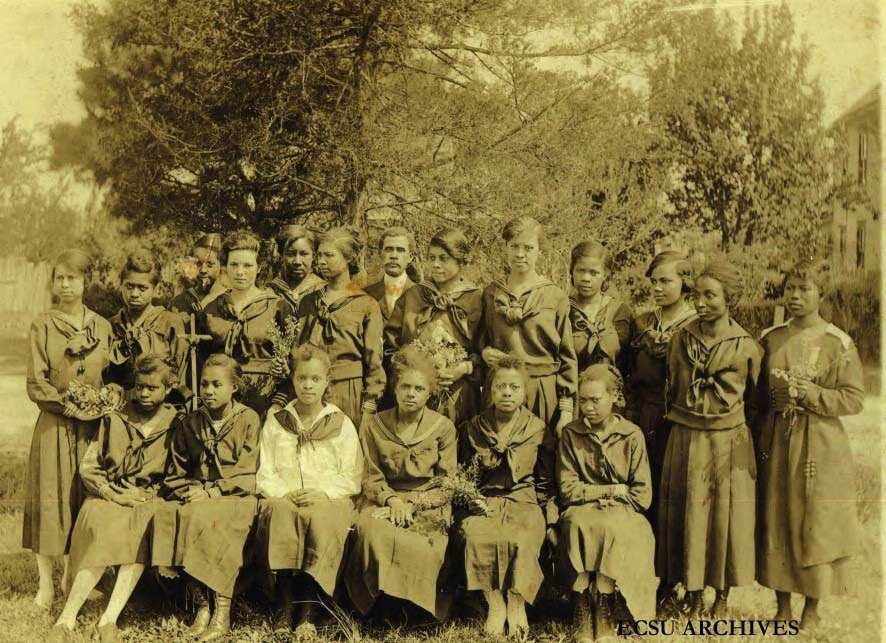
This is Principal Peter W. Moore and a group of teachers from Bertie County, N.C., at the State Normal School for a summer school session in 1916. African American teachers often studied at the school during their summer breaks to gain full teacher certification. Photo courtesy, University Archives, Elizabeth City State University
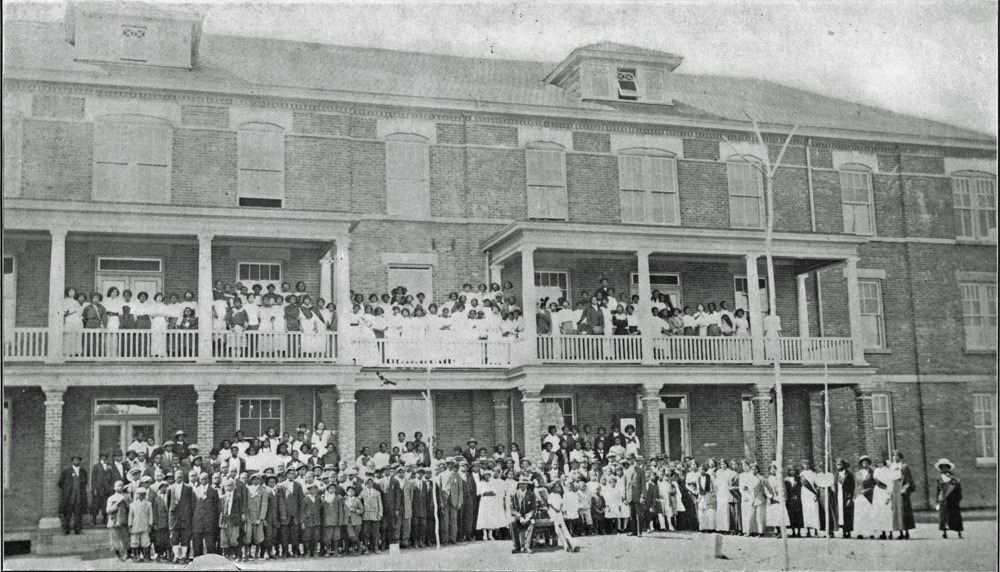
The growth of the school is evident in this photograph. Students and faculty are gathered in front of the State Normal School’s new administration building probably in 1912. Photo courtesy, University Archives, Elizabeth City State University
I think too of all the good that their students then did when they grew up, and the families they raised, and the thousand little ways that, over the course of their lives, what they learned from their teachers guided them.
I think about the dangers they survived, or that I pray they survived, and I think how often I have heard their former students, even when they were up in their 80s and 90s, remember those teachers with gratitude, reverence, and love.
In these photographs, the young people are often standing side by side with the school’s founding president, Peter Weddick Moore, a devoted educator who was the son of a couple born into slavery and whose father is believed to have been murdered by the Ku Klux Klan.
Whatever else I did at Elizabeth City State University– visiting the history program, touring the Rosenwald school, giving my lecture– I tried to keep the memory of these photographs with me.
* * *


Thank you, David, for these auspicious images and for all you do.
LikeLike
Thank you Alicia– it’s great to know you’re reading! I appreciate you taking the time to write!
LikeLike
I absolutely love and look forward to your stories.Thank you David!Darlene Badger If you fail to plan, then you plan to fail.
LikeLike
Thank you so much, Darlene. That means the world to me!
LikeLike
Thank you again for coming back to Elizabeth City. I would have loved to have had more time than just Tuesday night–but class comes first. Your talk was well attended.
digitalnc has a wonderful collection of ECSU photographs from years past. Sadly, we don’t take photographs the way we used to, so I am afraid that a century from now, there will be only slim pickings from our own time.
Here is the digitalnc link:
( (contributinginstitution:[Elizabeth City State University])) – Search Results – DigitalNC
LikeLike
It was great to see you even briefly, Glen. The visit was wonderful– felt good to be back!
LikeLike
Hi David,
I’ve been enjoying your blog posts for quite some time and wanted to reach out to say how much I appreciate your work. I grew up in Montgomery County and now live in Greensboro. My family has a long history with the North Carolina coast—my dad bought a small cottage in Emerald Isle in the 1970s that we still own and enjoy—so your writing often feels personally connected. I recently retired and have been spending more time reading and researching history, especially around race and the community where I grew up. As best I can tell, the year I started school (1965), was the first year of integration, though I was completely unaware of that at the time. It’s only been in later years that I’ve begun to reflect on and better understand some of those experiences. The work of historians like you has been incredibly helpful in that process, and I’m grateful for it. I did want to ask if you’ve ever come across Peabody Academy in Troy. It’s only in the past few years that I’ve become aware of its role in the community. I’ve also learned about its connection to Wake Forest, where I completed my undergraduate degree, through Lockey Simmons—a tannery owner in Troy who used enslaved labor, helped found Wake Forest, and later contributed to the Freedmen’s School movement after the Civil War. I’d be very interested in any perspective you might have on that history.
Thank you again for your writing and the care you bring to your work.
Best regards, Buck
LikeLiked by 1 person
Dear Buck,
It is a delight to hear from you. Thank you for your kind and supportive words about my work. It sounds like we are on similar journeys and it’s always good to have company! I wish that I knew more about Troy and Peabody Academy– it sounds like you’re onto something there. I have occasionally written about other parts of North Carolina, but I am afraid that I am largely a “world in a grain of sand” kind of historian, and my “grain of sand” is Eastern NC and especially the NC coast where I grew up. I relate very much to your experience of growing older and coming to see and understand the place I come from, and the experiences I had when I was young, in a new light. What I have tried to do in my work is embrace it all, the best and the worst and all the in between– and go deeper, the way we would with the ones we love most. From your words, I suspect you will relate to that. Thank you again for writing– it does mean a lot to me. And good luck on your journey, wherever it may take you. David
LikeLiked by 1 person