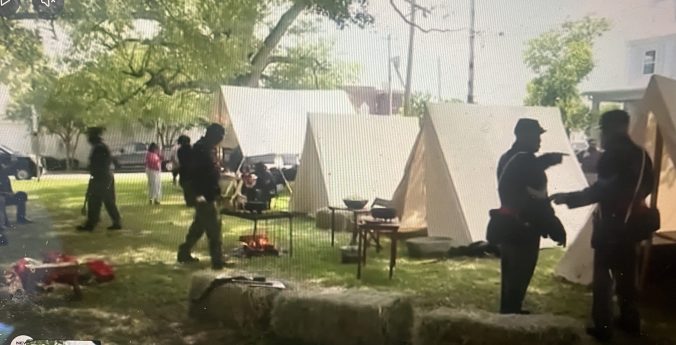
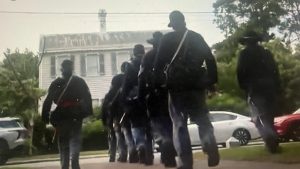
The 35th USCT Reenactor Group’s camp at the Black Troops Commemorative Ceremony in New Bern, N.C. Courtesy, WCTI-TV (Greenville, N.C.).
This is the keynote address that I gave a few days ago at the United States Colored Troops Commemorative Anniversary that was held on the grounds of the New Bern Academy Museum in New Bern, N.C.
Thank you for the invitation to say a few words here today. I am so pleased and so deeply honored to be with you.
I grew up just a little east of here, and I have been coming to New Bern all my life. It is good to be back home, and it is always a great pleasure to be among so many people who are dedicated to preserving, remembering and telling the stories of all of New Bern’s citizens.
We are here today to remember the more than 180,000 African American men who served in the Union army during the American Civil War.
We are here specifically to mark the anniversary of the arrival of representatives of the Union Army’s Bureau of Colored Troops in New Bern in May of 1863 and the establishment of the 35th Regiment, United States Colored Troops (USCT) literally on the ground on which we are standing today.
The 35th USCT was made up primarily of African American men from Eastern North Carolina who had come out of slavery and enlisted in the Union army in order to fight for their people’s freedom.
Over the years, I have had the privilege of working with so many good people here in New Bern, including many of you here today, and I have always been so impressed at the good work you do here.
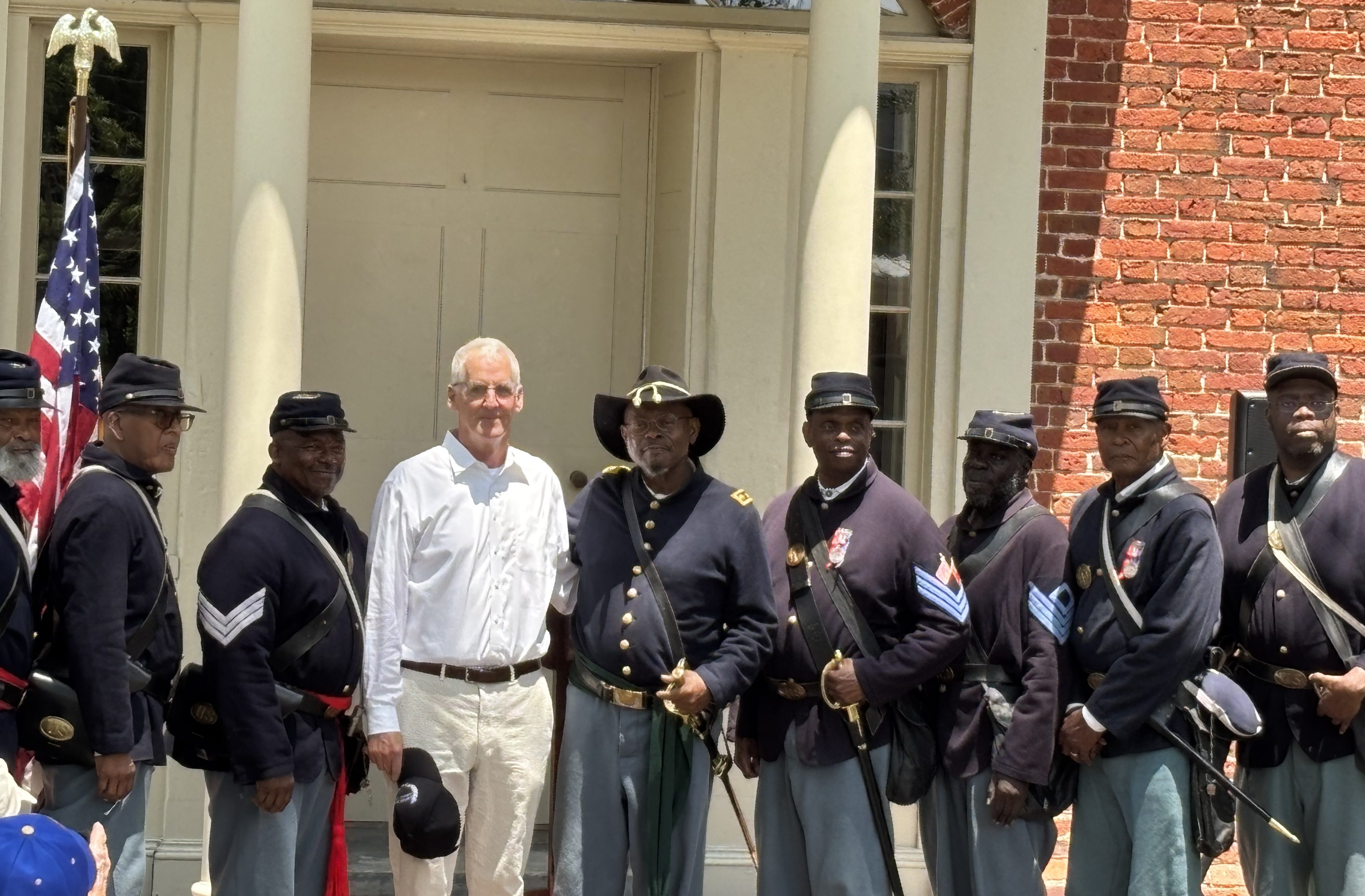
Bernard George and I (center) standing with his comrades in the 35th USCT Reenactors Group last Saturday. Photo by Laura Hanson
I am especially gratified to be here at the invitation of the 35th Regiment, United States Colored Troops (USCT) Reenactors Group, the men you saw a few minutes ago bearing the American flag and whose encampment you can now see across the way and that you can visit after this ceremony.
With the support and sponsorship of Tryon Palace, these men have generously given of their time and energy to insure that the African American soldiers who fought in the Civil War are not forgotten.
The 35th Regiment, USCT Reenactors and I go way back together.
Mr. Bernard George– their captain– and I, for one thing, are family and, even if we were not, I would claim him. Bernard and I sometimes say that we are “brothers from another mother,” and I have never been in that man’s presence when I did feel that in my bones.
Over the years, Bernard and I have worked hand in hand many times. One of my most special memories is when my book on Abraham Galloway, The Fire of Freedom, first came out.
At that time, Bernard sang with the State AME Zion Choir and, through his efforts, the choir’s members sometimes joined me at special events related to the book’s publication.
On those occasions, including one here at St. Peter’s, I would tell stories about Abraham Galloway and the choir would sing hymns that the newly liberated slaves had sung here in New Bern during the Civil War.
I found it a deeply moving experience, and I did not mind at all that I was so clearly not the star of that show. I felt lucky to be part of it.
One of the choir’s hymns from that time stands out to me especially– a hymn called “Am I a Soldier of the Cross?” that newly liberated black men and women sang just a block from here on Emancipation Day, 1865.
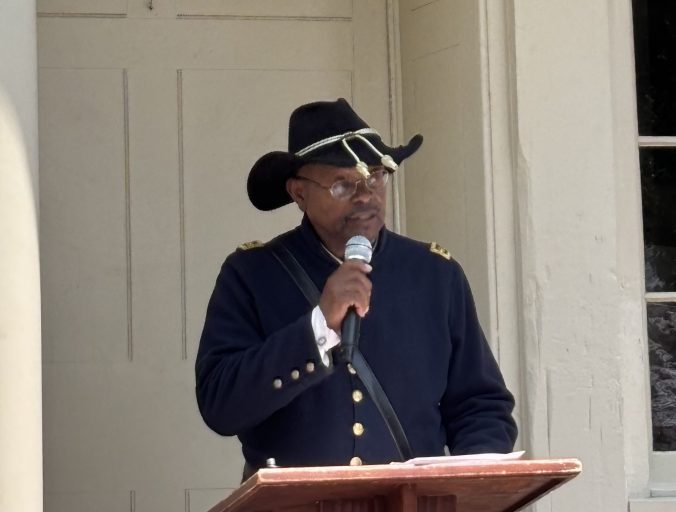
Bernard George speaking at the United States Colored Troops Commemorative Anniversary in New Bern, N.C. Photo by Laura Hanson
That was the second anniversary of the Emancipation Proclamation. On that day, thousands of African American men and women came to New Bern from a large swath of the North Carolina coast.
It was in the Civil War’s last days. Union forces– including the black soldiers I mentioned earlier– were on the verge of abolishing slavery in America. The future could not have looked brighter.
On that anniversary of the Emancipation Proclamation, they gave thanks to God in their churches.
They held political meetings. And, on a clear, crisp morning, they came together in a vast body on an open field also just a short walk from here.
The crowd that day included many black soldiers and sailors, women’s groups, legions of school children, and the members of the five Equal Rights Leagues that the former slaves had already organized in New Bern and nearby parts of the North Carolina coast.
At that time, there were eight schools devoted to educating the liberated black men, women, and children in New Bern. (In their off-duty hours, African American soldiers were among the teachers.)
At the gathering on Emancipation Day, one of the young scholars, Miss Caroline Green, a student at the Palmer School—gave a memorable speech and presented a battle flag to the First North Carolina Heavy Artillery, one of the African American regiments in attendance.
Abraham Galloway, who was still only 27 years old at that time but had seemingly lived a dozen men’s lives, also made a speech, and James E. O’Hara, one of the local African American school principals, and later a member of the U.S. Congress, recited the Emancipation Proclamation.
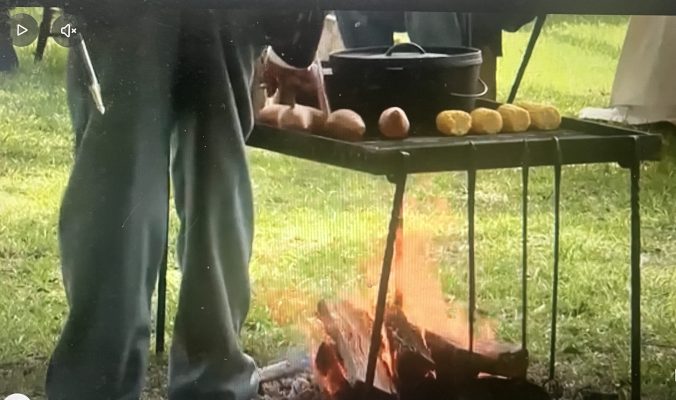
A scene at the 35th USCT Reenactors Group’s camp last Saturday. Courtesy, WCTI-TV.
But earlier in the day, as they paraded toward that open field, one of the five Equal Rights League chapters sang that hymn, “Am I a Soldier of the Cross?”
It is an old hymn, and one whose meaning I find it is sometimes hard for people to understand today.
Because there they were, in the last days of a long and terrible war, and on the verge of freedom, and the hymn that they chose to mark the day beseeched God to give them the chance to prove, day in and day out, that they were worthy of freedom in this life and salvation in the next.
-2-
I am so glad to be able to stand here today side by side with Bernard and his comrades from the 35th Regiment, USCT Reenactors Group.
In addition to Bernard, this band of men includes David Theroith, Vernon Guion, Marshall Williams, Gary Riggs, Louis Brown, Craig Allen, Curtis Jenkins, William Davis, William Hollowell, Jr., Donald Harmon, Curtis Thomas, Martin Harris, Michael Jordan, Robert Garrisson and Howard Burchette.
I said that I call Bernard my “brother from another mother,” but I have to tell you the truth: Bernard may be my favorite “brother from another mother,” but I have come to look at all these men as my “brothers from another mother,” and I hope that they feel the same way about me.
Standing by their side—and having them stand by my side— has always an experience I cherish.
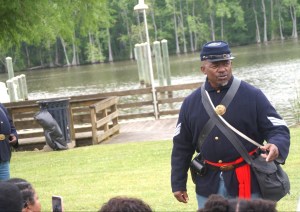
Mr. Curtis Jenkins of the 35th Regiment USCT U.S. Reenactors Group at the commemoration of the Plymouth Massacre in April 2025. Photo by Sharon Bryant
We have stood together at events here in New Bern, and in Harlowe, where many of us have deep roots, and at other occasions where they have made sure that the black soldiers who fought in the Civil War are not forgotten.
Most recently, the 35th Regiment, USCT Reenactors Group and I had the privilege of being part of a deeply moving ceremony that was held last spring in remembrance of the African American soldiers and civilians who died in what is known as the Plymouth Massacre.
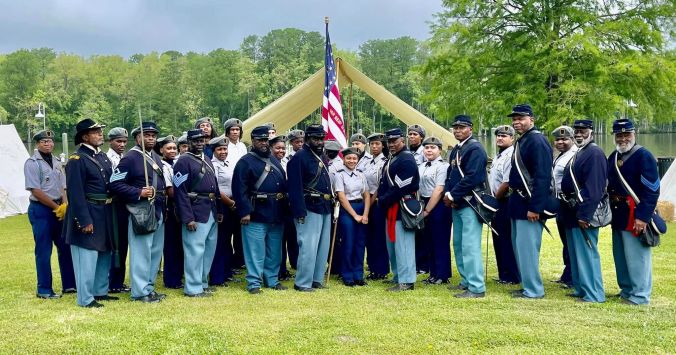
Junior ROTC cadets joined members of the 35th Regiment, USCT Reenactors Group and the 2nd Regiment, U.S. Colored Light Artillery, Battery B, of Wilmington, N.C., during the commemoration of the Plymouth Massacre last year. Photo by Sharon C. Bryant
The “Plymouth Massacre” refers to a war crime of a kind that was far too common during the Civil War– the murder of African American Union troops after they had been captured on the battlefield.
In Plymouth, just north of here, Confederate troops killed at least dozens and very possibly more than a hundred captured black soldiers and civilians after the Battle of Plymouth in April 1864.
Not all Confederate forces were that way, but there were Confederate regiments, including at least one at the Battle of Plymouth, that openly boasted that they had a policy of never taking black prisoners alive.
After organizing in New Bern, the black soldiers of the 35th USCT met similar Confederate troops after the Battle of Olustee, a fierce and bloody struggle in Olustee, Florida that occurred on February 20, 1864.
I do not believe that there has ever been a full reckoning of the number of the 35th’s men killed at Olustee after they had been captured or found wounded on the battlefield.
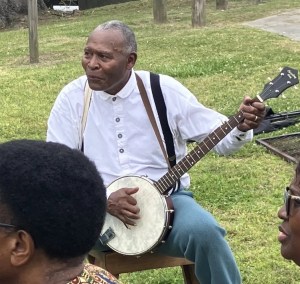
Mr. Curtis Thompson performed traditional songs and hymns at the commemoration of the Plymouth Massacre last year. He is a member of the 35th Regiment, USCT Reenactors Groups and also joined them in New Bern last Saturday. Photo by David Cecelski
Indeed, there were so many massacres of black soldier during those last years of the war, and so much carnage and waste of life generally, on both sides, that even the northern newspapers barely mentioned the black men who were killed after the Battle of Olustee.
But I will not soon forget that day in Plymouth when the 35th Regiment, USCT Reenactors Group and I had the privilege of being part of that long overdue commemoration of the Plymouth Massacre.
The 35th Regiment, USCT Reenactors Group was joined there by another African American Civil War reenactors group that I admire greatly—the 2nd Regiment, U.S. Colored Light Artillery Reenactors Group of Wilmington.
Together they brought an air of solemn dignity, a deep faith, and steady and unwavering moral purpose to the day.
Watching the way that they carried themselves, and the way they spoke, gave all who were there a feeling for the heroism of those black Civil War soldiers who fought and died there by the banks of the Roanoke River.
On that day, I watched the 35th Regiment, USCT Reenactors Group and their colleagues from Wilmington with a large group of Junior ROTC students from Plymouth High School.
I could see those young men and women bursting with pride as they stood there side by side with these men.
Two or three times, I have also visited the 35th Regiment, USCT Reenactors Group during special events that were held at the Stagville Historic Site in Durham County, near where I live.
Today Stagville is a revered place of remembrance for the descendants of those who were enslaved there before the Civil War and for all those who seek to know their story and honor their memory.
My daughter Vera is the director of the Stagville Historic Site, and Vera invites the 35th Regiment, USCT Reenactors Group to come to special events at Stagville every chance she gets.
At those times, I am quite happily relegated to wearing a nametag that says only “Vera’s Dad.”
And since I am not speaking on those occasions, and these guys are the star of the show, I have ample time to stroll through their camp and listen to their stories and watch how they interact with the public.
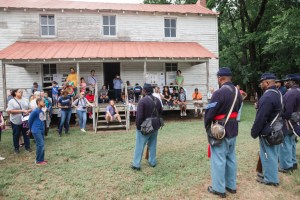
Juneteenth at the Stagville Historic Site in Durham County N.C. in 2019. Photo by Eric Waters
As I do so, I especially enjoy watching the 35th with the children who visit Stagville.
The children are so excited to see them. They are so curious, and so in awe of these men, and so full of questions. At those times, I can see how history seems so real to them, so alive and present.
I enjoy listening to the questions the children ask, and I admire the way that the men speak to the children like wise grandfathers: with strength, dignity, and pride, but gentleness and love too.
Even the youngest children seem to know that they are being given something precious.
And I know this is crazy, but at those times, as I watch Bernard in his role as the 35th USCT surgeon John DeGrasse, or the other gentlemen in their roles as others who served in the 35th, it almost seems as if those men and women of old have returned to us.
When I was growing up, my grandmother used to talk about people “crossing the river.” By which she meant, of course, the oldest river of all, the river between life and death and on whose banks we all dwell.
When I see these men with those children, whether at Stagville or in Plymouth or here in New Bern, it really feels as if those black freedom fighters of our past have slipped back across that river again and that they are here with us, guiding, protecting and blessing a new generation.
Gentlemen, I know that I am speaking for all of us here today, when I say thank you for all you do.
Thank you for helping us not to forget. Thank you for making sure that we have the example of these black solders’ courage, steadfastness, and faith to guide our own lives in these tumultuous times in which we live today.
-3-
This is a truly wonderful event. But as special as it is, I cannot deny that it breaks my heart that most of New Bern’s visitors never learn that they are walking in one of the great freedom-seeking sites in North America’s history.
This city is a place where thousands of African Americans escaped to freedom in a single night.
This city is a place where black men put a revolver to the head of Lincoln’s emissary—Edward Kinsley—and demanded not just freedom for their people, but equality for all God’s people.
This city is a place where black women such as Mary Ann Starkey and Maria Hargett organized resistance to slavery on every front.
This city is a place where one of America’s great freedom fighters—Abraham Galloway—first found his way.
This city is a place where churches and schools grounded in freedom were established and where a new town dedicated to freedom—James City—was built.
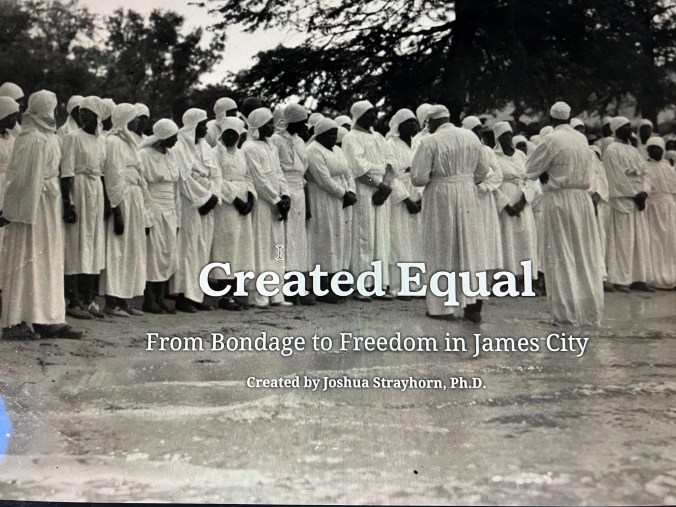
To learn more about James City, see the James City Historical Society’s recent digital exhibit, “Created Equal: From Bondage to Freedom in James City.” The exhibit was created by Dr. Joshua Strayhorn, a New Bern native who is now a professor of history at Penn State University.
This city is a place where, before the war was even over, groundbreaking chapters of the Equal Rights League dedicated to racial justice, civil rights, and democracy first blossomed in the American South.
This city is a place where those Equal Rights Leagues named their chapters after freedom fighters such as the anti-slavery insurgent John Brown, their hometown hero Abraham Galloway, and the black nationalist leader, the Rev. Henry Highland Garnett, who was once thrown off of a moving train up north for refusing to move into the “Negro” compartment.
This city is a place where a young black man named William Henry Singleton, barely days out of bondage, forged a brigade of some one thousand black men even while Pres. Lincoln still refused to let them fight.
This city is a place where, when Lincoln finally realized that he could not do without them, those black men refused to fight until the Union army agreed to treat them like men and true citizens of the Republic.
This city was a place where, as much as anywhere in the country, black men and women—soldiers and civilians, men and women alike—contributed heart and soul to making the Civil War into a war of liberation.
This city was a place where thousands of black men joined the Union army and fought and often died for their people’s freedom.
This city was a place where Robert Hamilton, probably the most important black journalist in Civil War America, came and wrote: “There seems to be more of the unquenchable fire of freedom in the eyes of these people than in those of any other people we have yet visited.”
This city was a place where a slave woman named Juno rescued her children, loaded them onto a dugout canoe, and all by herself guided them down the Neuse River through the darkest night to freedom.
The city was the place where my old friend Hattie Brown’s grandmother Luvenia, barely three years old at the time, and a slave, was lifted onto her father’s shoulders and carried across the Trent River to freedom.
To the end of her days, Hattie Brown’s grandmother remembered the river’s waters coming up to her father’s neck, and her own legs getting soaked, when her family fled Jones County to make their way to New Bern.
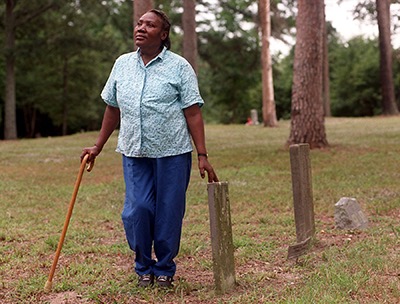
Hattie Brown at the Goshen Cemetery near Pollocksville, N.C., 1998. You can find the story I wrote on her and her family here. Photo by Chris Seward. Courtesy, News & Observer (Raleigh, N.C.)
If Hattie Brown’s grandmother could hold onto that memory long enough to share it with Hattie, and if Hattie could hold onto that memory long enough to pass it on to her children and grandchildren, which she did, it seems to me like we could do our part in remembering it too.
I have to be honest with you because I know that you would not want me to mince words on this matter: it breaks my heart that people come to New Bern and leave thinking of Swiss bears, Pepsi-Cola, and colonial gardens instead of that little girl and her family.
I pray—and I believe that there are too many good people in New Bern for it not to happen—that one day pilgrims will come here first and foremost because New Bern was a citadel of freedom and a light to the oppressed and downtrodden throughout America.
I pray too that they will come here to hear the stories that we have told today, and they will come here to walk the ground where Hattie’s grandmother and Juno, Mary Ann Starkey and Abraham Galloway, William Henry Singleton and all the men of the 35th USCT once trod.
In my dream for New Bern’s future—and I know that you share it— they will come here as well to restore souls grown weary with trying to make this a better world.
They will come to find hope in the lessons of the struggle for freedom here in New Bern and across the river in James City.
They will come here to find inspiration for the struggles for freedom and justice that we have in America today.
They will come here, I pray, to work toward that day when we will all call ourselves “brothers and sisters from another mother.”
-End-
Courtesy, WCTI-TV
Special thanks to Tryon Palace executive director Chrystal Regan, her colleague Mr. Vinson Biggs, the men of the 35th Regiment, USCT Reenactors Group, and a wonderful audience for their gracious hospitality and for making the day so memorable.


Very moving. Thanks for the enlightenment. JS
LikeLike
Another great trip back in New Bern history. Thank you David!
Darlene Badger
LikeLike