
Jamil Rashad and I at Westdale Vintage, the Fayetteville shop where he and his wife Michelle Clark bring together fashion, family, and history. Photo by David Cecelski
Last week I finished a five-day series of lectures, workshops, and historical meanderings that led me down the Cape Fear River from Fayetteville some 120 miles to the sea.
This is a little travel log of the places I went this trip, the people I met, and some of the things I learned along the way.
This is Jamil Rashad and me. Jamil and his wife Michelle Clark are the proprietors of a really special vintage clothing shop in Fayetteville that was my first stop on this ramble down the Cape Fear.
The shop’s name is Westdale Vintage, and it is located on Fort Bragg Road in Haymount, an old and funky neighborhood about 2 and 1/2 miles west of the Cape Fear River.
Jamil has a passion for denim. He wears it, he studies its history, he collects it, he sells it, he designs clothes made from it. I don’t think there is anything about denim that doesn’t interest him.
And that is what led him to me.
In his research on denim’s history, Jamil had found an article that I wrote quite a few years ago on the history of Erwin Mills in Erwin, N.C., some 25 miles north of Fayetteville.
For much of the 20th century, Erwin Mills was among the world’s largest makers of denim, that sturdy cotton twill fabric with diagonal ribbing that we all know from Levi’s Jeans and the like.
Beginning in 1903, life in Erwin revolved around the mill and the making of denim– most especially overalls, coveralls like mechanics wear, and eventually lighter weight shirts.

To my great pleasure, Jamil had a story about every pair of denim in the shop. Photo by David Cecelski
Erwin called itself “The Denim Capital of the World,” and the mill’s closing back in 2000 shook the town to its core.
When Jamil contacted me, he had some questions about the history of Erwin Mills and he was also looking for other historical sources that speak to the history of denim in our part of the world.
I’m not sure how much help I was to him, but he very graciously invited me to stop by the shop the next time I was in Fayetteville.
I love people with a passion for history, and maybe especially those who have a passion for the rich stories behind the ordinary things of our lives– and for generations, few things were more ordinary, or so much a part of our lives in Eastern North Carolina, than denim overalls and trousers.
Jamil, it turned out, sees old denim and vintage clothes generally as forming a tapestry of life itself.
I love to be reminded that we live in a world of unsuspected depths, and of histories submerged and waiting to be discovered– and that is just what Jamil’s ardor for denim did for me.
* * *
When I left home and headed to Wilmington, I wasn’t sure that I’d have time to make the detour to Fayetteville.
But it was only a half-hour out of my way, and when I got to Benson I just impulsively cut south toward the Cape Fear River and Fayetteville. I hadn’t even given Jamil a heads up that I was coming.
I crossed the Cape Fear and then drove into Haymount, where the shop is.
Haymount is home to some of Fayetteville’s oldest buildings– the Robert Strange Town House, circa 1817, is the oldest– and also to trendy coffee shops, tattoo parlors, and at least one very cool vintage clothing store.
Jamil was surprised to see me, but very warmly welcomed me to Westdale Vintage.
Over the course of my visit, I learned a lot more about how the shop came to be.
Three years ago, Jamil and Michelle left Raleigh and moved back to Fayetteville, her hometown, so that they could look after her father. At the time, he was in the last stages of Progressive Supranuclear Palsy (PSP).
This is how the shop’s website describes Westdale Vintage’s birth:
Michelle’s journey into the vintage business began during her time as a full-time caregiver for her father.
Unable to frequent her favorite out-of-town vintage stores, she started sourcing unique finds during her early mornings and lunch breaks.
Her father delighted in the impromptu fashion shows Michelle would put on with her discoveries, sparking a deeper connection to the vintage lifestyle.
Noticing the lack of vintage clothing stores in Fayetteville, Jamil and Michelle began hosting local pop-up shops, which were met with enthusiasm from the community.
Two weeks after Michelle’s father passed away, a serendipitous opportunity arose when one of her favorite buildings in Fayetteville’s Haymount neighborhood became available.Inspired to honor her father’s memory and their shared family history, the couple decided to open Westdale Vintage at 1225 Fort Bragg Road.
Here is a photo of Jamil and Michelle, a spectacular couch, and her dad’s denim that I found on the shop’s website.

Co-owners Jamil Rashad and Michelle Clark at Westdale Vintage, Fayetteville, N.C. Photo courtesy, Westdale Vintage
Signs of Michelle and Jamil’s affection for her dad are all over the shop.
In one corner of the store, Jamil showed me a lovely little altar of photographs and keepsakes devoted to his father-in-law’s memory.

A corner of remembrance at Westdale Vintage. Photo by David Cecelski
He also showed me other family photographs on a wall near the front door.
Totally stole my heart. I love seeing a small business rooted in family and community, and that is just how Westdale Vintage felt to me.
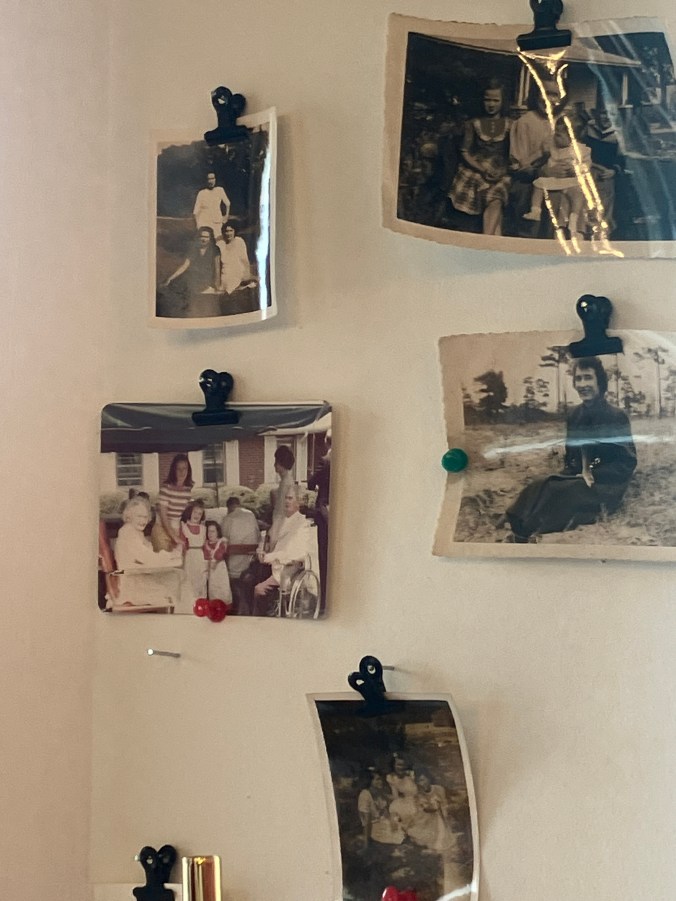
Family photographs at Westdale Vintage. Photo by David Cecelski
A few feet away was a pair of denim overalls and a denim jacket that had belonged to Michelle’s dad. Jamil had salvaged them from his father-in-law’s barn– another kind of remembrance of what must have been a very special man.
While I was at the shop, I learned that Jamil is into all kinds of things. He’s obviously all about the shop, but he’s also the lead singer for the funk and soul band Boulevards. He also mentioned that he’s still an avid runner– he’s training for the New York Marathon now.
But gracious his passion for denim is strong.
Jamil is even part of an Instagram community called the Indigo Invitational Fade Comp, the world’s largest and most inclusive raw denim fading competition.
If you’re into it, you register a new, unworn pair of raw or dry denim jeans and wear them heavily for 365 days to document natural wear patterns, contrasts, and unique fabric fades.
That’s probably not my thing, but I really do like how Jamil’s passion and intellectual curiosity for denim compelled me to think about these ordinary articles of clothing and their meaning.
Historically speaking, I find it hard to think of an artifact of daily life in Eastern North Carolina’s history that was more ubiquitous than denim work clothes.
In the first half of the 20th century, three North Carolina cities– Greensboro, Durham, and Erwin– were all among the largest makers of denim in the country and probably the world.
For many years, Cone Mills, in Greensboro, made the denim for Levi’s Jeans.
Especially between about 1900 and World War II, denim was in every home of a working man and woman, on every farm, and practically on every man and boy and plenty of women and girls too.
If you had come to Eastern North Carolina and looked out across the tobacco fields, or watched the men file out of the mills, or ventured into a machine shop, what you saw was denim.
For many of those people, it was all they wore: for far more than you might expect, that one pair of overalls, along with a lighter, maybe flannel shirt and brogans, was all they had to wear.
Patched and re-patched till they looked like crazy quilts, taken in, let out, passed down– denim overalls were everywhere.
And as Jamil’s Instagram group highlights: in the patterns of wear and the ways they faded, denim overalls and trousers were a record of people’s lives.
They showed the hardness of the times, the work people did, and how tough people were.
* * *
When I stopped by Westdale Vintage, Jamil gave me a great tour. It is really a beautiful place, so full not just of fun, interesting, and good looking clothes, but clothes with a story, a history.
As I walked through the shop, I got the feeling of lives lived, toil, and the earth, but also of joy and fun and flair.
Just speaking of Jamil’s fancy for denim clothes, the shop also made me think about the ways that, during and after World War II, denim came to be more than the textile that went into working men’s clothes.
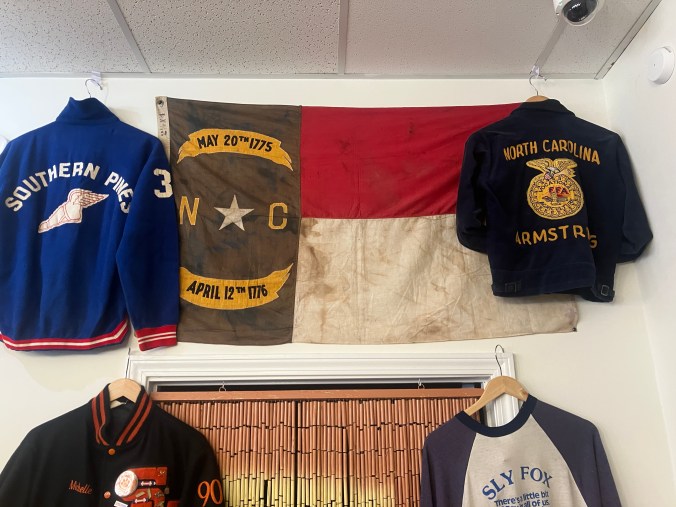
Every item in the shop felt like a moment of time preserved. Photo by David Cecelski
During the war, multitudes of women went to work in the nation’s shipyards, factories, and machine shops for the first time.
These were the famous “Rosie the Riveters” of yore– my grandmother Vera was one of them. She worked at an aircraft machine shop at the Cherry Point Marine Corps Air Station.
Many of those women wore denim jeans or trousers on their jobs six or seven days a week. For the first but not last time, denim became a symbol of female empowerment.
In the following decades, greasers, bikers, civil rights protestors, anti-war activists, and musicians from Elvis Presley to Tupac Shakur also turned denim jeans and overalls into symbols of rebellion and the counter-culture.
I didn’t get to spend a whole lot of time with Jamil. I had to get on to Wilmington, and he had customers to take care of.
But the time I did have with him was a great pleasure, and the shop is really glorious.
I’m wearing my Westdale Vintage tee shirt today, and I look forward to my next trip to Fayetteville.
Next time I hope that I get to meet Jamil’s wife Michelle too and hear more about her father, and I can’t wait to see what new stories Jamil discovers about denim and its history.
To be continued. Next stop: Wilmington.


Minor correction – Haymount is WEST of the Cape Fear River
LikeLike
Thank you! All fixed! Corrections– minor and otherwise– always appreciated!
LikeLike