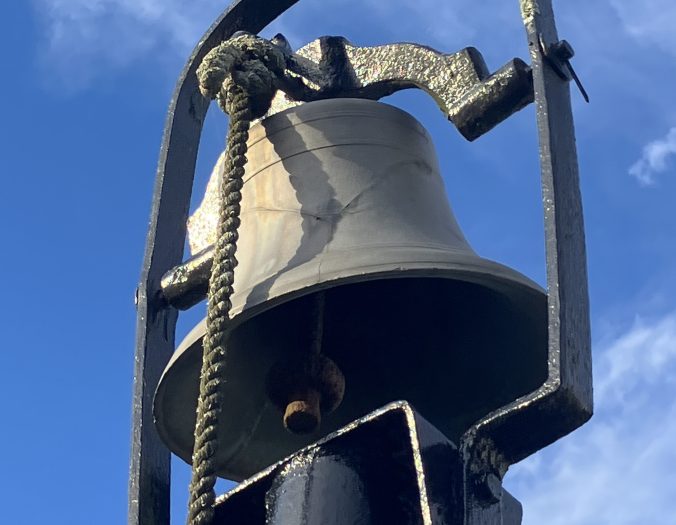
The bell at the Institute United Methodist Church in Institute, N.C., was originally on the grounds of Lenoir Collegiate Institute ca. 1855-1860. Photo by David Cecelski
Tonight I am staying in Institute, a village in the farm country of Lenoir County that came to be here because a college, now long gone, was located here in the years just before the American Civil War.
That college was called the Lenoir Collegiate Institute. Its history was brief: the school opened in 1855 and closed in 1860.
The students and faculty were gone by the summer of 1860, but the buildings that had been built for the college remained. They became the foundation for what is now the village of Institute.
Quite a few of them are here yet. This lovely old home where I am staying— “Mama Hardy’s B&B”—is one of them. When the college was open, this house was one of the student dormitories.
—
This was my last stop on what has been a long day, but a very good day.
I began the day back home, rising at first light and driving just beyond Wilson, then cutting down through Greene County.
I went through Stantonsburg and Snow Hill, then continued south a few more miles to my destination, a historically tri-racial community– black, white, and Indian– that is called Browntown.
Browntown is only a few miles from Mama Hardy’s, just the other side of Wheat Swamp.
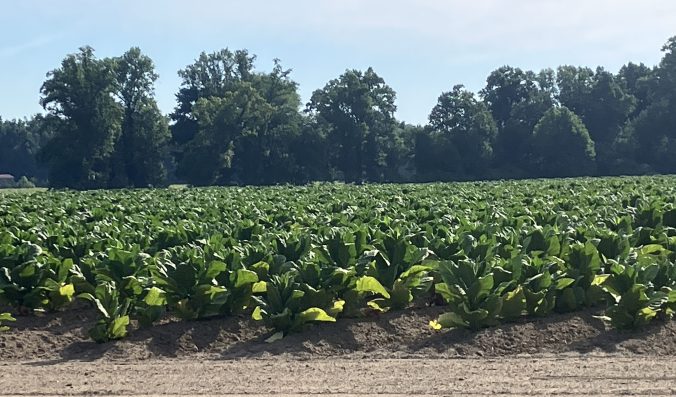
Tobacco field, Greene County, N.C. Photo by David Cecelski
The community is largely in Greene County, but straddles the county line and is partly in Lenoir County too.
A young woman named Ignacia Joyner and her father, David Brown, are among the most dedicated keepers of Browntown’s history. They had invited me to come down and explore the community with them.
We had a grand morning. Mr. Brown, a welder by trade, and a former union leader, seemed to remember every story that his elders had ever told him about Browntown’s past.
Ignacia is the same way. Professionally speaking, she is a hospital nurse, but she has no fear of archives and libraries and goes wherever she has to go to recover and preserve the community’s history.
Over the course of the morning, father and daughter took me down many a backroad, showed me all kinds of interesting historical sites, and enchanted me with many a story about Browntown’s past.
I was especially taken by our visit to their family homeplace. The farm has been in their family for many generations, and it is the place where David and his eight brothers and sisters grew up.
To me the highlight of our visit to the farm was their showing me a shady spot down in the woods that has long been said to be the site of an Indian graveyard that was here before the Tuscarora War.
Ignacia told me that she first heard about the Indian graveyard from her grandmother, Isabel Brown.
Ignacia believed that her Isabel, in turn, first learned about the graveyard from her mother Addie, who was half Indian and half white. She was born way back in 1881 down in Wheat Swamp.
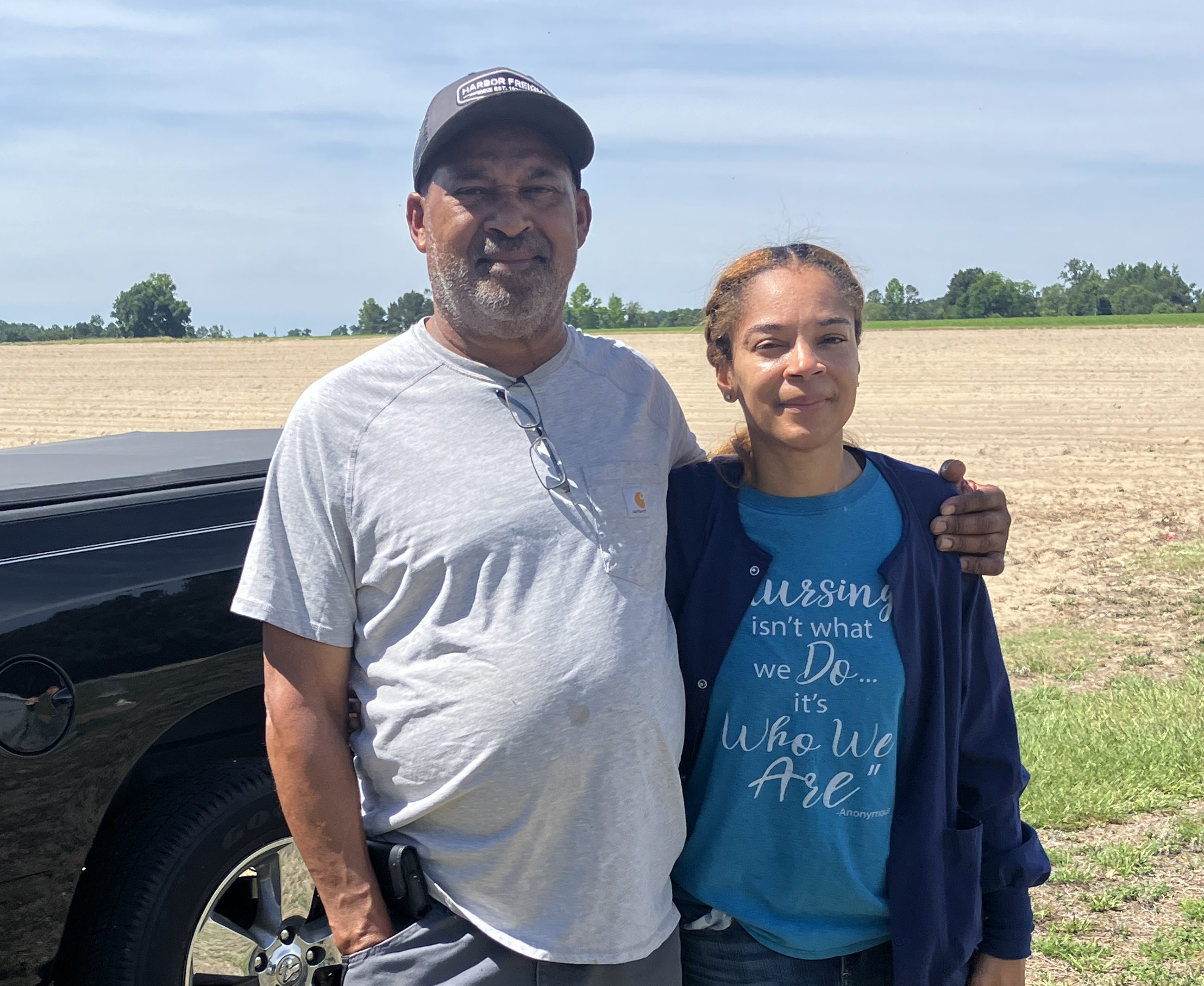
David Brown and his daughter Ignacia Joyner at the site of a family cemetery in Browntown, a rural community south of Snow Hill, N.C. Photo by David Cecelski
Browntown is in the heart of what was the Tuscarora Nation. The site of Fort Neoheroka is just up NC-58. A village called Innennits was the other side of Snow Hill. Another settlement, Caunookehoe, was only a few miles to the east, a little ways out of what is now Hookerton.
Two other, larger Tuscarora towns were also close-by: Catechna to the east, and Torhunta (also known as Nahunta or Narhantes) to the west, near the headwaters of Contentnea Creek.
Both were destroyed in the Tuscarora War of 1711-13.
The morning to me was magical. Ignacia and her father brought Browntown’s past to life for me. Listening to their stories, I could see how the diverse strands of their heritage entwined and grew together across the ages.
—
I said good-bye to Ignacia and her dad around midday, then got back on the road. I thought about going straight to Mama Hardy’s in Institute for the night, but I couldn’t resist making a detour to Hookerton first.
That was because Hookerton is the home to Morris Barbecue, and I was hoping to get a lunch there before they closed for the day.
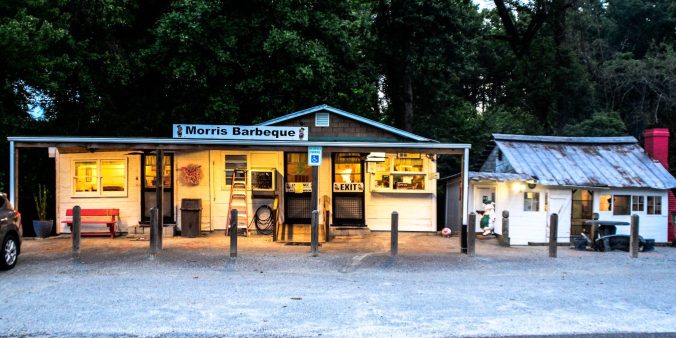
Morris Barbecue, Hookerton, N.C. Photo courtesy, The State You’re In
It was worth the trip. Morris’s is a just a little cafe, but it has been in business since 1931 and it has great feel.
Morris Barbecue is only open on Saturdays: 8 AM – 2 PM for take-out, 9:30 AM to 2 PM for eat-in. Be sure to reserve ahead if you want skins and bones.
I have always been fond of Morris’s but I probably hadn’t been there in 10 or 15 years.
Things hadn’t changed much. The only big change I noticed was that the proprietors had taken down the photograph of the monkey that used to sit on the front porch and smoke cigarettes.
It’s always been a friendly place, monkey or not. While I ate my sandwich and hushpuppies, everybody there, the proprietors and all, talked farming and the drought, baseball and all manner of other philosophical issues.
Once we had resolved the world’s problems, and I had downed my last hushpuppy, I headed to Mama Hardy’s.
—
Mama Hardy’s B&B turned out to be a lovely, two-story residence that, I learned later in the evening, was originally built with a salt box design, a cedar shake roof (now tin), and lapboard siding.
I parked in the front yard beneath an oak tree, then went in and settled into my room. The proprietress, Ms. Ida Brown (her mother was a Hardy), stopped by a little later to welcome me.
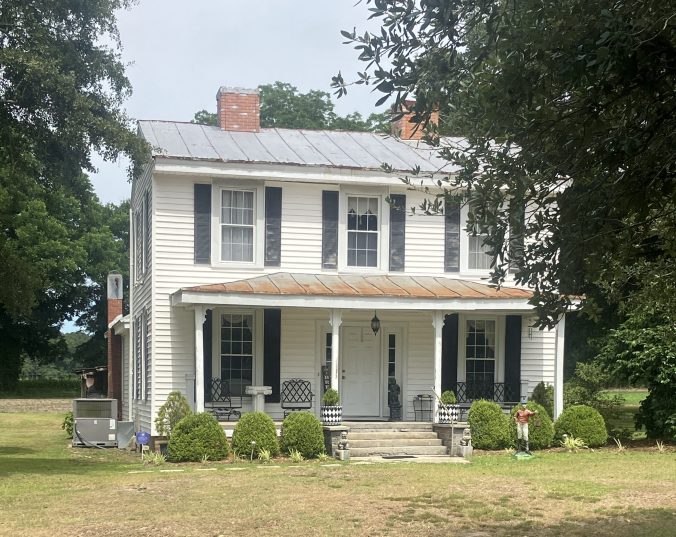
Mama Hardy’s B&B, Institute, N.C. Photo by David Cecelski
Now 83 years old, Ida is a kind and gracious hostess. She has lived in Institute all her life, and I would come to learn that, like Ignacia and her dad in Browntown, she is also a keeper of the old stories.
Ida told me that, when she was a child, Mama Hardy’s was her grandmother’s home. She had spent a many a night here back in those days.
While Ida showed me around Mama Hardy’s, she also shared a great deal of history about the Lenoir Collegiate Institute with me.
She told me that the college had both male and female students, was originally founded as the Lenoir Male and Female Seminary, and was loosely affiliated with the Methodist Episcopal church.
The college’s founder, the Rev. William Cunninggim, was a local Methodist minister. Many of the students were also children of Methodist ministers and missionaries, though more were probably the children of the region’s gentry.
All the students and faculty were white of course. In 1860, more than half of Lenoir County’s population were slave laborers. The college’s bell was not the one to which they answered.
—
While we were touring Mama Hardy’s, Ida also invited me to look through a collection of historical works related to Lenoir Collegiate Institute that she had put together over the years.
Her collection included a very interesting copy of the college catalogue from the 1857-58 academic year, as well as newspaper clippings, photographs, and a booklet on the college’s history.
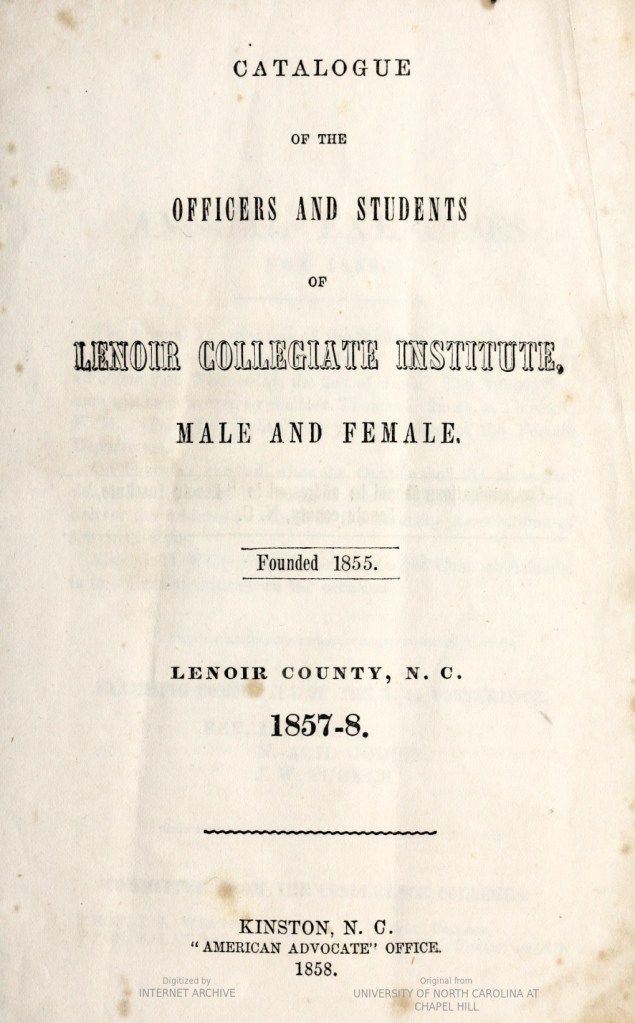
Catalogue of the Officers and Students of Lenoir Collegiate Institute, Male and Female, 1857-58 (Kinston N.C., 1858). Courtesy, North Carolina Collection, Wilson Library, UNC-Chapel Hill
The booklet was wonderfully informative. Written by a Rev. Bruce Pate, a Methodist minister with local roots, it was published in Raleigh back in 1981.
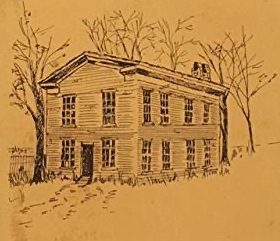
Institute Methodist Church. Cover illustration from the Rev. R. Bruce Pate’s A Moment in Time: A History of Lenoir Collegiate Institute (Raleigh, N.C., 1981).
Rev. Pate called the booklet A Moment in Time: The History of Lenoir Collegiate Institute.
Two sources that he located in the manuscripts collection at Duke University’s Perkins Library stood out to me.
The first was a diary that included notes made by one of the Institute’s faculty members, a Miss Sarah A. Smith.
Miss Smith was a young Vermont woman who taught at the Institute beginning in 1855 or 1856.
Her notes do not seem to have been lengthy, but they concerned the formation of a women’s literary society at the college and gave me at least some sense of the college’s intellectual character.
The second group of manuscripts that Rev. Pate found at Perkins Library were no less interesting. They included eight letters written by one of the Institute’s students, a Miss Phoebe Alford.
The letters dated from July 11, 1859, to May 13, 1860.
According to Rev. Pate’s account, the letters glowed with evangelical fervor, as Methodist writings often did in those days.
Judging from Miss Alford’s letters, she assessed her experience at the college almost solely by the degree to which campus life echoed her own religious zeal.
In the letters, you can see her passion: she yearned for fervor and religious ecstasy, shouting and tears.
—
When we completed her tour of Mama Hardy’s, Ida offered to show me around the village of Institute.
I was excited to do it. I could not imagine having a better guide than Ida.
She began the tour just a little way behind Mama Hardy’s. Riding in her minivan, we first visited a community cemetery surrounded by farm fields and watched over by a lone red cedar.
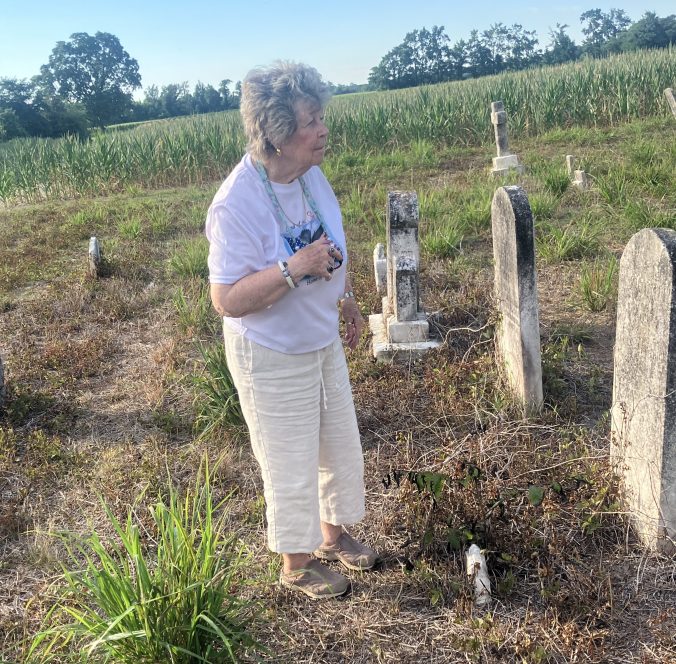
Ms. Ida Brown at the community cemetery in Institute, N.C. Ida told me that she has always loved working with her hands. To prepare Mama Hardy’s for visitors, she did everything from make new living room curtains to sanding the floors and painting. At 83, she does not seem to be slowing down much. In addition to operating the B&B, she also continues to substitute teach at the local high school. Photo by David Cecelski
Ida told me that much of her family is buried in that cemetery.
However, she had brought me there not see her family’s graves, but to visit the final resting place for the only student known to have died at the college.
That student’s name was Thomas S. Lamb. He was from Bath, some 50 miles to the east. Evidently, he had been helping a surveyor on a snowy day and come down with pneumonia.
Ida explained that young Mr. Lamb could not be taken home for burial because of the snow.
Instead, he was laid to rest here in Institute, surrounded by fields and where the light in the early evening, if it was like when Ida and I were there, is so beautiful it might well bring tears to your eyes.
—
Ida and I then drove out onto Institute’s main road. As she drove slowly along, she pointed out other buildings that are now private residences, but which had originally been part of the Lenoir Collegiate Institute.
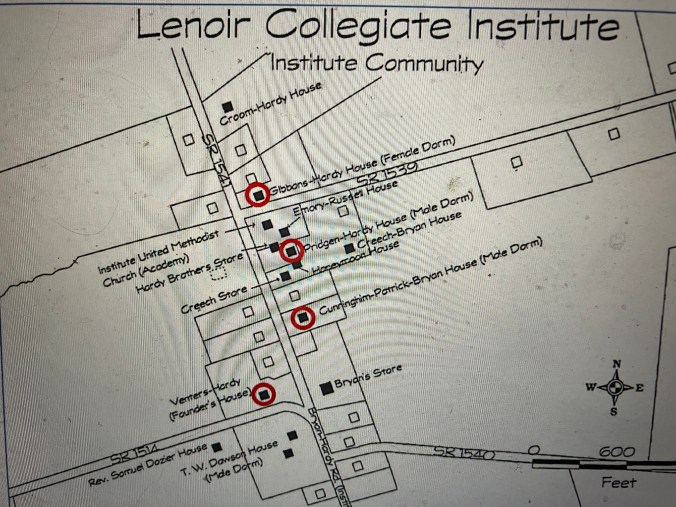
This map of Institute’s historic buildings comes from a survey that was done as part of the planning process for a highway pass. See Historic Architecture Eligibility Report: Construct Kinston U.S. 70 Bypass, Lenoir County (NCDOT, 2017).
Some had been dormitories like her grandmother’s house; others were built for the college’s professors and their families.
Ida noted that the college’s leaders strictly separated the living quarters for the male and female students.
To quote an article on the college’s history that I found in Ida’s collection at Mama Hardy’s:
“There was a line across the dusty roadway outside…. It could not be crossed to the east by the men, nor to the west by the young women, except by written permission of their principals.”
Raleigh News & Observer, 12 Feb. 1950.
The young men resided in dormitories or took room and board in private residences on one side of the village, while the young women took their room and board on the other side of the village.
At the crossroads by Bryan’s Store, Ida turned around and drove back through the village to the Institute United Methodist Church, which had also originally been part of the Lenoir Collegiate Institute.
When the college was open, the building had two floors. The downstairs had served as the campus’s main assembly hall and chapel, while the upstairs was used as classroom space for the young men.
The church has since been remodeled and now only has one floor, but has a lovely high ceiling.
Ida led me into the church annex, and in a hallway that connected the annex to the sanctuary, she showed me an old photograph of schoolchildren and their teachers standing in front of the building.
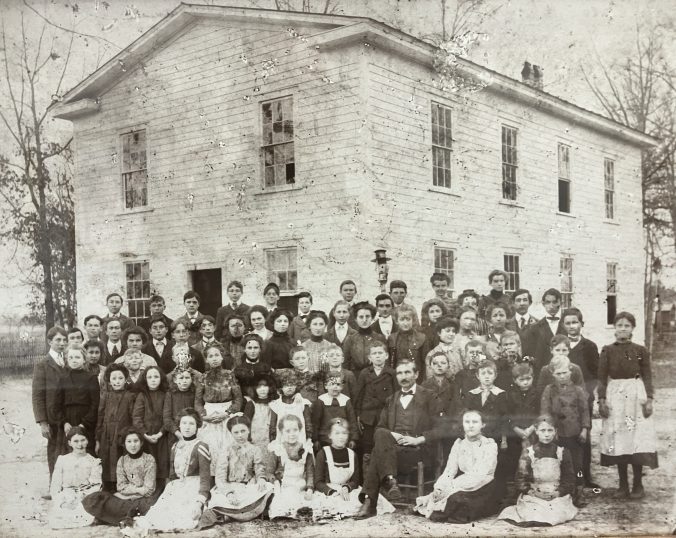
Students and teachers at the community school in Institute, N.C., ca. 1910. The building was originally part of the Lenoir Collegiate Institute.
After the college closed, the local Methodists continued to hold their worship services at the church, but there was a long stretch when it was also used as a community school.
The photograph was from that era. Ida pointed out her father among the schoolchildren, so considering Ida’s age, I imagine that the photograph was taken in the first quarter of the 20th century.
Ida then led me into the sanctuary. It was a lovely spot: cool, serene, and restful, a place of comfort and solace.
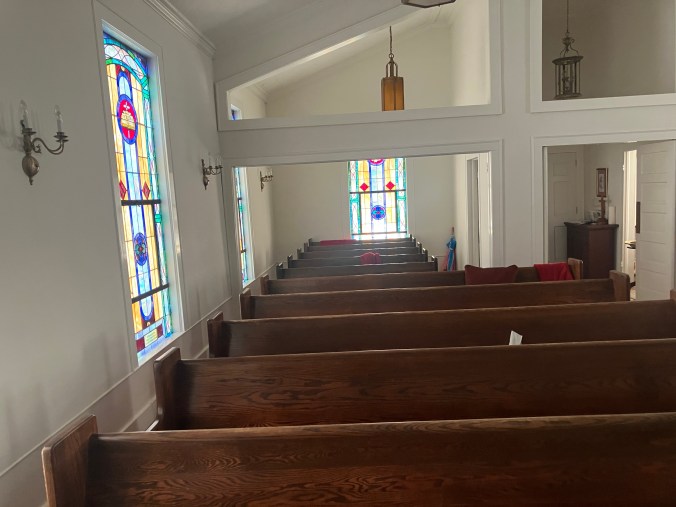
A view of one side of the sanctuary at the Institute United Methodist Church in Institute, N.C. The table in the back on the far right was the church’s original altar. Photo by David Cecelski
That 1950 issue of the News & Observer that I quoted earlier also discussed how the college’s faculty separated the male and female students from one another in what is now the church sanctuary.
In that article, an Institute resident recalled his father telling him that a long, narrow plank had run the length of the first floor when it was part of the Lenoir Collegiate Institute.
That plank, his father told him, divided the hall in half, so that the young women sat on one side, the male students on the other, and I am sure that neither ever dared take a glance across the aisle.
According to the N&O story, the practice of segregating males and females was so deeply embedded in Institute custom that even well into the 20th century, long after the plank had been removed, even husbands and wives did not sit together for worship.
—
The church’s sanctuary was the end of our tour of Institute, except that in the churchyard, as we walked back to the minivan, Ida pointed out the college’s old bell. She even relented and let me take her portrait with it.
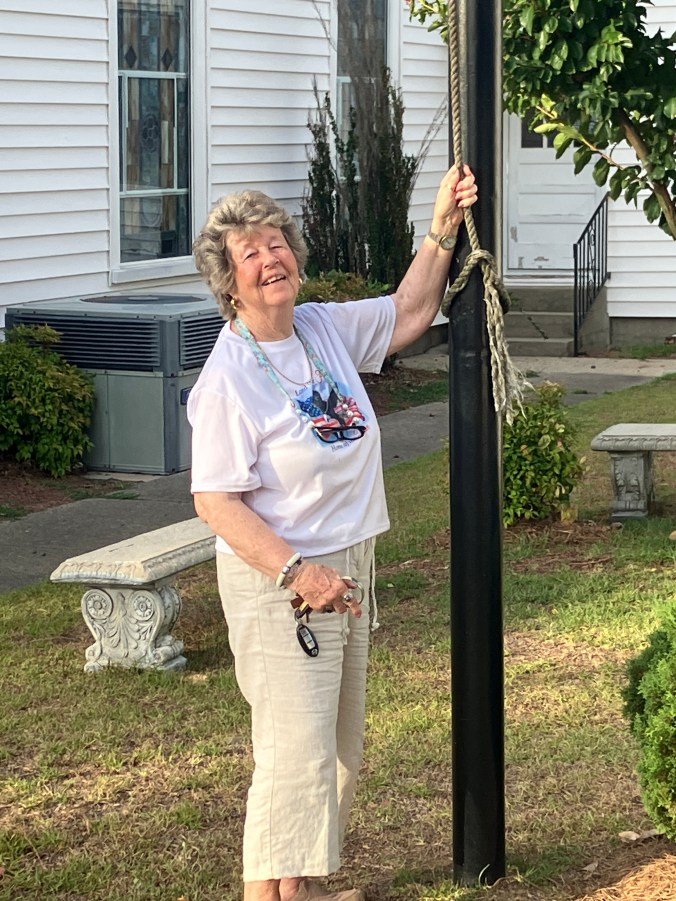
Ms. Ida Brown at the Institute United Methodist Church in Institute, N.C. Photo by David Cecelski
The bell now stands on a tall iron pole that is set into the ground a little to one side of the church’s front door.
That bell must have rung many a time to call the college’s students to rise in the morning and to beckon them to chapel.
Maybe at the end of the day, the bell’s ringing also called them to supper, and later to their evening prayers.
I assume that the bell tolled for poor Thomas Lamb, when they buried him in the snow, and I can’t imagine that it did not ring out on Easter mornings at sunrise, announcing the Resurrection.
—
As we left the church, Ida and I talked a little about why the Lenoir Collegiate Institute’s history was so brief. Evidently, the reason is not clear but has been much discussed over the years.
Some accounts say the college’s leaders had counted on the railroad coming to Institute and had grown discouraged after a route through La Grange was chosen instead.
Another story says the college’s closing had something to do with the Civil War, but that did not make sense to me. The last academic year ended nearly a full year before Fort Sumter.
Ida is among those who believe that the college simply lost too much of its key leadership in and around 1860.
The departure of the college’s visionary president, Levi Branson, was probably the most damaging. He left Institute that year to become the headmaster of a school in Carteret County.
The college’s founder, on the other hand, the Rev. Cunninggim (often appearing as “Cunningham” in historical records), was a rather unusual man of the cloth from the start.
I have run across him while doing other historical research and come away thinking that he was surprisingly devoted to real estate schemes and business ventures for a man of God.
His business interests, I might add, included some very dark dealings. The worst, at least to my knowledge, was instigating the violent destruction of a free black community in Beaufort County, N.C., so that he could take the community’s land and build a new town.
That was in 1860, the same year that the Lenoir Collegiate Institute held its last classes.
(For more on the free black community in Beaufort County and its fate, see my essay “Remembering Betty Town” that I published here in July 2025.)
—
As I burn the midnight oil here at Mama Hardy’s, I have been thinking back on the day.
I have been reflecting on my time in Browntown and here in Institute, but I have also been thinking even about my lunch in Hookerton and the joy of being back there again after all these years.
After Ida brought me back to Mama Hardy’s, I had also driven into Snow Hill to find some supper.
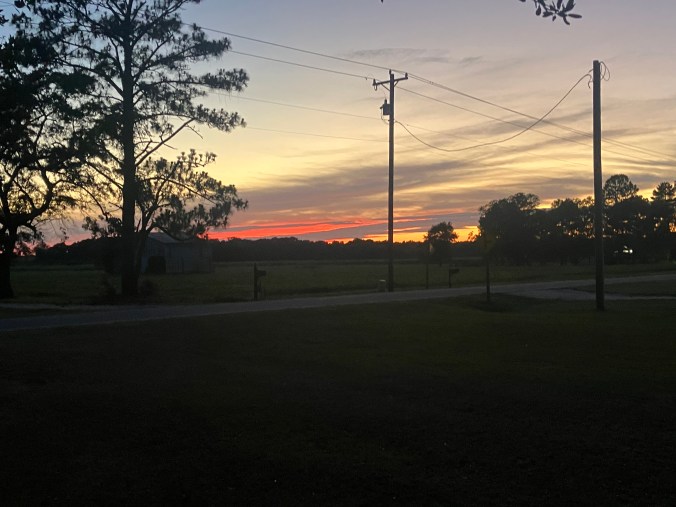
Sunset across from Mama Hardy’s. Photo by David Cecelski
I arrived in Snow Hill around sunset, but the pickings were slim. Snow Hill is a small town where restaurants do not stay open late even on a Saturday night in the summertime.
I was lucky though. I found a Mexican food truck that was still open and looked like it had a good crowd. Some of the customers were tailgating, and others were sitting at a pair of picnic tables next to the food truck.
After looking through the menu, I ordered a plate of birria tacos— the Tijuana-style type that are kind of a thing now I guess, the ones that are crispy, cheese-filled, and dipped in consomé.
None of the picnic tables were unoccupied, but when I got my tacos, the proprietors very graciously invited me to sit with their family. They were at the closest table and also in lawn chairs set out around the table.
It was a lovely way to end the day. We ate and talked and laughed. The young people were completely bilingual, Spanish and English, and I think the older people and I did pretty well with their not-so-good English, my horrible Spanish, and lots of hand signals– a good dinner overcomes all.
After a while, the proprietors’ aunt brought out a platter of taquitos fresh off the stove, everybody sharing with everybody.
My tacos were delicious, and so were the taquitos, and the company was even better. Little children played all around us. Next to me, a baby slept. Fireflies lit up the night sky.
These are the days of which I dream. Waking up with Laura, visiting with Ignacia and her dad in Browntown, lunch in Hookerton, my time in Institute with Ida, my supper in Snow Hill— this whole day is the kind I live for.
They are the days when we all seem to be brothers and sisters. When the earth seems kind to us, not cruel. When somehow, some way, those I have lost no longer seem so far away.
They are the days when I am reminded how good it is to listen to the music of people’s voices, and how good it is to break bread together.
I suppose one should be careful on days like this. Too many days like this and we might forget the things that divide us. We might start to believe again in this country that we all love.
We might even begin to rejoice again in the sweetness of who we are and all that holds us together.
Happy 250th, America.
I wrote this Saturday night before last.
 David Cecelski
Interesting as usual
LikeLike
Thank you for researching and writing these stories. I have read more than a few of your stories . They are always informative and delightful. However, the today is very special. Thank you for documenting and sharing.
LikeLike
O, my goodness gracious! Wonderful.
just back from a similar trip through Anson and Hoke, walks through similar cemeteries in Morven and Raeford, and talks with Steve Bailey at Anson County Historical, in Wadesboro, and musician, writer, and developer Ron Huff, in Ashley Heights. Days to live for.
LikeLike
David your post always seem to make me think that I am witnessing a journey back in time.I always say “where and what’s next”.
Yahoo Mail: Search, Organize, Conquer
LikeLike
What a beautiful reflection. A travelogue and the feeling for adventure that only can occur when you combine backroads, true curiosity and willingness to listen. It is perhaps the way we might find our country again.
LikeLike