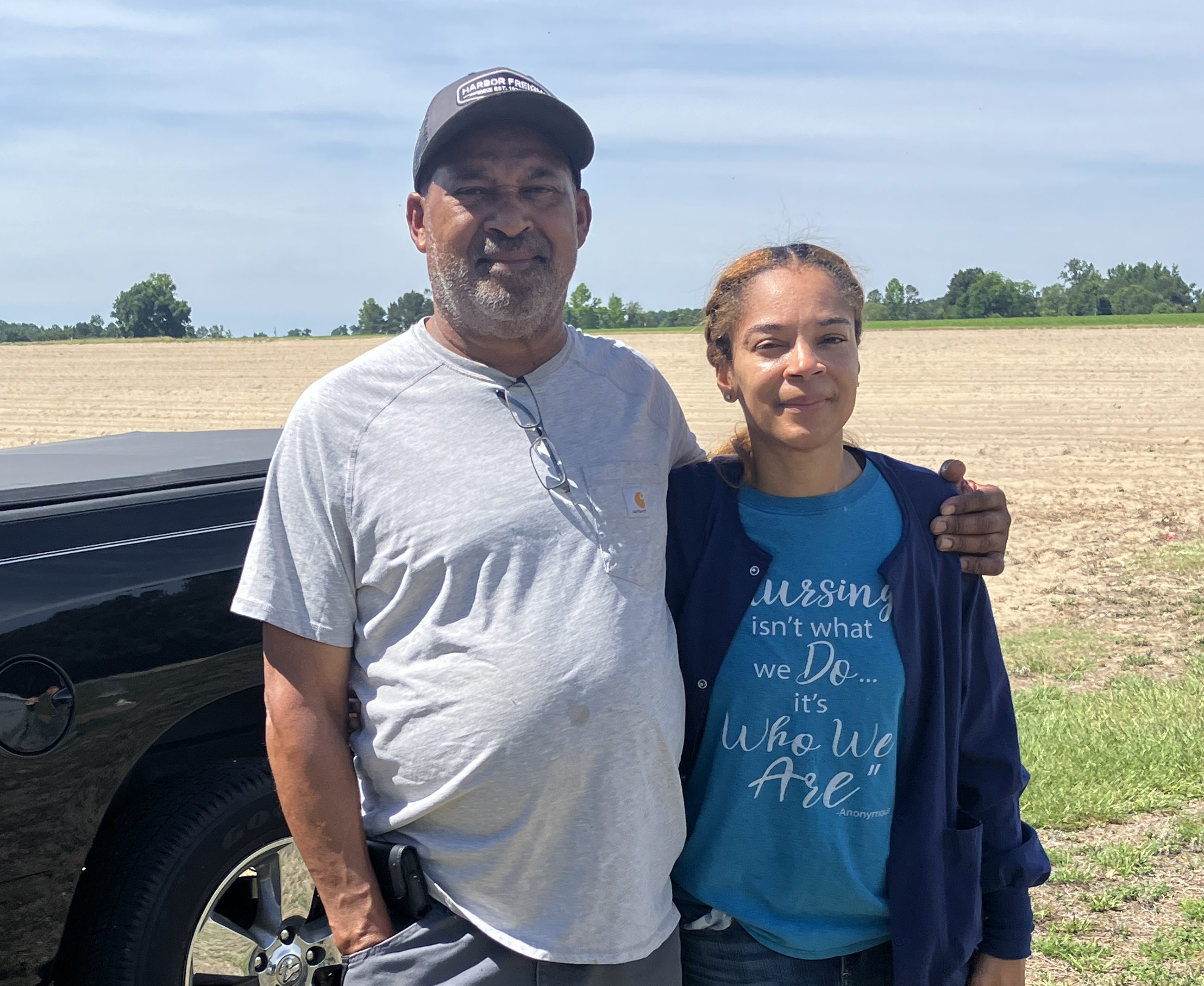
David Brown and his daughter Ignacia Joyner in Browntown, a rural community south of Snow Hill, N.C. with a rich history and deep roots in Africa, Europe, and Native America. Photo by David Cecelski
The other morning I left home at first light and drove just beyond Wilson, then cut south and traveled into the heart of Greene County.
I passed through Stantonsburg, crossed Contentnea Creek and skirted along the edges of Nahunta Swamp.
When I got to Snow Hill, I turned just past the Piggly-Wiggly and headed south a few more miles, first on Hull Road, then on Wheat Swamp Road, until I reached my destination, a historically tri-racial community– black, white, and Indian– that is called Browntown.
I arrived in Browntown while there was still some coolness in the air. The drought was at its worst and even from the road you could see how dry the tobacco and corn fields were.
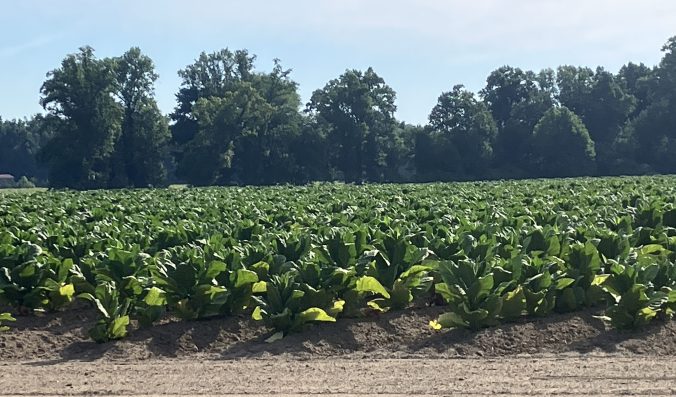
Tobacco field, Greene County, N.C. Photo by David Cecelski
Browntown is largely in Greene County, but straddles the county line and is partly in Lenoir County too.
It is beautiful country: fields and woods, quiet two-lane roads, and a long, long history.
A remarkable young woman named Ignacia Joyner and her father, David Brown, are devoted keepers of Browntown’s history. They had invited me to come down and explore the community with them.
We had a grand morning. Mr. Brown, a master welder by trade, and a former union leader, seemed to remember every story that his elders had ever told him about Browntown’s past.
Ignacia is the same way. Professionally speaking, she is an operating room nurse, but she has been learning her way around archives and libraries. She goes wherever she has to go to recover and preserve the community’s history.
Father and daughter took me down many a backroad that morning. They showed me all kinds of interesting historical sites, and they enchanted me with many a story about Browntown’s past.
I was especially taken by our visit to their family homeplace. The farm has been in the Brown family for generations, and it is the place where David and his eight brothers and sisters were raised.
Next to a stand of longleaf pines, David told me how it used to be when he was growing up: he pointed out the pecan tree that his grandmother planted, now towering over the old, long abandoned house.
He talked about the chickens and hogs that they had when he was young, the old well, the orchards and the garden.
Ignacia told me about an old historical document that she had found that described Browntown as “a poor man’s country.”
I suppose that was probably true, but to me Browntown sounded more like it was the kind of community where people worked hard, kept to themselves, and did for themselves.
Nodding toward the family’s old pack house, David recalled the days when the whole family worked in the tobacco fields.

Collard patch, Browntown (Greene County), N.C.
He said that he and his sister Vicky used to find Indian arrowheads around the pack house when they were children.
Of course, those were signs of native people being there thousands of years ago, long before the time of Christ.
While we were talking, Ignacia noticed a patch of sassafras a few feet away.
The sight brought back a pair of memories for her. Both were about stories that her uncles had told her.
One uncle had recalled a time in his childhood when he had been sick and his mother or grandmother healed him with sassafras.
Another uncle had told Ignacia that their neighbors in Browntown sometimes came to his grandmother when they were ill.
She may have given them other herbal medicines as well, but the one that he remembered was sassafras bark.
Ignacia and David also drew my attention to a small grove of old pines beyond the nearest field.
All their lives, they told me, the old people in Browntown have told them that that spot is the site of an Indian graveyard that dates back before the time of the Tuscarora War of 1711-1713.
Browntown is in the heart of what was the Tuscarora Nation. The site of Fort Neoheroka is only a little ways up NC-58. A village called Innennits was just the other side of Snow Hill. Another settlement, Caunookehoe, was only a few miles to the east, a little ways out of what is now Hookerton.
Two other, larger Tuscarora towns were also close-by: Catechna to the east, and Torhunta (also known as Nahunta or Narhantes) to the west, near the headwaters of Contentnea Creek.
They both figured in the Tuscarora War. At great cost, Torhunta fell in 1712. Catechna, on the other hand, was the place where the Tuscarora are said to have killed John Lawson, the English explorer and naturalist.
Colonial forces and their Yamassee allies also laid siege to Catechna. After 10 days, the Tuscarora’s fort had still not fallen. A truce was called. A few weeks later, they tried again.
The second siege lasted another 10 days and ultimately led to the surrender of the Tuscarora warriors.
Ignacia told me that her grandmother, David’s mother, had first told her about the Indian graveyard.
Her name was Isabell Brown– Ignacia always called her “Mama Bell.”
Ignacia’s “Mama Bell” was born in 1920 and lived to be 103. She only passed away a couple years ago.
Ignacia told me that her grandmother had inspired her to preserve Browntown’s past. Until the end of her life, her grandmother had urged her to remember the old stories and to share them with others.
Ignacia believed that her grandmother, in turn, had first learned about the Indian graveyard from her mother Addie.
Addie G. Brown was born in Wheat Swamp in 1881. She was half white and half Indian, and she lived to be a hundred. She settled in Browntown, her husband William’s home, after they were married.
We talked by the homeplace a while longer, then we walked down into the woods behind us. David and Ignacia wanted to see if there was any water flowing in the branch that ran across their family’s land.
David recalled that he had bathed in that branch many a time when he was young.
The branch was another place where he and his sister always seemed to find Indian arrowheads, just like up at the pack house and also in the woods and fields around the Indian graveyard.
The stream bed was lovely: shady, mossy and cool. But in these times of drought, we were not surprised that it was dry.
Ignacia and her father took me to other places, too. After we came back up from the branch, David drove back out to the road, then headed to a family cemetery a few miles away.
When we got there, we left the road and drove far back into the fields, down along the edge of the woods.
There we visited Addie and Isabel’s graves, as well as those of their husbands and other family members.
By the time we were done there, the morning was getting late and we needed to get David back home so that he could get on with his day.
Ignacia and I dropped him off but we kept going: driving up and down Browntown’s backroads.
We passed farms and churches and a store or two. We also passed a place that, Ignacia told me, is said to be an unmarked slave cemetery, dating back who knows how long before the Civil War and Emancipation.
According to Ignacia’s research, many and maybe most of Browntown’s citizens had been free people of color before the Civil War.
But the slave cemetery, if indeed that is what it is, was a good reminder: half of the people in Greene County at the time of the Civil War were slave laborers, all of them men, women, and children of African descent.
They too were part of Browntown’s history.
At that moment, I thought: I would have known none of this if I had come here without Ignacia and her dad.
I could have driven right through there and, except for the small green sign saying “Browntown” on the corner where Browntown Road and Wheat Swamp Road come together, I never would have had any idea where I was.
I would have never known that important things had happened there. I would never have known that it was a place worth paying attention to. I would never have known that it was a place worth remembering.
-2-
Ignacia and I stopped to see an acquaintance of hers in the store that is in the community’s old Masonic hall, then headed on.
The store, Ignacia mentioned to me, is next to the field where the community’s annual barbecue is held.
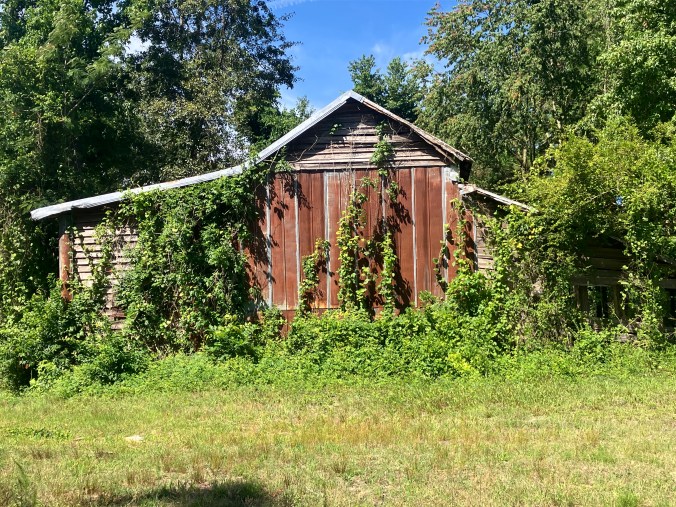
Tobacco barn, Browntown, N.C. Photo by David Cecelski
As we explored the community’s nooks and crannies, Ignacia recited the family names that lived on the roads where we were traveling. Most were families that had been in there far beyond any living person’s memory.
There were Browns, of course, but also Grants– Ignacia’s great-grandmother was a Grant– and also many other families.
I remember Ignacia mentioning families by the name of Wade, Mills, Scott, Suggs, Jones, Sutton, Braxton, and Dixon. She may have mentioned others that I can’t recall now.
Ignacia told me that she has found evidence of Browntown dating back at least to the early 1800s, but the community is possibly far older.
She told me that she still has much research to do, and she is still working her way back in time.
Browntown may have its origins in the early 1800s, but the community may also have been born in the days of the American Revolution or even the first decades after the Tuscarora War.
“We are here visible but not visible,” Ignacia told me as we went up and down the community’s roads.
By that, if I understood her correctly, she meant that Browntown is a special place, and one that belongs in the heart of our state’s history, but that no history books or historical markers have ever told its story.
Maybe that will change one day. But I think Ignacia already knows: in some fashion or another, she is the one who has been called to tell Browntown’s story.
My day in Browntown was magical. Ignacia and her father David were wonderful guides. They brought the community’s past to life.
Listening to their stories, I could hear the ways that rich and diverse strands of our history– rooted in Africa, in Europe, and in Native America– came together and continue to come together there in Browntown.
I look forward to learning more about Browntown.
Every time I talk with Ignacia, she seems to have some exciting new discovery to share with me, some new tale from a community elders or a new map or a deed that she found in an archive.
As I listen to Ignacia, the story of Browntown’s past just gets more and more interesting– and I grow more and more sure that Browntown will be seen and remembered.
 David Cecelski
wonderful history. Thx so much.
LikeLike
David, Everything you write is always interesting. Hyde is suffering from the dry corn fields and the extremely hot weather. My store employees are hoping that customers will get out in this heat and visit us, but so far, not nearly enough of that. RS
LikeLike
David, you find and write NC black history so well.
Browntown? I only vaguely remember folks mentioning Browntown before my mom moved baby sister and me from Kinston to North Jersey in 1965 when I was 14. We lived in K-Town’s city limits in the Projects most of the time. My mom was a Waccamaw Siouan and Caucasian who identified as Black and married Black men but ended up raising her four girls as a single mother. Don’t know why Im telling you all this but thanks for reading. And thanks for writing the history you write.
I’m currently writing a thinly disguised autobiographical fictional fantasy movie just to discover who I really am before I leave the planet.
Reading your articles inspire me (AND guess what? I’m still tweaking/rewriting What The River Knows to get a manager or agent interested in shopping it around. The good thing is that It actually gets better with each rewrite. So perhaps we will see it on the silver screen one of these years.
Gratitude.
[image: FB_IMG_1753029066789.jpg] Playingod Films Presents https://www.facebook.com/ILMfilmmaker Alicia Inshiradu: CEO, Filmmaker, Screenwriter, Playwright, Producer, Director
LikeLike
Kudos to Ignacia and her dad for their stewardship of Browntown’s history!
LikeLike
Thank you Ms. Henderson, it’s a journey of some sort and impacts how we view the past, present, and future.
LikeLike
A place I have passed through numerous times. Thanks David and also the Browns for sharing and preserving this important history.🙂
LikeLike