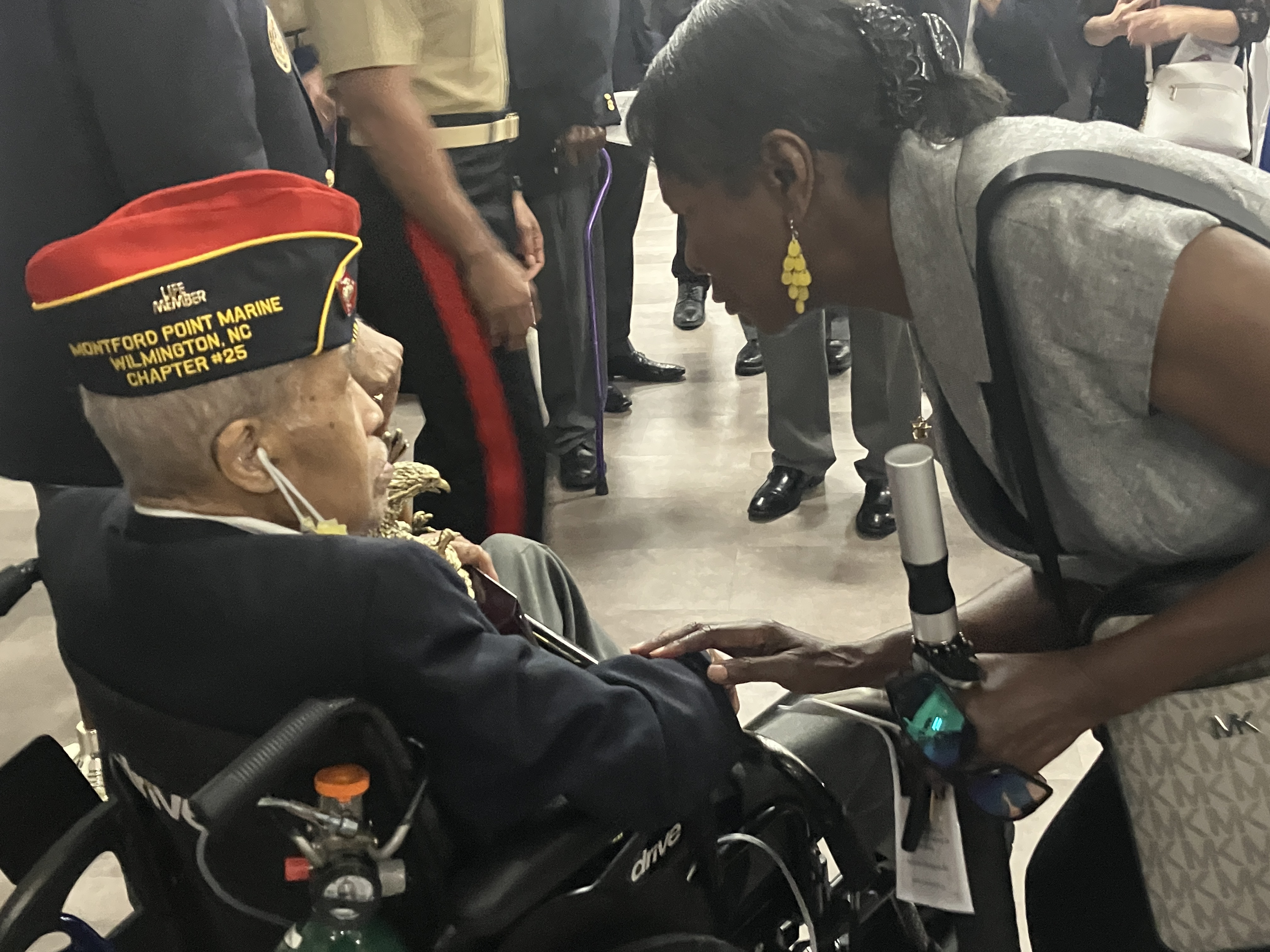
My friend Terri Everett greeting her friend, U.S. Marine Corps Ret. Gunnery Sgt. Francis M. Hooper, Jr., at the 17th Annual Montford Point Marines Day Ceremony at Camp Gilbert H. Johnson on August 28. Gunnery Sgt. Hooper was one of the first African Americans to serve in the U.S. Marine Corps and will soon celebrate his 98th birthday. (U.S. Marine Corps photo by Cpl. Jessica J. Mazzamuto)
At the end of last week, I was in Jacksonville, N.C., for a couple days to do historical research. While I was there, a friend invited me to join her at the Montford Point Marines Day Ceremony. I wrote this that night.
This morning I had the great pleasure of attending the 17th Annual Montford Point Marines Day Ceremony at Camp Gilbert H. Johnson here in Jacksonville, N.C.
Every summer the event is held in honor of the first African American men to serve in the United States Marine Corps.
On June 1, 1942, the United States began enlisting African American men to serve in the U.S. Marine Corps for the first time.
The first 1,200 black volunteers began a racially segregated boot camp at Montford Point three months later.
Between 1942 and 1949, 20,000 black Marines would come through Montford Point, which was a section of Camp Lejeune, the sprawling, 200+ square mile base here next to Jacksonville.
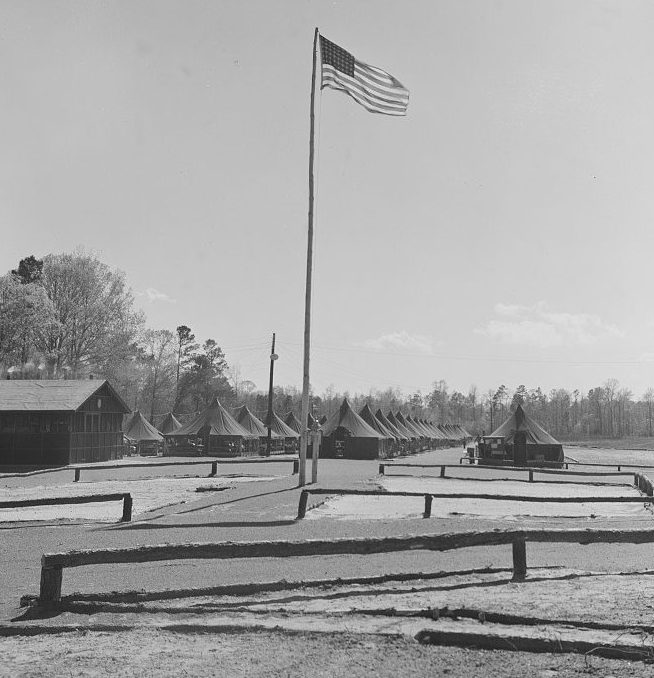
Quarters of the 51st Composite Battalion, Camp Montford Point, March 1943. Photo by Roger Smith, OWI. Courtesy, Library of Congress
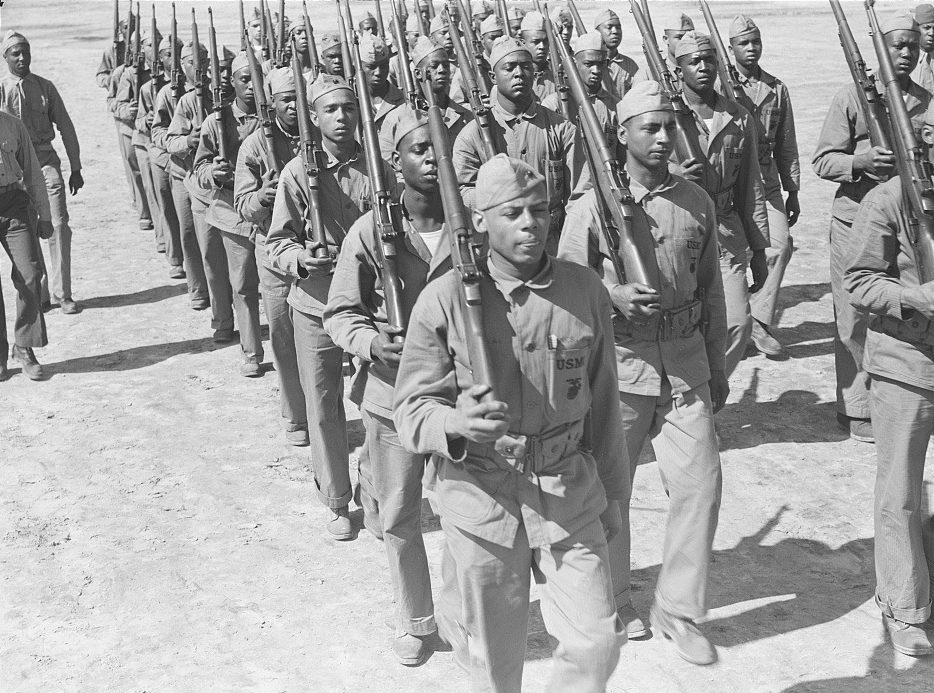
Drilling at Camp Montford Point, March 1943. Photo by Roger Smith, OWI. Courtesy, Library of Congress
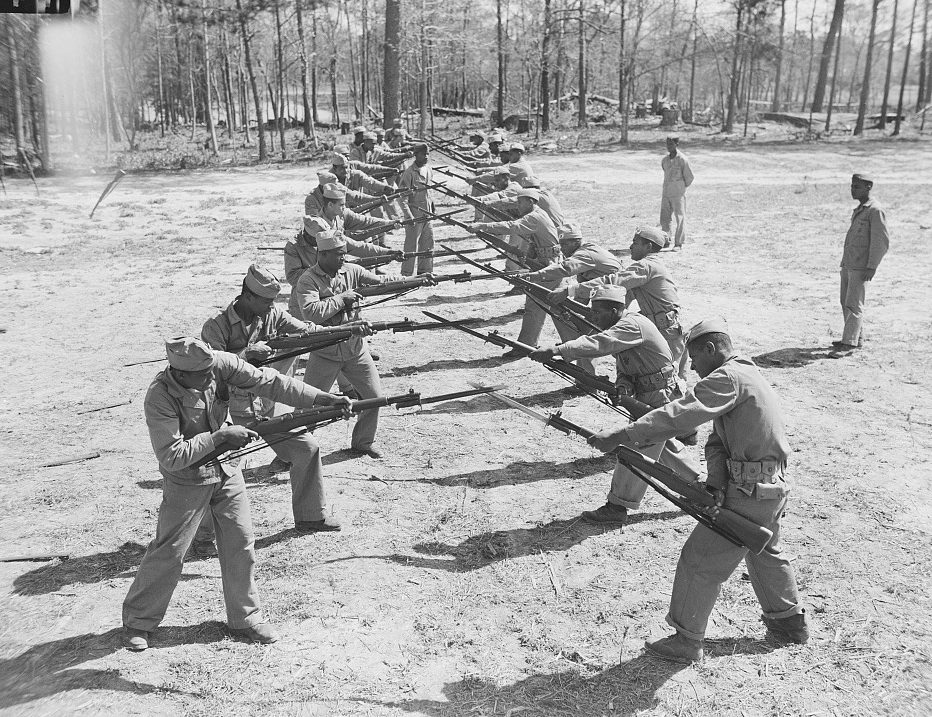
Bayonet drill at Camp Montford Point, March 1943. Photo by Roger Smith, OWI. Courtesy, Library of Congress
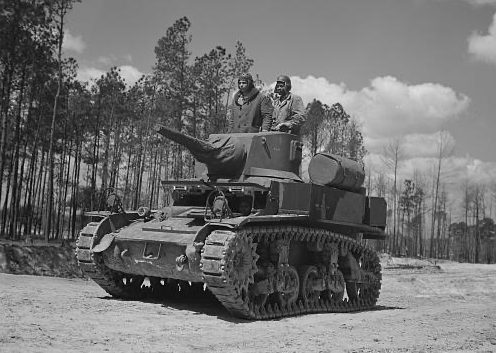
Montford Point Marines on training maneuvers with a mounted 90mm anti-aircraft gun, March 1943. Photo by Roger Smith, OWI. Courtesy, Library of Congress
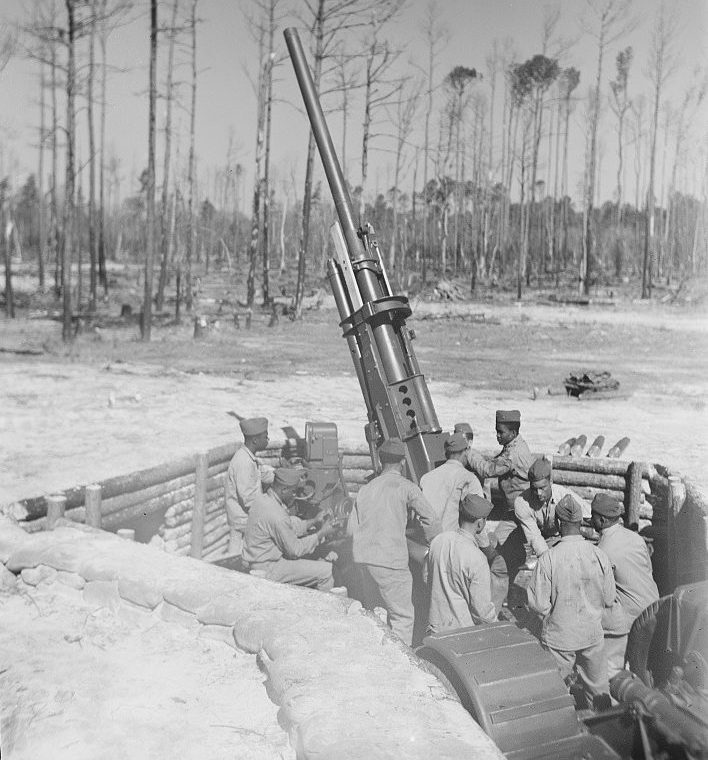
Training in anti-aircraft gunnery, Camp Montford Point, March 1943. Photo by Roger Smith. Courtesy, Library of Congress
Those first black Marines comprised the 51st Composite Defense Battalion, an anti-aircraft and coastal defense unit whose original mission was to act as air and coastal defense for naval bases in the Pacific.
The men of the 51st faced racial hostility and discrimination within the ranks, and they encountered the worst of Jim Crow in Jacksonville.
Yet they endured, going on to serve their country and open doors for future generations of black Marines.
I found the ceremony today deeply moving. Originally scheduled to occur at the Montford Point Marine Memorial, the event’s organizers moved the ceremony to Camp Gilbert H. Johnson because of the threat of bad weather.
Camp Gilbert H. Johnson is the former site of Montford Point and remains a satellite camp of Camp Lejeune.
The camp is named in honor of Sgt.-Maj. Gilbert “Hashmark” Johnson, one of the first African Americans to serve in the U. S. Marine Corps, one of the first to be trained as a drill instructor, and one of the first to lead combat patrols overseas– in his case, in Guam.
Early this morning, a large crowd of Marines, sailors, and civilians gathered in an auditorium at Camp Johnson. City and county officials and faith leaders were among them.
At least seven of the Montford Point Marines were in attendance. None of them was young. One was about to turn 98.
All of them looked proud to be there.
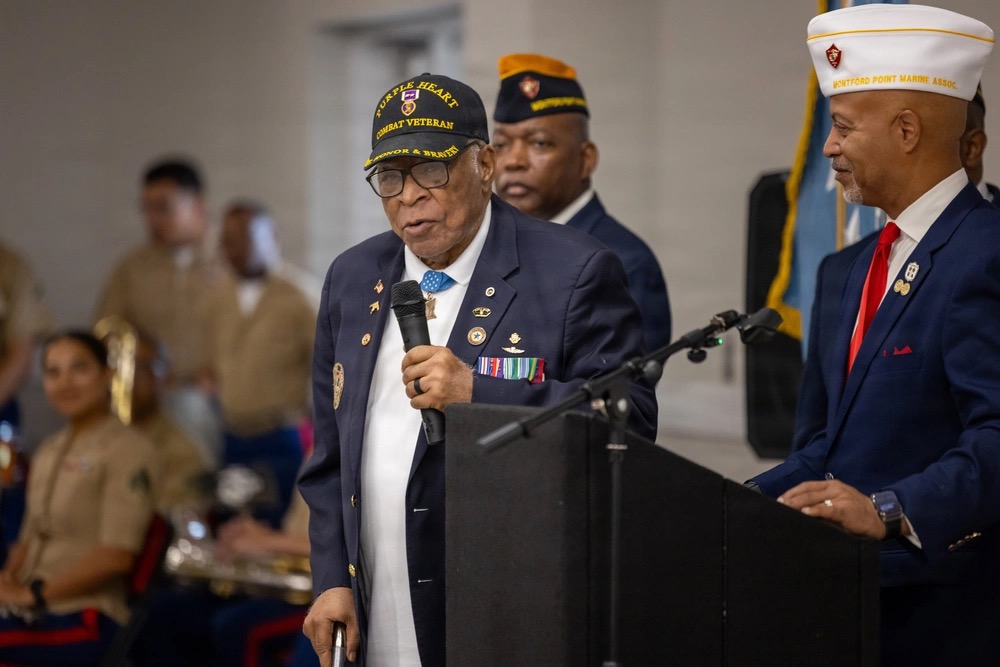
U.S. Marine Corps Retired Maj. James C. Capers Jr., a Medal of Honor recipient, also spoke at the 17th Annual Montford Point Marine Day Ceremony. Maj. Capers was also one of the Montford Point Marines. Photo courtesy, U.S. Marine Corps
They had come from all over the country to be at the ceremony.
Mr. Ronald C. Johnson, a retired USMC gunnery sergeant and the president of the National Montford Point Marine Association, spoke of the Montford Point Marines’ history.
“This is not just black history. This is not just Marine Corps history. This is American history,” he intoned.
Camp Lejeune’s commanding officer, Brig.-Gen. Andre M. Ingram, delivered a stirring keynote address in which he gave homage to those first black Marines.
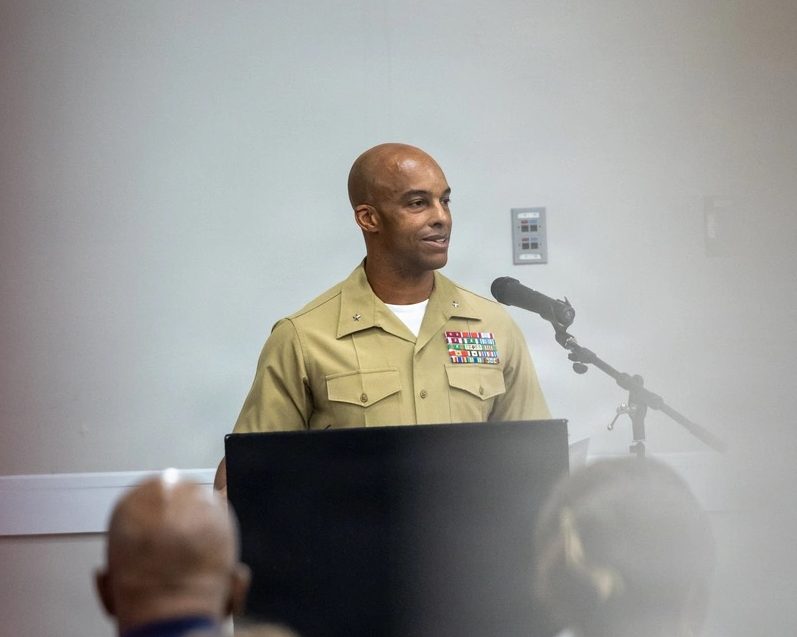
U.S. Marine Corps Brig.-Gen. Andre M. Ingram, the commanding general of Camp Lejeune, was the keynote speaker at the 17th Annual Montford Point Marine Day Ceremony. (U.S. Marine Corps photo by Cpl. Jessica J. Mazzamuto)
My father was a career Marine and I grew up around the Marine Corps, but I had never heard a Marine Corps officer give such a personal address. Brig.-Gen. Ingram, who is African American, spoke of his father, who became a Marine a generation after the Montford Pointers.
He spoke too of himself coming to Camp Gilbert H. Johnson— the former Montford Point– as a young lieutenant 30 years ago and knowing very little about the Montford Point Marines at that time.
He spoke of how much it meant to him personally to learn the history of the Montford Point Marines.
I thought that his words could not have been more sincere or heartfelt.
When he looked over to the surviving Montford Point Marines in attendance and thanked them for their service and their sacrifices, you could have heard a pin drop in that auditorium.
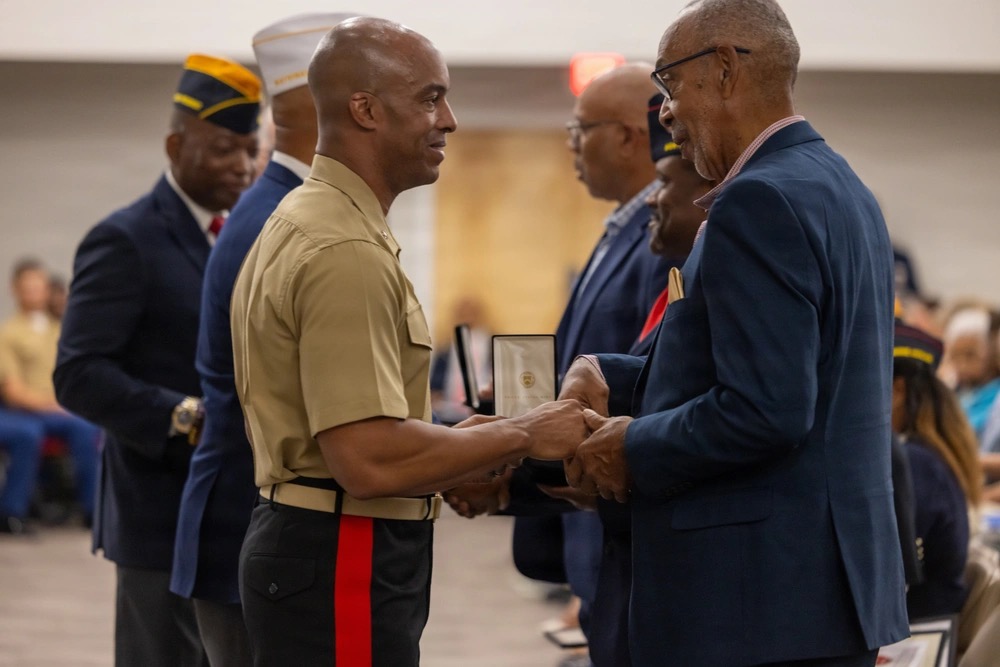
At the ceremony, Brig.-Gen. Ingram, awarded the Congressional Gold Medal posthumously to 11 Montford Point Marines. The Marines’ families had come from all over the U.S. to accept the honor on behalf of the recipients. (U.S. Marine Corps photo by Cpl. Jessica J. Mazzamuto)
For that moment, the general seemed to be simply a son or grandson showing his gratitude and respect to his father or grandfather.
The black-and-white photographs above and those below were taken by a pioneering black photographer named Roger Smith in the spring of 1943.
Now preserved at the Library of Congress, they are the fullest portrait we have of Camp Montford Point during World War II.
I thought it might be fitting to share a few of them here today.
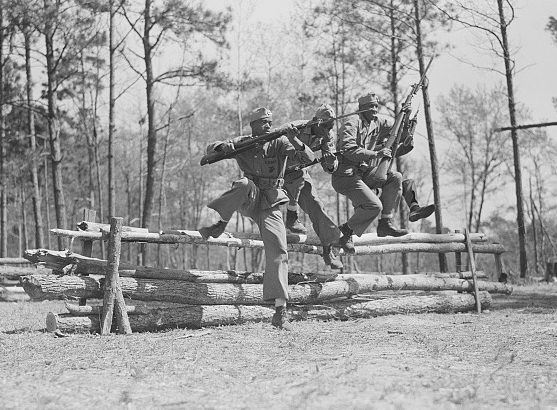
Bayonet and obstacle course training, Camp Montford Point, March 1943. Photo courtesy, Library of Congress
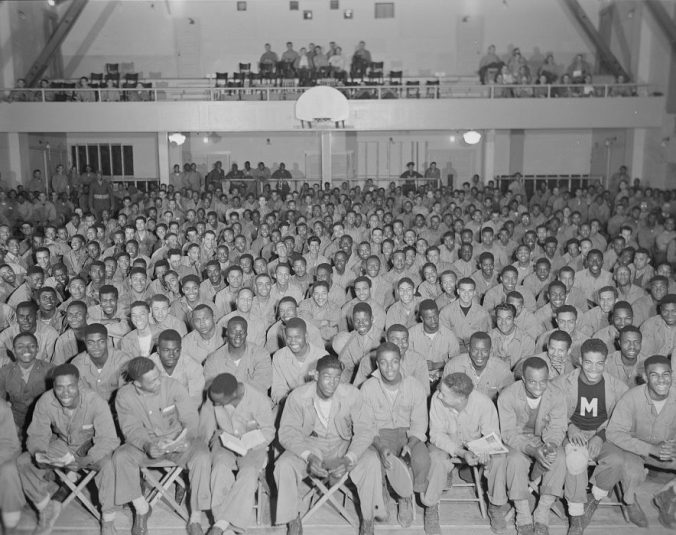
Roger Smith’s notes refer to the scene in this photograph as a ” social gathering” of the 51st Composite Battalion, perhaps a concert, movie or a USO show. Photo by Roger Smith. Courtesy, Library of Congress
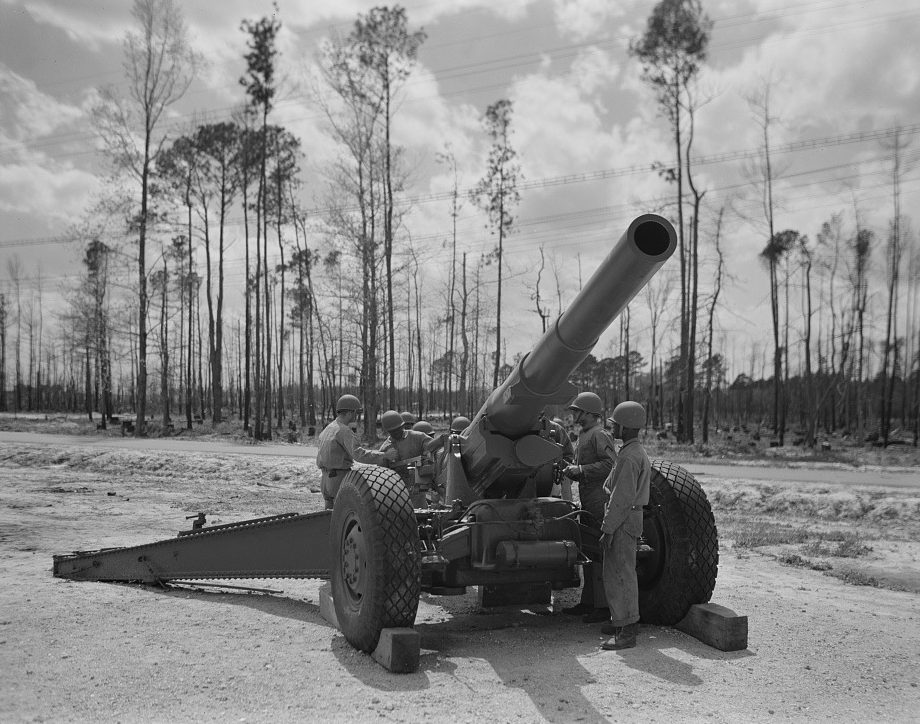
Training to use a 155-mm coast defense gun. Photo by Roger Smith. Courtesy, Library of Congress
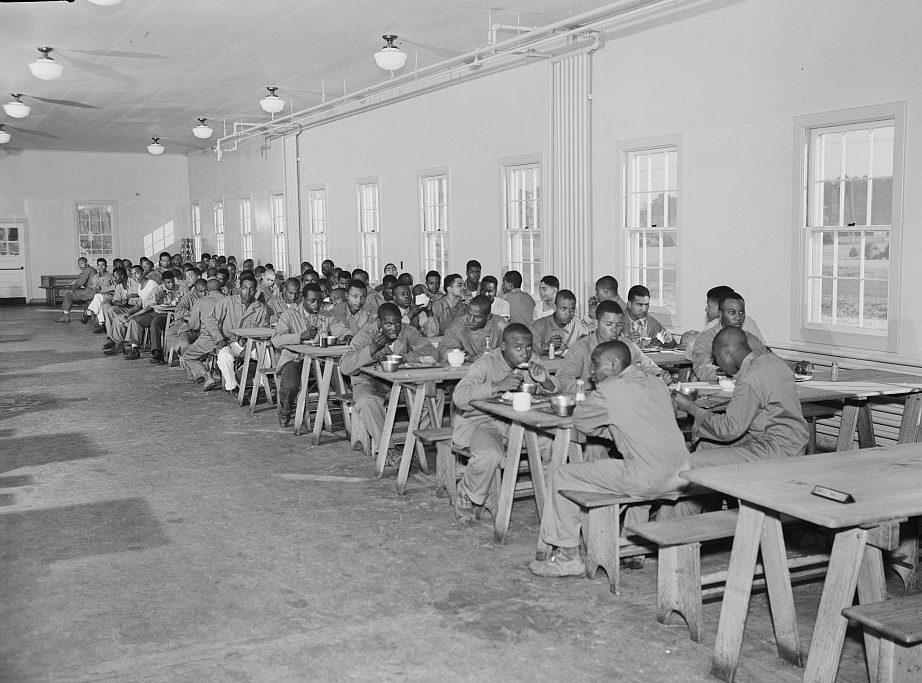
Lunch at the mess hall, Camp Montford Point, March 1943. Photo by Roger Smith. Courtesy, Library of Congress
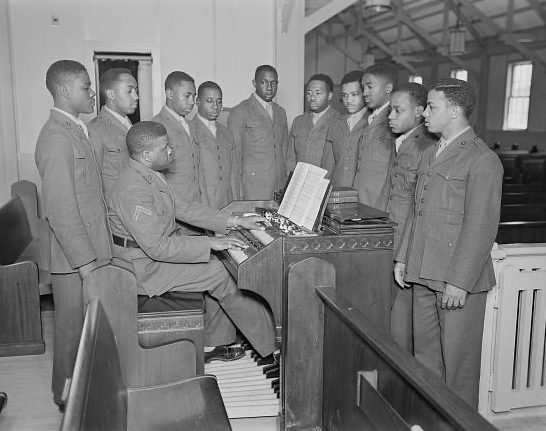
Men from the 51st Composite Battalion at a choir rehearsal at Montford Point’s chapel. According to Roger Smith’s notes, Private First Class Walker Manly is the organist. Photo by Roger Smith. Courtesy, Library of Congress
A native of Baltimore, Roger Smith was employed at that time by a new federal agency called the Office of War Information (OWI).
In 1942 and ’43, he was the only photographer in what was called OWI’s Negro Press Section.
He documented black wartime life and military service in the U.S., then distributed the photographs to the Pittsburgh Courier, the Chicago Defender and more than 200 other black-owned newspapers.
If you’d like to learn more about the Montford Point Marines, I highly recommend a visit to the Montford Point Marine Museum and the Montford Point Marine Memorial here at Camp Lejeune.
There are also several interesting books about the history of the Montford Point Marines, but I am especially fond of Melton McLaurin’s The Marines of Montford Point: America’s First Black Marines.
Dr. McLaurin’s book is made up of oral histories with 60 Montford Point veterans. He lets the men tell their own stories to the extent possible, and I found their every word compelling.
 David Cecelski
A very informative article by a great writer.
LikeLike