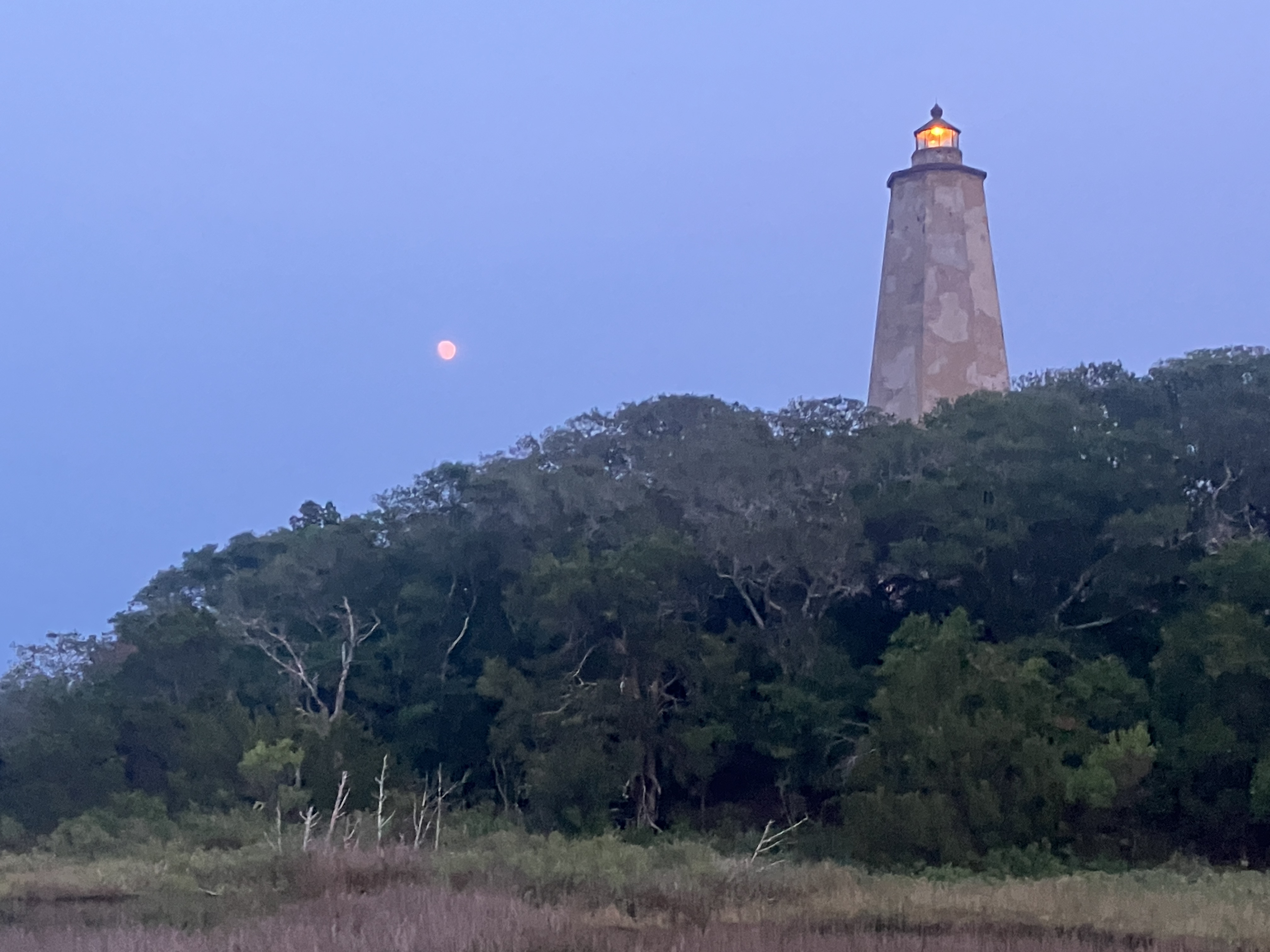
The Bald Head Light, known affectionately as Old Baldy, was first lit in 1817 and is North Carolina’s oldest lighthouse. Photo by David Cecelski
This is the last of my missives from my recent trip along the Cape Fear River, beginning in Fayetteville and ending up at Bald Head Island.
I wrote this one while I was still on Bald Head Island.
This morning I am at the mouth of the Cape Fear. I can see “Old Baldy,” the island’s lighthouse, just down the road here.
Beyond the inlet, I can see the Oak Island Light. Across the way is Cape Fear, Frying Pan Shoals and the Atlantic.
I took the ferry out here two nights ago. Last night I gave a lecture here for the Old Baldy Foundation.
My lecture was based on my book The Waterman’s Song, which focuses on the history of African American maritime life and rebellion on the North Carolina coast from the 17th century through the Civil War.
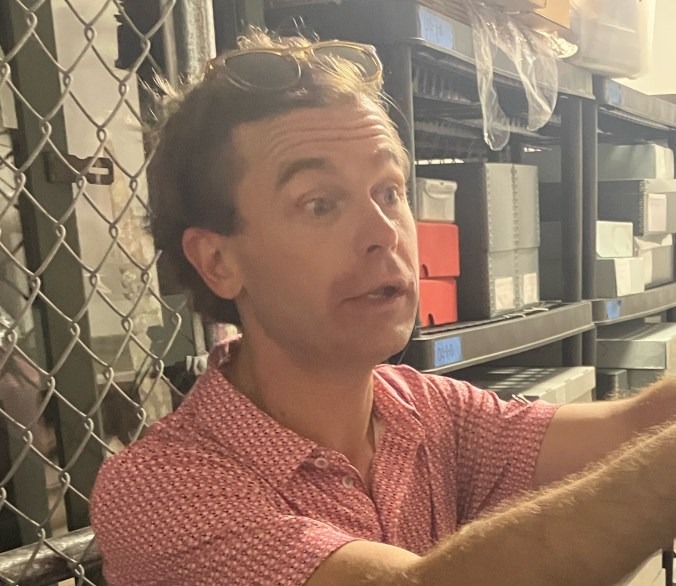
While I was on Bald Head Island, the wonderful public historian Travis Gilbert gave me a tour of the treasures in the Old Baldy Foundation’s archival storage facility. Photo by David Cecelski
The audience was wonderful. My hosts were more than gracious. The view, spectacular.
From where I stood to give my lecture, I was facing a large bay window out of which I could watch a flock of ibis feeding in the salt marsh. It was a lovely place to talk about our coast’s history.
I have been on the road a lot this year, often feeling, considering the times we are in, as if I was telling stories while they can still be told.
Earlier in the day, before my lecture, I had the great pleasure of touring both the Old Baldy Lighthouse and Smith Island Museum and the museum’s off-site archival storage facility.
My guide, Travis Gilbert, is a public historian and preservationist who is extremely knowledgeable about Bald Head Island’s history.
Currently, Travis is also the Old Baldy Foundation’s director of philanthropy.
Travis took me first to the museum’s archival storage facility. It is a temperature and humidity controlled warehouse where the Old Baldy Foundation preserves historical manuscripts, photographs, and other artifacts for which the museum currently has no space for public display.
I love visiting places like that: you never what discoveries lie waiting within them.
We could only stay for a short time, but while we were there, Travis showed me the original copy of a famous 1806 pen-and-ink drawing depicting a waterspout at the mouth of the Cape Fear River.
It is an amazing scene: it shows the waterspout, the lighthouse that was here at the time, and a seagoing vessel that looks as if its captain has just run the inlet and is headed out to sea.
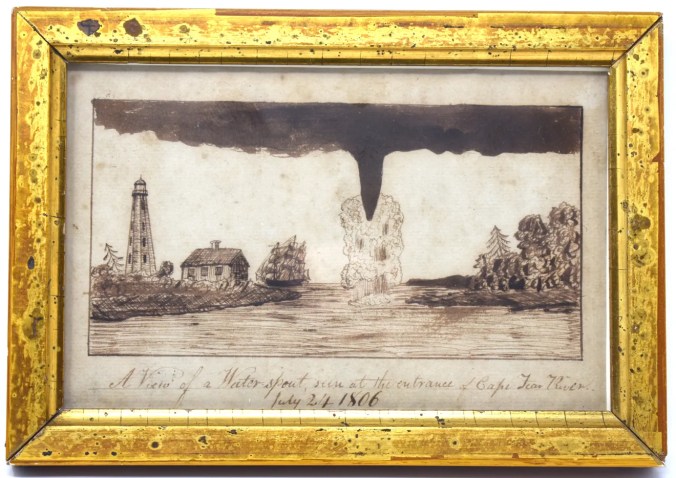
One of the highlights of Travis Gilbert’s tour of the Old Baldy Foundation’s archival storage facility was this pen-and-ink drawing of a water spout at the mouth of the Cape Fear River and of Bald Head Island’s first lighthouse in the summer of 1806. .Affectionately known as “Old Baldy,” the current lighthouse dates to 1817. Courtesy, Old Baldy Foundation
It is the only known image of Bald Head’s first lighthouse, which was here on the island from 1794 to 1813, other than a little sketch that appeared on a map in 1794.
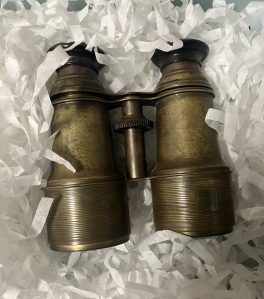
The Old Baldy Foundation’s collection includes these binoculars belonging to one of the lighthouse’s keepers in the early 20th century. Photo by David Cecelski
While we were at the storage facility, Travis also showed me other interesting historical artifacts.
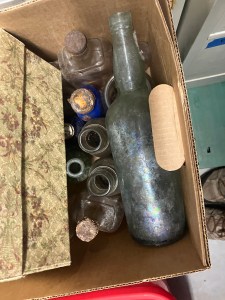
At the Old Baldy Foundation’s archival storage facility, boxes of treasures, big and small, were everywhere. Photo By David Cecelski
I was especially excited to see a ledger of local shipwrecks that was kept at the Cape Fear Life Saving Station from 1883 to 1906.
The ledger lists every shipwreck on the waters around Bald Head Island during that period.
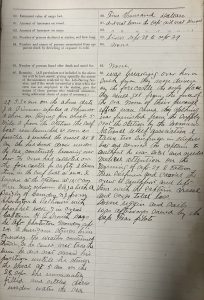
A page from the log of local shipwrecks that was kept at the Cape Fear Life Saving Station from 1883 to 1906. The log is preserved in the collections of the Old Baldy Foundation. Photo by David Cecelski
I would have loved to spend a whole day with the log. It is marvelously detailed: every entry describes the vessel and its cargo, the captain and crew, the weather or other circumstances that led to the wreck, the rescue attempt, if one could be made, and the losses of cargo and human life.
Just looking through the logbook quickly, I got the feeling that, with time and patience, and a little creativity, you could forge a compelling work of maritime history simply out of the information on its pages.
By the time that Travis pried the logbook from my hands and dragged me kicking and screaming out of the storage facility, it had grown late in the morning.
All the same, we could not resist a short stop at the Old Baldy Lighthouse and Smith Island Museum so that he could show me at least one artifact that was on public display there.
That artifact was a rare gold gilded tunic button from a British officer’s coat dating to the American Revolution. UNC-Wilmington archaeology students discovered the button on the island just a few years ago.
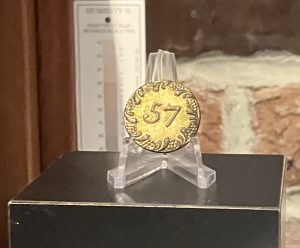
A rare 1776 King George III gold guinea coin was on display at the Old Baldy Lighthouse and Smith Island Museum on Bald Head Island. Photo by David Cecelski
The button’s importance was symbolic. It evokes the experience of the American Revolution on the island.
During the Revolution, British generals established a small fort and hospital called Fort George on the island and used it as a staging ground for blockading American shipping into the Cape Fear River.
The gold button is a relic of that moment, now 250 years ago, back when the United States of America was just being born.
* * *
After my lecture last night, I visited with some friends of friends who are staying out here, but then I had most of the evening to myself.
A little before sunset, I walked out to the ibis rookery, then spent an hour or so strolling along the marshes below the lighthouse.
At dusk I listened to the clapper rails calling back and forth, and when it got darker and they went silent, I just enjoyed the quiet.
While I was down at the marsh, I thought about the places I had gone, the things I learned, and the host of brilliant and dedicated educators with whom I had the chance to work.
They were all just so inspiring. To see how caring they were, and how strong, and how thoroughly they understand how much we look to them in these times– they really did fill me with hope.
As I walked along the marsh in the dark, the lighthouse flickering just across the way, I lifted a little prayer of gratitude to them all.
And I hoped that they believe what I told them at the end of every event where I had a part, that I will always come when they call.
-End-


Might call this spring for a little visit to my marine science class…
LikeLike
You know I’ll come if you call– answer is always yes for you!
LikeLike