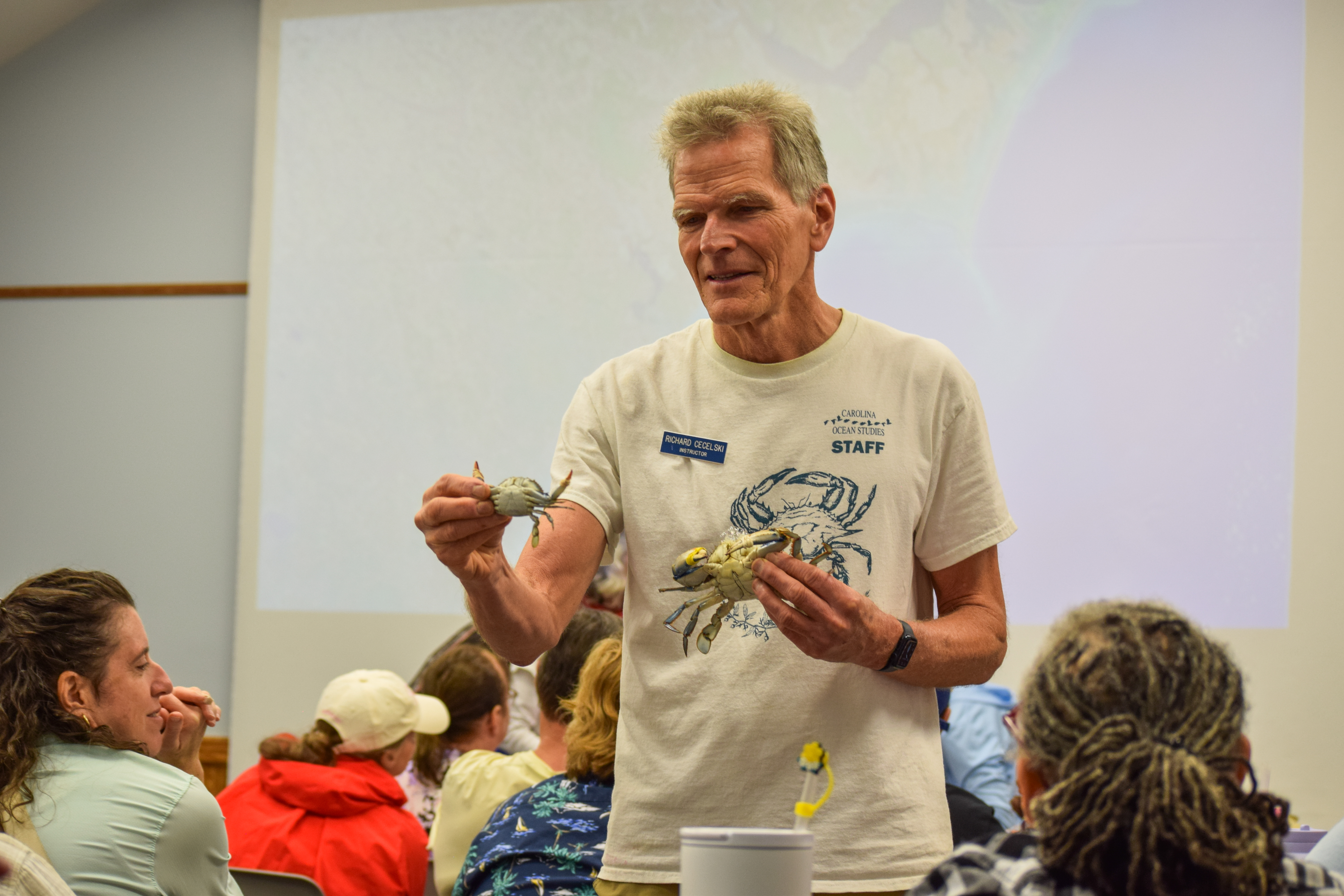
My brother Richard is the founder and director of Carolina Ocean Studies. Over the last 34 years, he and his family and their staff have introduced hundreds of thousands of schoolchildren to the wonders of the North Carolina coast. COS has two bases– one in Carolina Beach, the other in Carteret County. Photo courtesy, Carolina K-12
This was my third stop on a 5-day ramble I took along the Cape Fear River a couple weeks ago.
As I continued my little journey from Fayetteville to the sea, I followed the Cape Fear River south, stopping for a night at my brother and sister-in-law’s home in Carolina Beach and then joining them the next morning at Carolina Beach State Park, 12 miles south of Wilmington.
Cori Greer-Banks and her colleagues at Carolina K-12 had collaborated with Richard and Sandie to create a special coastal experience for the more than 50 teachers who were enrolled in “Harbors of Democracy.”
Richard is the founder and director of Carolina Ocean Studies, a wonderful marine education outfit that organizes coastal field trips for school groups from across North Carolina.
(Richard and Sandie’s son Jake is now COS’s director of field operations, but he was out of town this day.)
Over the last 34 years, COS has introduced hundreds of thousands of schoolchildren to the wonders of the North Carolina coast.
This trip however was to be a special study trip for the Carolina K-12 teachers, and it was going to focus on how the land and sea shaped the history of Wilmington and that whole part of the coast.
Richard and Cori had planned to take the teachers to Masonboro Island, an uninhabited and incredibly beautiful barrier island that is located just north of Carolina Beach.
The 8.4-mile-long island is now a state nature preserve, and it is one of the coastal sites where Carolina Ocean Studies often takes school groups.
However, the storm that had hit us in Wilmington the night before was still with us the next morning.
The thunderstorms had grown more scattered, but there was still too much wind and rain to go out to the island.
Soon after first light, Richard and Cori had to cancel the workshop’s boat trip out to Masonboro, but they did not give up on providing a special coastal experience for the teachers.
Instead of going out to Masonboro, Richard, Sandie, and the COS staff proceeded to make a little magic happen.
They decided to move the morning’s session to the Carolina Beach State Park Visitor Center, then set about turning the center’s auditorium into a little piece of Masonboro Island.
Working hand in hand with Cori and her colleagues, they brought in scientific displays, seashells, wildlife puppets, a slide show, and a passel of live blue crabs in bins of seawater.
By the time they were done, we could almost feel the ocean breeze and the sand between our toes.
Here are a few photos of Carolina Ocean Studies and Carolina K-12 doing what they do– and some very enthusiastic teachers who seemed to be learning a lot and having a lot of fun.
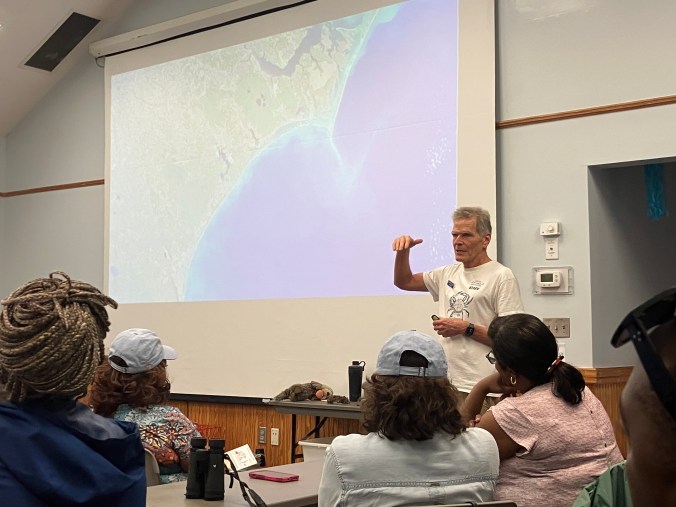
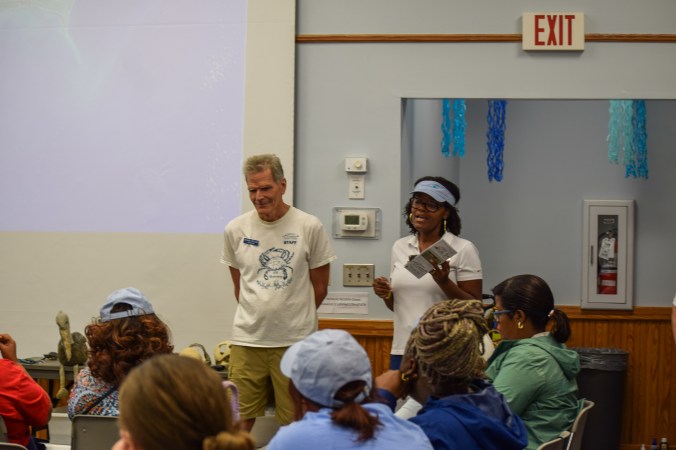
Here we see Richard discussing the ocean currents, tidal forces, and geological processes that shaped and continue to shape the unique character of the North Carolina coast. (I taught him everything he knows.) Richard and his son Jake head a very talented staff of marine educators who run field trips for school groups to Masonboro Island, the Cape Lookout National Seashore, and other points along the North Carolina coast. Photo by David Cecelski
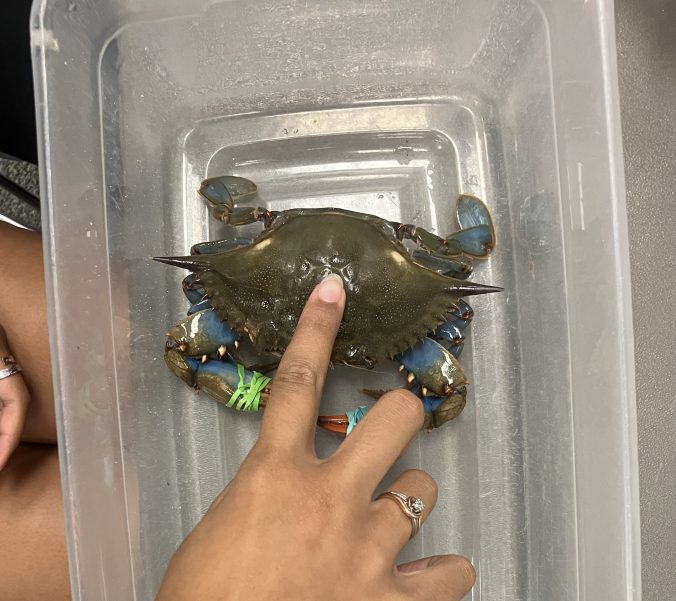
One of the morning’s presentations that most captivated me was on the biology of blue crabs, one of the marine species that the teachers would have caught and studied if we had been able to go out to Masonboro Island. Since we could not go out to the island, COS staff brought live blue crabs into the visitor center at the state park. In this photo, we see one very brave teacher touching a live blue crab for the first time. The presentation was part of in-depth discussion of estuaries and their importance to marine life and the state’s commercial fisheries. Photo by David Cecelski
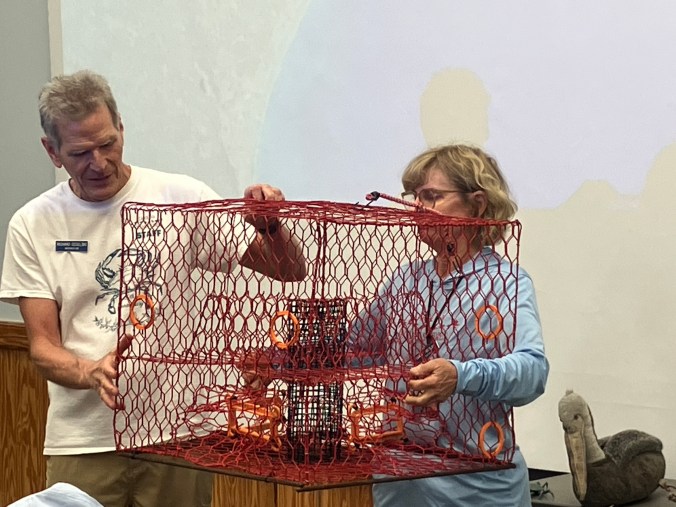
At the Carolina K-12 workshop, Richard and Sandie demonstrated how a crab pot works. Sandie has always been a big part of Carolina Ocean Studies, but she’s also had a remarkable career as a schoolteacher. For most of her 30+ years in the classroom, Sandie was a marine biology and oceanography teacher in New Hanover County’s public schools, while also helping out COS in a hundred different ways on the side. Among Sandie’s many accomplishments, she founded the Marine Science Academy at Ashley High School, a signature, four-year program that features college-level oceanography and marine biology classes, hands-on fieldwork, and career-focused local partnerships. Photo by David Cecelski
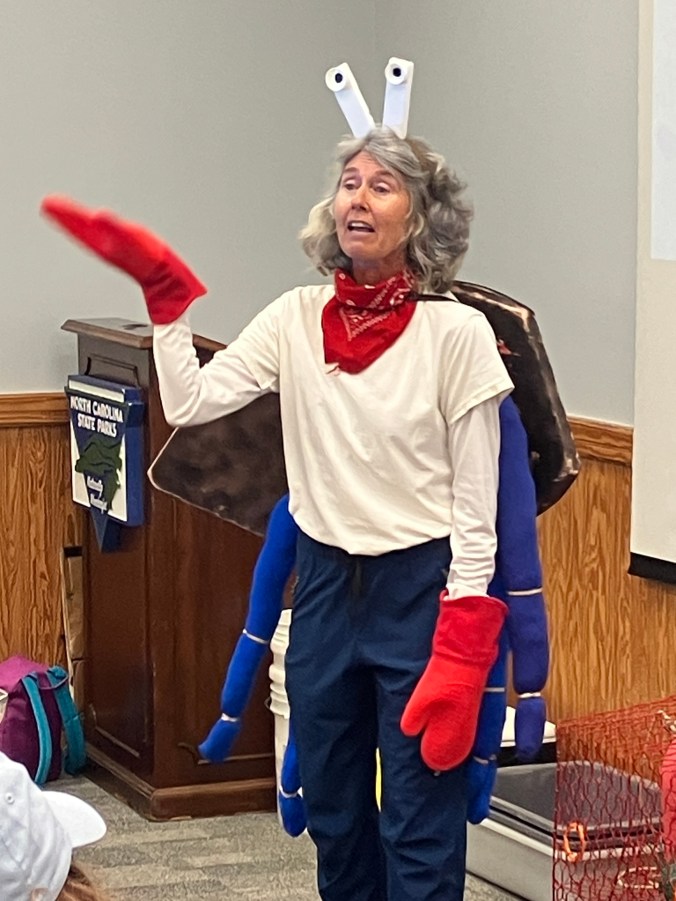
As part of the COS presentation, staff member Kathleen Van Keuren morphed into a blue crab to explain her species’ life cycle and the blue crab’s importance to the our coastal economy. Kathleen was a middle school teacher in Wake and New Hanover County for 20 years before retiring and moving to Carolina Beach. Her students must have loved her! Looking pretty spectacular in her crab get-up, Sally– her crab name– did a phenomenal job educating us about the blue crab life cycle and its importance to our marine environment and the coastal economy. (In the blue crab business, a “sally” is the term for an adolescent or immature female crab.) Photo by David Cecelski
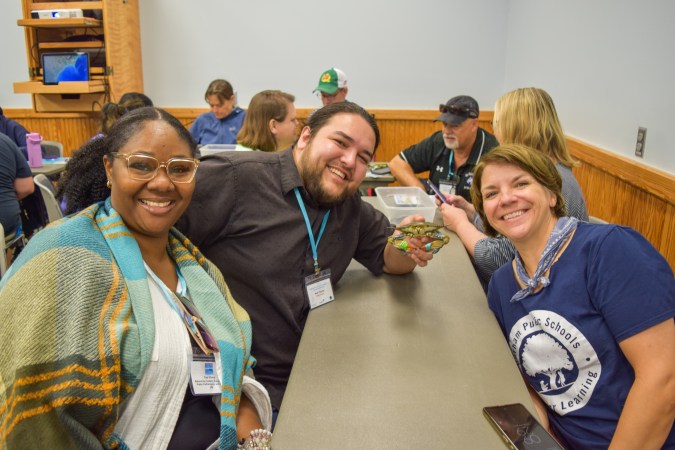
Needless to say, the teachers were into it! Photo courtesy, Carolina K-12
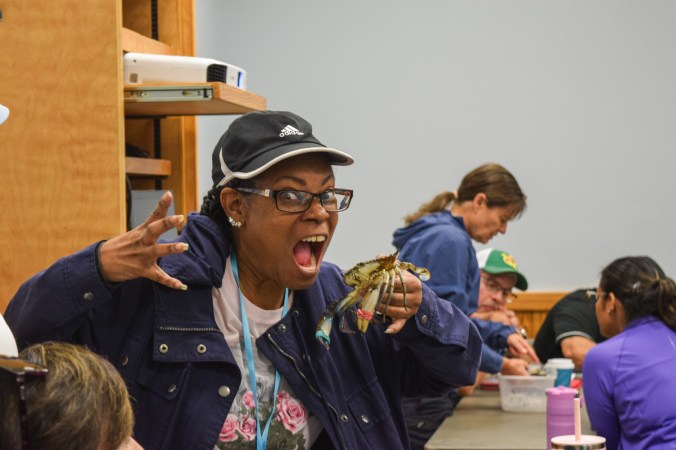
Some– like Lanelle Sutton from Wayne County– more than others! Photo courtesy, Carolina K-12
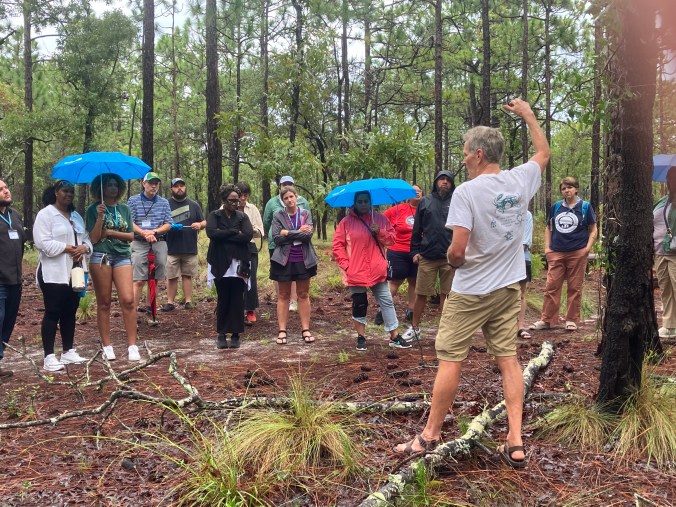
We also got lucky. In the middle of the morning session, we had a half-hour break in the storm. Richard seized the moment: he lead us outside to a nature trail that runs through a longleaf pine savanna just behind the Carolina Beach State Park Visitor Center. Once out there, in just a bit of a drizzle, he talked about longleaf pine ecology and the central role that the longleaf pine’s products– turpentine, tar, and rosin– played in the history of the Cape Fear region. Photo by David Cecelski
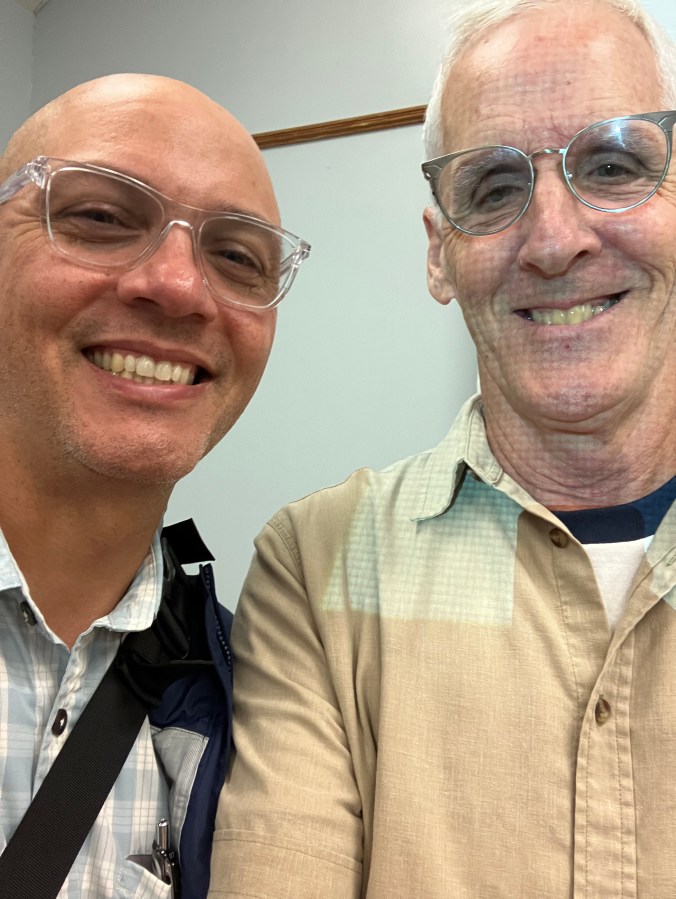
On our way out to the nature trail, I had the very great pleasure of visiting with Dr. Ryan Emanuel, a Lumbee environmental scientist who is a professor of hydrology at the Nicholas School of the Environment at Duke University. I had just finished his extraordinary new book, On the Swamp: Fighting for Indigenous Environmental Justice and I was grateful to have the opportunity to tell him in person how deeply impressed I was by the book. I consider it a landmark work of environmental history and a pivotal contribution in reimagining our relationship with the natural world. Dr. Emanuel had given a lecture to the Carolina K-12 workshop participants the night before and stayed in Wilmington overnight so that he could join the session that morning. Photo by David Cecelski
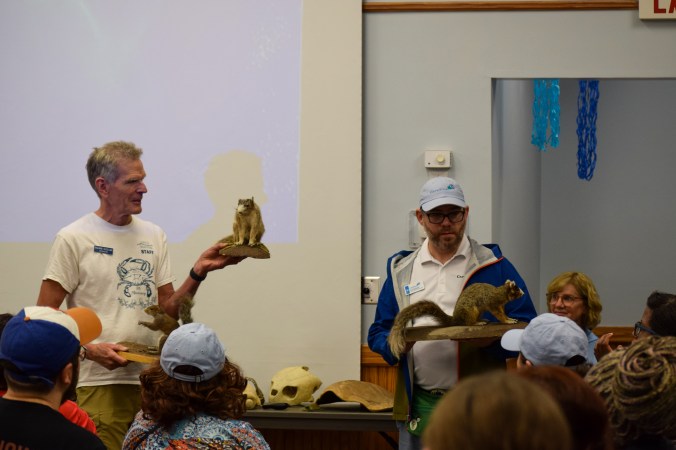
After we came back indoors, Richard discussed some of the animal species that are endemic to the longleaf pine ecosystem at Carolina Beach State Park and which once covered much of the Cape Fear region. In this photo, Richard and another gentleman, I believe one of the teachers, are holding fox squirrels from the taxidermy collection there at the Visitor Center. Photo courtesy, Carolina K-12
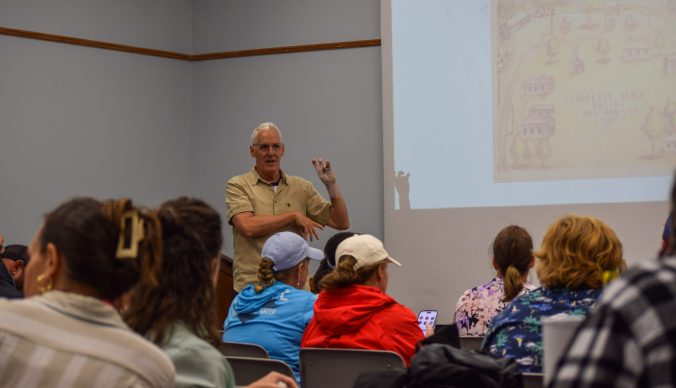
Later in the morning, I contributed a little bit to the workshop session by giving a lecture on the history of Seabreeze, an extraordinary, African American beach resort located on Myrtle Grove Sound from the 1920s into the 1950s. If we had been able to go out to Masonboro Island, COS’s boat would have passed by the site of Seabreeze. Photo courtesy, Carolina K-12
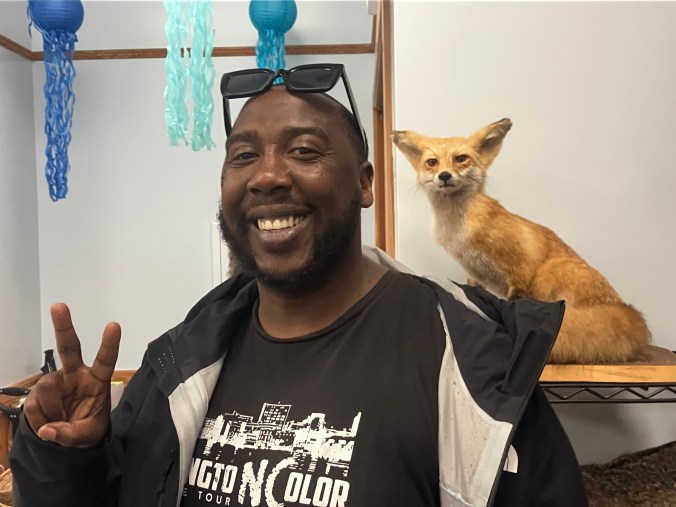
Whenever the teachers asked me a question about Seabreeze that I couldn’t answer, I turned to Cedric Harrison, who was also part of the Carolina K-12 workshop. A Wilmington native, Cedric is the founder and owner of WilmingtoNColor, which runs a host of tours on Wilmington’s black history and culture that are both good history and great storytelling. One of the tours focuses on the history of Seabreeze. Photo by David Cecelski
Two of the finest educators I know, my brother and Cori Greer-Banks, wrapping up Carolina K-12’s morning workshop at Carolina Beach State Park. Photo by David Cecelski
I thought the session was a work of genius. I know it was probably just another day for both Carolina Ocean Studies and Carolina K-12– they are used to pulling rabbits out of hats.
But to me it was no small thing. To take a rained-out trip and turn it in just a few hours into a thoughtful, exciting and memorable educational experience is a feat that was a wonder to behold.
And for me personally, it was especially nice to work with my brother and Sandie.
By the time we were done, the skies had opened up and rain was once again coming down on us.
I did not mind at all: even as I walked out into the rain, I was thinking about the teachers and how excited they were by the morning, and all the good they would do with what they had learned, and the children they would inspire.
Back at Richard and Sandie’s, I changed out of my wet clothes and took some time to reflect on the morning.
I was thinking that maybe it was time for a trip to Britt’s Donuts, or perhaps a run up to get an ice cream cone at the Kure Beach Fishing Pier.
Richard, on the other hand, barely took a breather. Right after lunch, he began to get his ducks in a row: Jake would be back in town the next day, and Richard, Sandie, and Jake and their staff would be taking a large group of 8th graders out to Masonboro Island a couple days later.
And as always, I knew, watching him, that my brother was going to do everything he could to make sure that those young people would have an experience that they would remember for the rest of their lives.
Next stop– Bald Head Island

