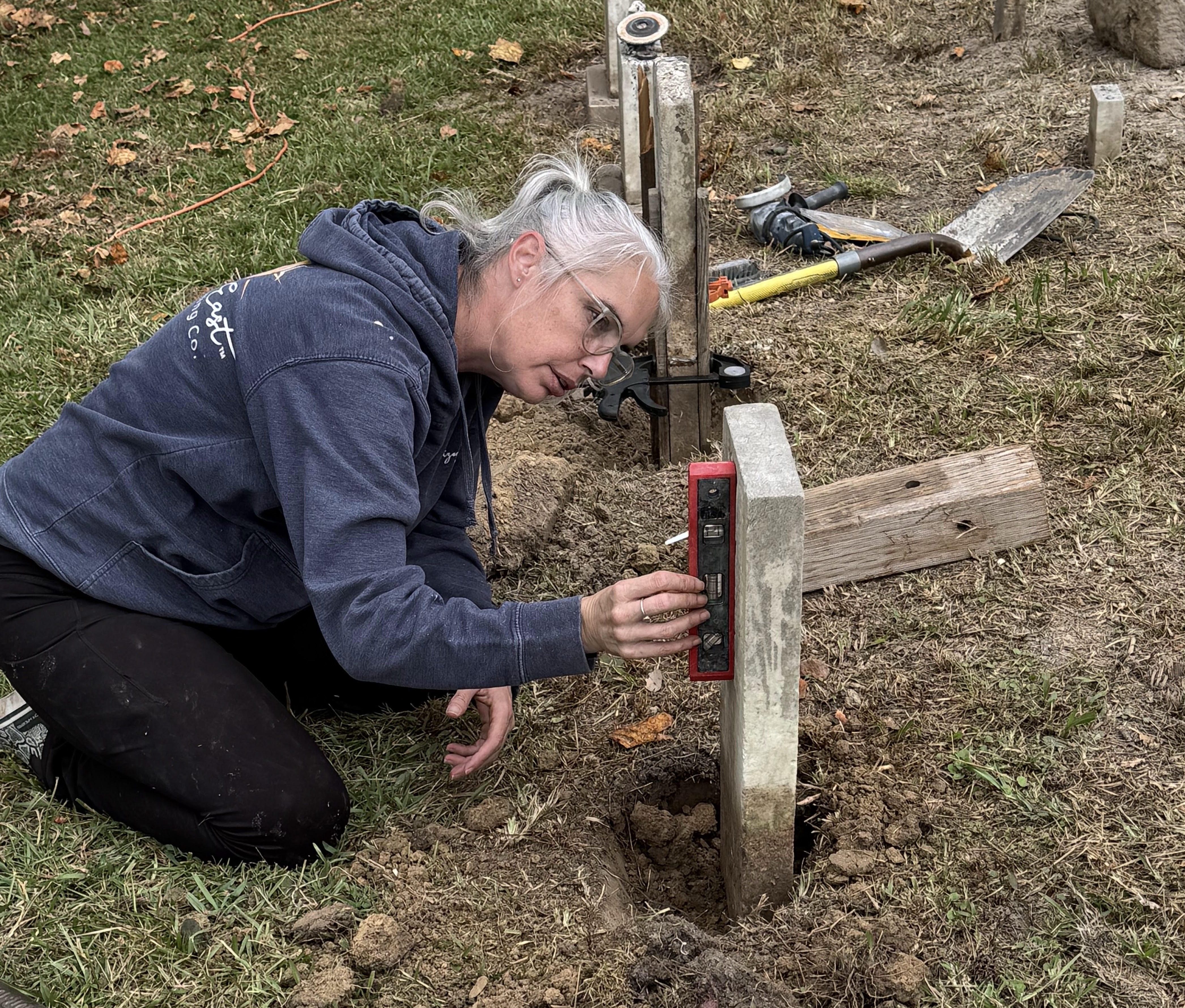
Sarah Biros navigating the difference between a level stone and a plumb stone at the Averitt-Stephens Cemetery in Richlands (Onslow County), N.C. Photo courtesy, Sarah Biros
On our way to Tar Landing, I asked Sarah Biros how she had come to be the one that looks after lost cemeteries.
Who finds them in the woods. Who clears away the brush. Who makes it so you can read the inscriptions again.
Who pieces the broken stones back together. Who finds the unmarked and long forgotten graves.
Sarah told me that it was in her blood. And then she went on to tell me about her great-grandmother, who lived to be 104 years old and was the one who tended the dead down in Tar Landing.
Tar Landing was a tiny little settlement back in the woods a little way up the New River from Jacksonville, N.C.
Sarah’s great-grandmother was Thelma Langley. She was born in 1904 and grew up on farm in Pender County.
She was raised in Pender County, down near Hampstead, but she married a man from Tar Landing.
She met her husband when he visited her family’s farm. He was selling seed peanuts to her father, and her father invited him to stay for dinner. He came back a month later and had dinner with them again.
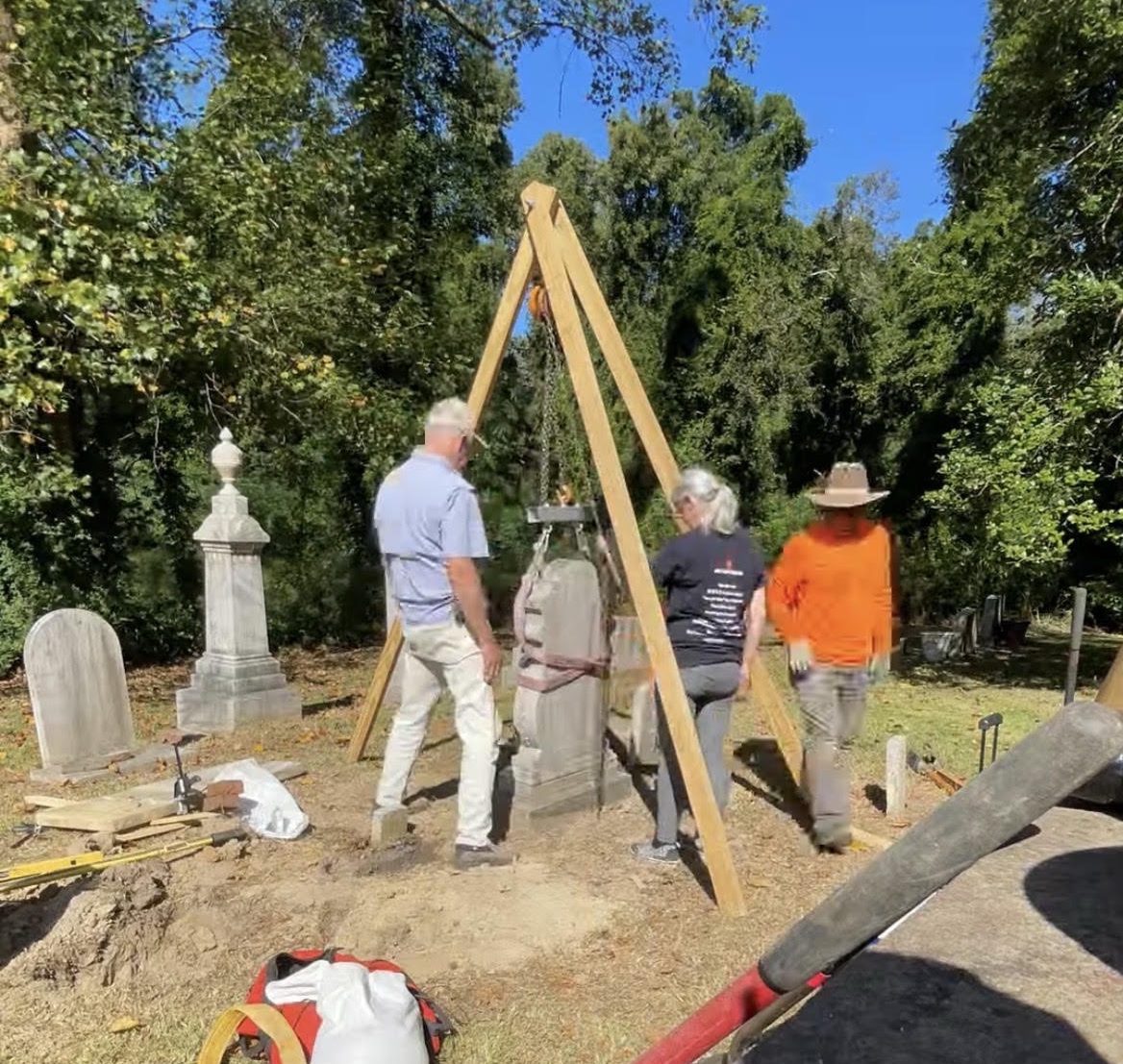
Sarah and the other two members of her cemetery team, Manuel Jaramillo and Joe Jarman, resetting a gravestone at the Averitt-Stephens Cemetery in Richlands (Onslow County), N.C. “We are one another’s team,” she told me. Photo courtesy, Sarah Biros
After dinner, he walked Sarah’s great-grandmother up to the train station and asked her to marry him.
She told him that she would consider his proposal. He returned a few weeks later and she said yes, she would marry him.
They settled in Tar Landing, which was his home. At that time, Tar Landing was not much more than a Baptist church, a schoolhouse, a general store or two, and scattering of little farms.
—
Sarah’s great-grandmother would come to know grief and loss at an early age. She lost her first child in 1921, when she was only 17 years old. She lost her second child six years later.
Sarah showed me their graves, which were in a little family cemetery at the end of Tar Landing Road.
We got out of the car at the end of the dirt road, then walked down a path that led past a trailer home and an old barn. The graveyard was lovely: it was in the cool shade of woods that were dark and deep.
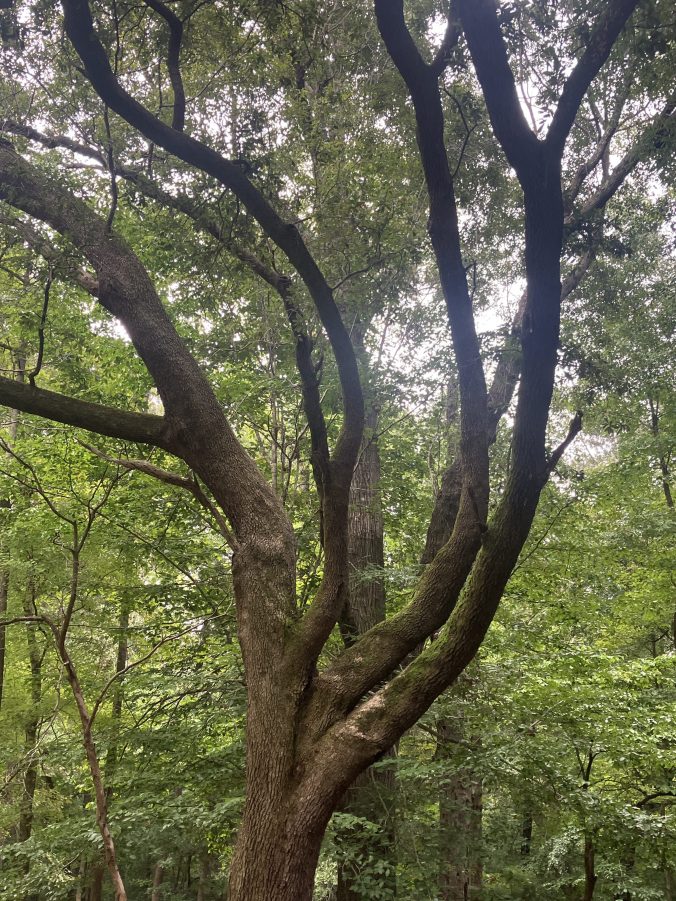
We found the cemetery where Thelma Langley’s two children were buried here on the edge of the woods at the end of Tar Landing Road. Photo by David Cecelski
The second child’s grave was marked with a headstone. The first child’s grave was not, but Sarah knows that it is there between the second child and their mother.
With the help of ground-penetrating radar, she had seen that a little baby had been buried there.
Sarah told me a story about the child’s birth. It came up when I asked her what kind of woman her great-grandmother was.
The story that her great-grandmother told her was this: she was near due, but there was work to be done and she had gone out to crop tobacco one morning by herself.
While she was working, she went into labor suddenly, before she could go for help or anything. She delivered the baby herself, but the child was stillborn.
She lay her lost child’s body on a bed of tobacco leaves and cut the cord herself.
Sarah’s great-grandmother told her that she wrapped the child in a tobacco leaf. Then, when she was strong enough, she lifted herself back up and finished her work in the tobacco field.
Maybe she did not work that much longer, and no telling what she was thinking, much less feeling. But times were hard, and I guess life was hard, and she was going to keep on.
“She was a hard woman,” Sarah told me.
She was not the kind that gave a lot of hugs, she also told me, or the kind that gave praise lightly.
But Sarah’s great-grandmother loved her fiercely, and Sarah loved her back with all her heart, at least from all I could hear in her voice when she spoke of her great-grandmother.
“She is why I am like I am,” Sarah told me.
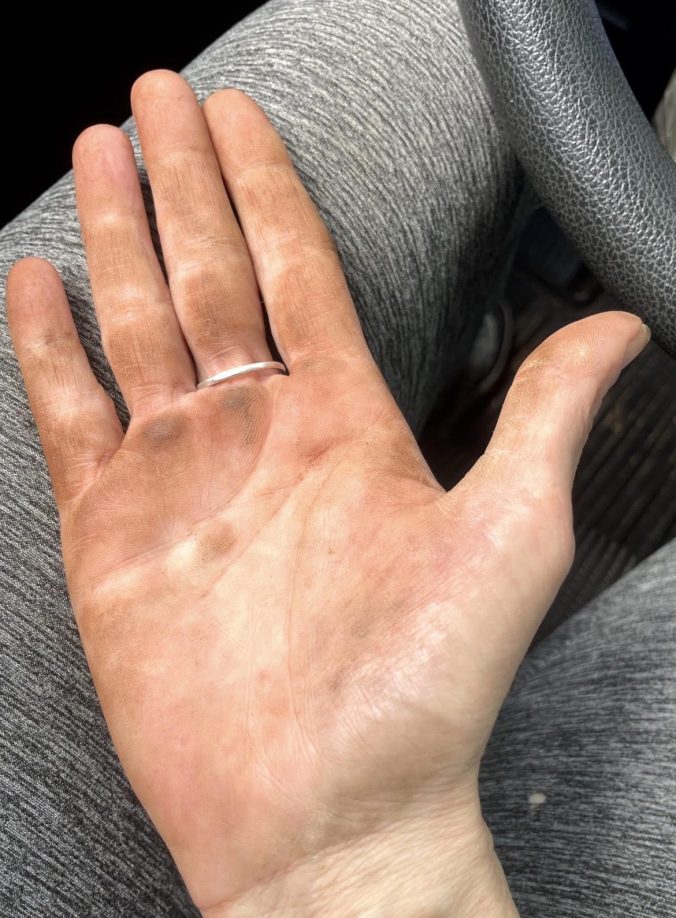
Of this photograph, Sarah wrote me: “I always liked pictures of my great-grandmother’s hands. You could tell she worked. They were dainty, but never soft. I always liked seeing her hands in pictures and after I work in a cemetery I see some of her hands in mine.” Photo by Sarah Biros
—
Sarah’s great-grandmother often shared stories with her. She told stories from the past, sometimes things she remembered, other times things that the old people had told her when she was young.
She often left little notes for Sarah. She would remember an incident or a story that one of her elders had told her and she would write it down so that Sarah would have it.
Her great-grandmother was also the one who sat with the dead, Sarah told me.
When someone in the community died, she went to their home and washed the body, dressed them, and did whatever else was needed to be done to prepare them for burial.
Then she would sit with the body from the time of their death until the burial.
For me Sarah’s description of her great-grandmother brought to mind stories that I have heard about the midwives of long ago.
Many times, I have been told, those midwives would stay with a mother for several days or even weeks if it had been a hard delivery and the mother was weak or ill or was by herself.
Those midwives tended to mother and child, but from all I have heard, they also cooked and cleaned and looked after the other children, if there were other children, until the mother was back on her feet.
Sarah’s great-grandmother was much the same way, except that she was there not at the beginning of life, but at its end.
—
Sarah told me that it was her great-grandmother who first told her about a family cemetery that had been lost and forgotten in a thicket just off Pony Farm Road.
The cemetery was on land that had been in Sarah’s family since the 18th century but was lost to the family in the 1920s.
The new owners let the cemetery go untended. Brush and briar took over the land. In time, people forgot that it was there.
Sarah’s great-grandmother told her that Sarah could locate the cemetery if she found a large pecan tree whose boughs made it look like an angel. Beneath the tree, she said, was the graveyard.
Sarah did find the pecan tree that looks like an angel. But the thicket under its spreading limbs was so dense that she could not see any trace of the cemetery at all.
Sarah was undaunted. Hacking her way through the thicket, she soon found the grave markers.
Some were intact. Others had been torn from the ground. Quite a few were broken. At least a few had been vandalized. What was left of the broken markers were stacked up in a pile.
Most of the people buried there were Sarah’s ancestors on her great-grandfather’s side of the family.
Sarah got to work. She got permission to go onto the land. She found friends more than willing to help her. Her children pitched in.
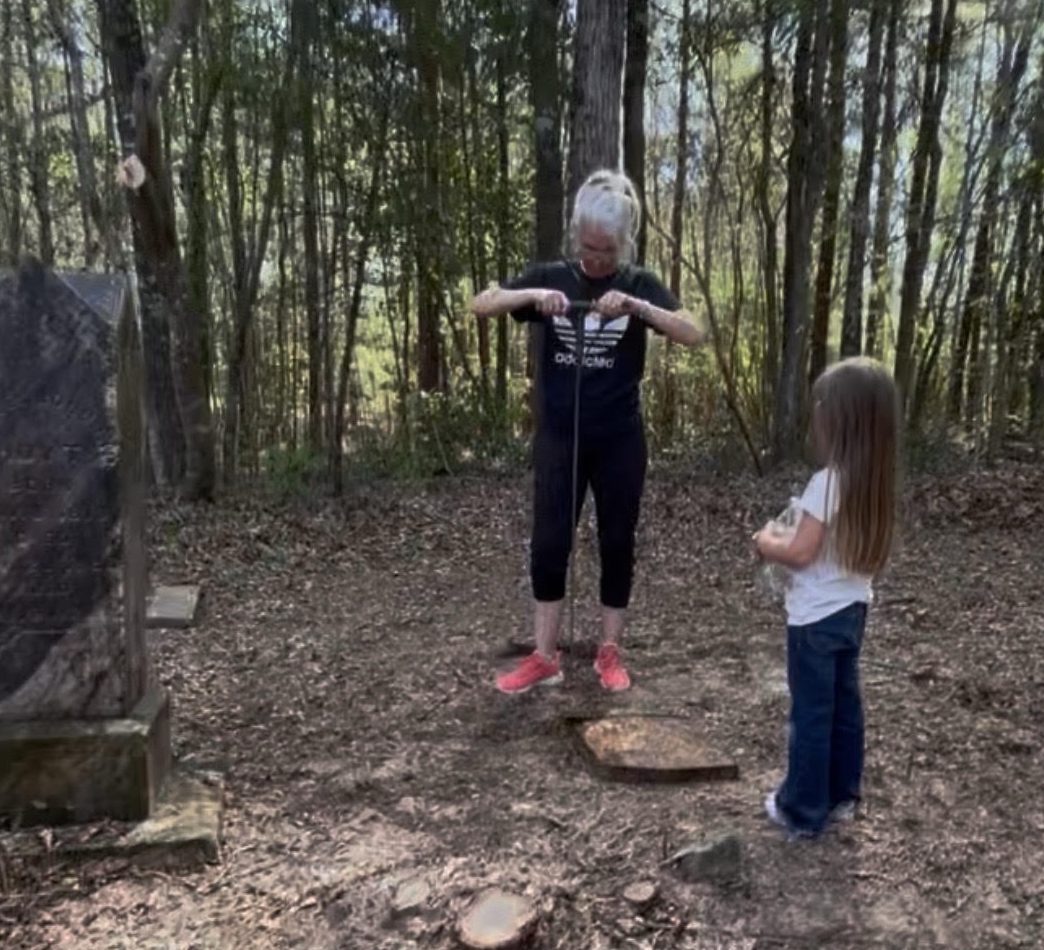
Sarah showing her daughter how to use a probe to find a broken headstone under the surface at the Nicholas E. Armstrong Cemetery just outside Richlands (Onslow County), N.C. Photo courtesy, Sarah Biros
They cleared the thicket. Hauled away brush. Mowed and weeded. They employed ground-penetrating radar to locate the remains of those who were buried there when nothing was left of a marker.
She and her helpers put the markers back together, scrubbed them clean, deciphered inscriptions, and did all else that needed to be done.
That was the first graveyard that Sarah rescued. Then there was another and another and another. To me it seems if something inside Sarah had been awakened by that first cemetery on Pony Farm Road.
Now I wonder if whatever it was that awakened in Sarah is akin to the feeling that her great-grandmother had for those who had come through life and gone on to the next world.
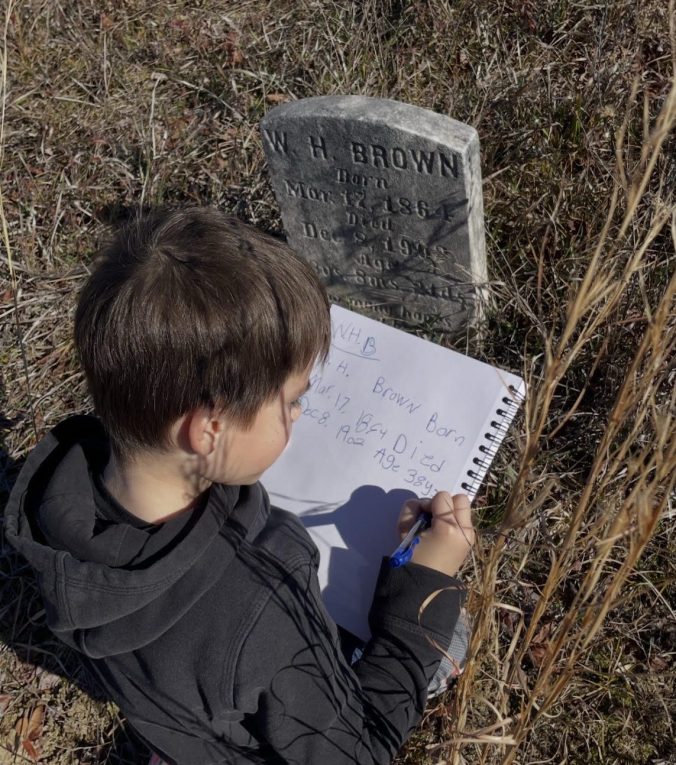
Sarah’s son learning to document headstones at the Aman Cemetery in Jacksonville, N.C. Photo by Sarah Biros
In the last few years, all kinds of people have been getting in touch with Sarah.
I do not know how she finds the time to help them. She is a wife and a mother of three children, and she works two jobs.
When people call her, they often tell her a story that they have heard about a cemetery that has long been forgotten.
Or maybe somebody has stumbled on an old graveyard down in the woods or at abandoned homesite.
Other times, someone knows of a cemetery that is threatened by a housing development or quarry or an industrial site.
So they call Sarah, the woman, they have heard, who rescues lost cemeteries and looks after the dead.
-End-

