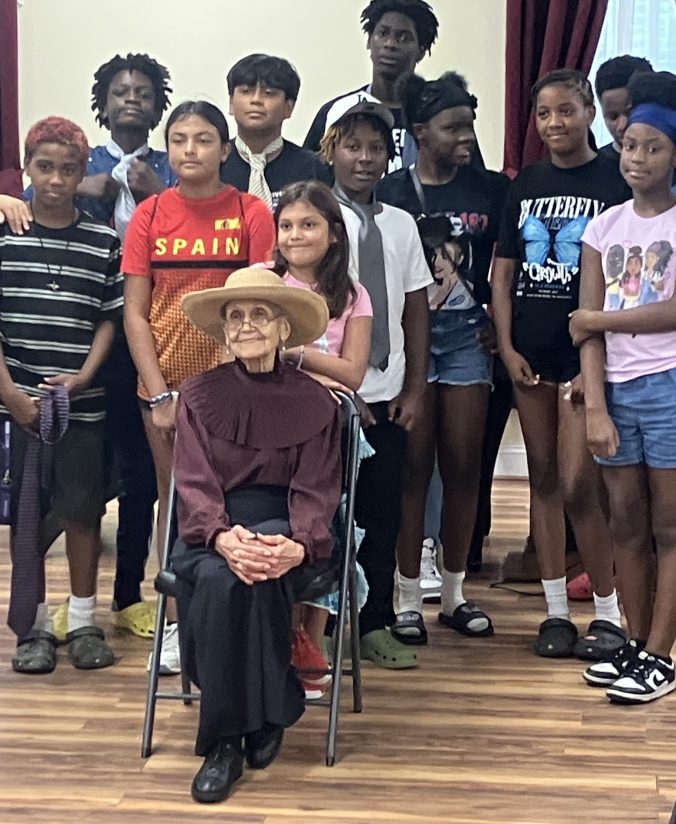
Willa Cofield and students at a Youth Day event at the Franklinton Center at Bricks, Whitakers, N.C., in August 2025. Photo by David Cecelski
This week I have been remembering the summer day last year when I finally got to meet Willa Cofield.
Willa was 96 then, and though she seemed and still seems far, far younger, I think that she would be the first to understand that I was beginning to wonder if we would ever meet face to face.
We had gotten to know one another over the telephone. I do not remember who called whom first, but I relished every word of every call.
Even over the telephone, I could tell right away that she was a special person– the kind of person who sees deeply into things and who seems to feel empathy for the whole world down in her soul.
In our phone calls, we talked a lot about in Enfield, the small town in Halifax County, N.C., where she grew up. We talked about the history of the civil rights movement and the role she played it.
And of course we talked about what is happening in America now, and how these disturbing times resonate with life when she was younger in some ways, but not in others.
Above all, we talked about the memoir that she was writing: The Nine O’Clock Whistle: Stories of the Freedom Struggle for Civil Rights in Enfield, North Carolina.
Willa was writing the book in collaboration with two of her younger friends, Cynthia Samuelson and Mildred Sexton, both of whom were her students when she taught high school in Enfield.
The three of them were nearly finished writing The Nine O’Clock Whistle when Willa and I started talking on the phone.
I will never forget the day we celebrated the book’s publication, me down here, Willa at her home in Plainfield, New Jersey.
—
One of the things I liked most about talking with Willa was that no matter what business was at hand, or how bad the latest news was, she always asked about my garden.
Are the narcissus blooming yet, she would ask, or are your tomatoes ripe? Is the corn tasseling?
I would tell her about my garden, and she would tell me about the flowers that her grandmother grew or share a memory of a neighbor back in Enfield who had the sweetest figs.
I learned that Willa finds beauty and light in the darkest times, and she never gives up hope.
Over time, I came to see that one of the ways that I was finding hope was by talking with Willa.
—
I did not think that I would ever have the chance to meet Willa. But then late last summer, a bit out of the blue, that changed.
Willa had grown determined to attend the annual homecoming at the Franklinton Center at Bricks, just a few miles from where she grew up, and her lovely daughter Tanya had offered to drive her down.
Founded in the late nineteenth century, the “Brick School,” as it was usually known, was originally an important school for African American children in the part of Eastern North Carolina where Willa grew up.
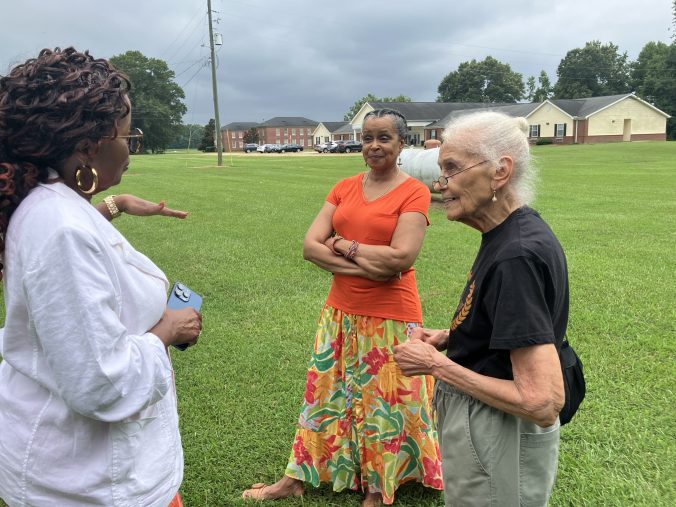
Willa, her daughter Tanya Watson (center) and Dr. Brenda Billip Square at the Franklinton Center at Bricks, August 2025. Dr. Square is a noted archivist, librarian and pastor who was the longtime director of the archives at the Amistad Research Center in New Orleans. In recent years, she has been giving much of her time to developing the archive at the Franklinton Center at Bricks. The Center’s board of directors is currently raising funds to renovate the old Rosenwald School so that it can house the archive and library. Photo by David Cecelski
Over the generations, the Brick School evolved into the Franklinton Center at Bricks, which is no longer a traditional school but a gathering place for those who work for social justice and liberation.
I love this passage in the Center’s mission statement:
Our vision is to manifest a world where systemic oppression does not exist; the whole divinity of a person is realized; the memory, contribution and resilience of our ancestors is embraced; and the environment is healed. This world embodies the gifts of learning, outdoor play, teaching, health, safety, love, and connection to beloved community.
The Brick School– and now the Franklinton Center at Bricks– has been an important part of Willa’s life since she was a small child.
She was a student at the Brick School for a time in the 1930s. She was involved in civil rights movement activities there 30 and 40 years later, and she eventually became the chronicler of its history.
You can find the wonderful documentary film that Willa made on the Brick School’s history here.
—
Willa and her daughter were already at Bricks when I arrived on the afternoon before the homecoming.
I could only a stay a night, and I knew that Willa would be very busy, but I was beyond excited to see her even if it was only for a few minutes.
I checked into my room, then went looking for her. I found her talking with a group of children at a Youth Day gathering at the conference center.
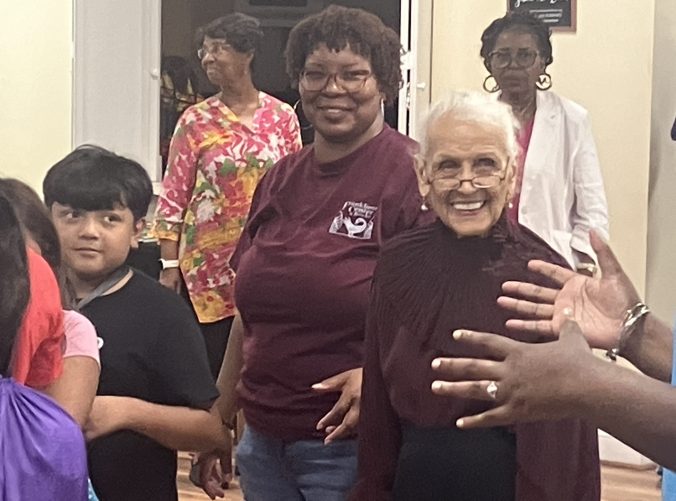
Willa Cofield (front right) at the Youth Day event at the Franklinton Center At Bricks, August 2025. Photo by David Cecelski
I loved seeing her with the young people. She had been an English teacher for many years in Enfield, before the local school board fired her in retaliation for her civil rights activism.
Watching Willa with the children, I could see the teacher in her, the care for them that was in her heart, and how deeply she believed in what they could be and what they could give the world.
The rest of my visit was a bit of blur, the time with Willa was so sweet and meant so much to me.
When she was done at the Youth Day event, Willa and a small group of us walked down to the long abandoned Rosenwald School where Willa had gone to the second grade back in the 1930s.
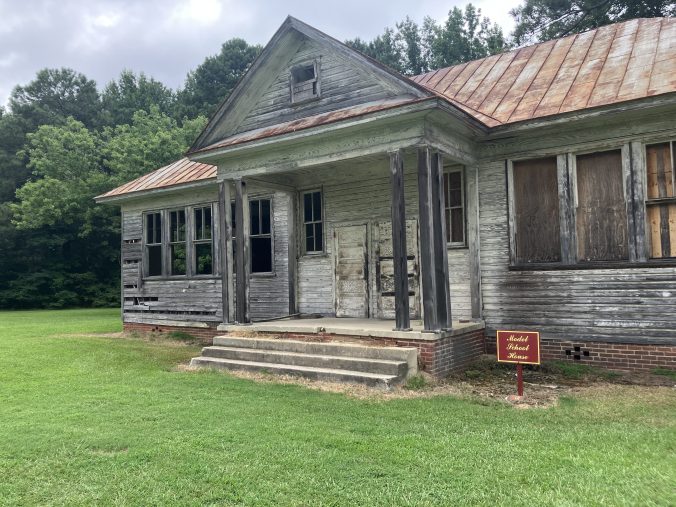
The old Rosenwald School on the campus of the Franklinton Center at Bricks. Photo by David Cecelski
Willa remembered everything: the teachers, the books, the other students, even where the outhouse was.
Later Willa and I ate dinner together at the cafeteria, and then we talked late into the evening. In the morning, we rose early and walked and talked some more before breakfast.
As we strolled by Principal Inborden’s house and the fields where the students used to work to help support the school, Willa told stories about the Bricks School’s early days.
She talked about where and how things used to be.
I remember that she also told a story about W.E.B. DuBois visiting the school, and she also mentioned that, when she was a child, local black farmers used to come there to learn the latest agricultural methods.
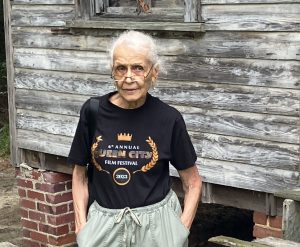
Willa Cofield at the Franklinton Center at Bricks, August 2025. Photo by David Cecelski
I found it easy to forget that Willa was 96 years old. She walked as fast as I did and only once, when we had to jump a ditch, did she take my hand.
“I probably could have done that on my own, but I am not as steady as I used to be,” she said.
—
I had to leave the next morning after breakfast. The crowd was just beginning to arrive for the homecoming’s opening ceremony when Willa and I said our goodbyes.
When we parted, I walked back to my room to get my things. Willa rushed off to the homecoming. She was due to give a talk on the Brick School’s history later that morning.
As I drove by the founder’s house and the farm fields, then turned onto the state road toward home, my gratitude for those few hours with Willa had no boundaries.
We live in dark and troubling times. The day is late. I had a long drive home. My heart was overflowing with joy.


I have a lady friend near me at Lake Waccamaw who you should meet. She has a fascinating story from the Jim Crow era. She is recuperating from a fall injury now, but would love for you to come to Lake Waccamaw, stay in my bnb and come with me to see her. Adored this story! You touch my heart.
LikeLike
Beautifully written, as always, preserving the rich history of eastern North Carolina. Thank you.
LikeLike