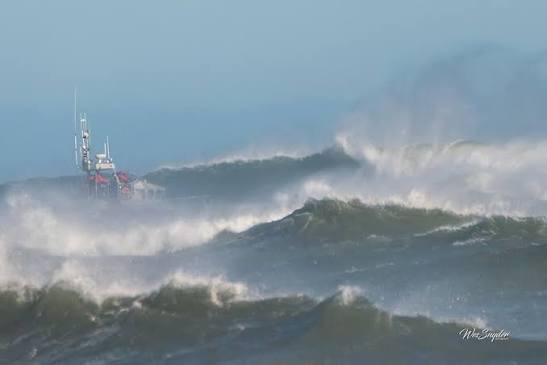
A Coast Guard vessel in Oregon Inlet during a rescue training exercise, December 2023. Photo by Wes Snyder
I recently gave a lecture at the Hyde County Historical Society’s semi-annual meeting in Swan Quarter. The occasion was especially meaningful to me because it was held at the O.A. Peay School, the historically black school that was at the center of my first book, Along Freedom Road.
My wife Laura and I stayed at The Ridge like we usually do. Our friend Azalea took care of us, and we could not have been more grateful.
We don’t love Azalea just because of her oyster fritters, but they’re so good, you couldn’t blame us if we did.
We visited other old friends too. I was especially glad to see Thomas Whitaker from up in Fairfield. I have known him since the year I lived next to Lake Mattamuskeet more than 40 years ago.
Laura and I could only stay three nights this time, but I was visited by a hundred memories going back to my first days there: the winter nor’easters. The cranberry bogs. An Easter sunrise service on the shores of the lake that Laura and I attended when we were very young.
The murmur of the tundra swans and snow geese out on the lake at night.
Little Brother Topping’s place at New Holland. The crab house at Gull Rock. St. Lydia’s and Job’s Chapel. The salt marshes along the Pungo. The church suppers at Soule United Methodist.
The summer the peat bogs burned and burned. And burned. Smoke and fire and incandescent sunsets, week after week.
And Julia Bick, who lived down the road from The Church That Was Moved by the Hand of God.
You don’t find somebody with a soul like that just any day.
Also, Etta Mae Greene. She was Azalea’s friend Sandy’s grandmother, and I remember Ms. Etta every time I see Azalea or Sandy.
When Sandy was a little girl, her grandmother used to carry her to the civil rights marches in Swan Quarter.
Ms. Etta was also the one who invited me to the O.A. Peay School’s alumni homecoming all those years ago. If it hadn’t been for her, I would never have discovered the story that led me to write Along Freedom Road.
———-
On one morning this trip, we drove into Engelhard to get gas and do a little shopping.
While Laura was exploring a thrift shop, I wandered around the harbor like I used to do when I lived there.
I waded through the king tide and went down to the fish houses and the docks. I watched the fishermen unload their catches for a few minutes, then I walked back to the little bridge across Far Creek.
There is an abandoned old building there, teetering on the edge of the creek, that used to be a little cafe.
In my younger days, I would sometimes go to that cafe first thing in the morning, well before light.
A couple of guys I knew would meet me there on days when it was too rough for them to take their boats out.
The place would be crowded with guys that worked the winter fishery. Everybody ate breakfast and drank a lot of coffee, and sooner or later, the talk always turned to the inlet, or so it seemed to me.
I don’t know about now, but in those days, the fishermen in Engelhard, the ones in the winter fishery, sometimes made for Oregon Inlet and sometimes made for Hatteras Inlet.
As I understood it, the captains made their choice early in the morning, depending on the wind and tide and weather.
They’d get on the radio to the other captains and decide whether to go or not go, and if they were going, where to head.
If they did go, they’d leave Engelhard in pitch black dark so they could reach one or the other of the inlets at first light and make their first set in the ocean at sunrise.
———-
On those mornings at the cafe, one thing was clear to me: nobody wanted to cross the bar at Oregon Inlet by themselves.
Instead the boats would gather on the sound side of the inlet in what they called their tribes, which as I understood them were kind of fraternities, groups of maybe 10 or 12 boats that stuck together and looked out for one another.
Out on the water, the men in a tribe were like brothers. They might not know one another from Adam on shore. But from what I heard, they would do just about anything for one another out there.
If a boat had a transmission leak, a broken ring shaft or lost a rudder, the other captains in a tribe would lend a hand, share parts, or do whatever else they could to get them home.
When a tribe ran the inlet, they’d warn one another if a boat had lost sight of a marker and was drifting offline.
And if, God forbid, something happened in the inlet, your tribe’s boats would be the first to come to your rescue.
The stories they told about the inlet– Oregon Inlet– were chilling. At the cafe, the guys spoke of swirling eddies and sinkholes, waves as high as houses, avalanches of foam and spray.
Sometimes the stories ended well. Other times, they ended with planking and ribbing washing up on the beach for days.
I remember an older captain chastising the younger guys for talking about the inlet like it was some evil place.
It’s just nature, he said, and it is what it is.
But I also remember him saying, you better be right with God if you’re aiming to go through that inlet on a day like this.
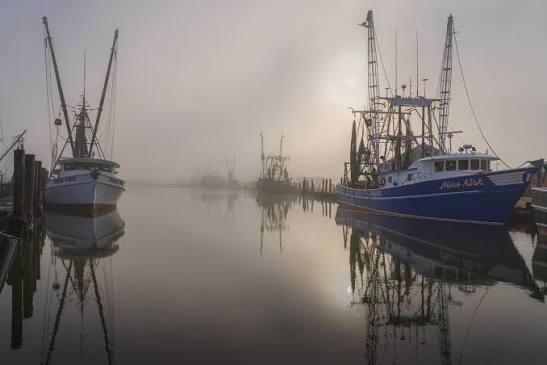
A foggy morning on Far Creek in Engelhard, December 2025. Photo by Brian Edwards
———-
On the winter mornings they went out, a tribe’s boats would all gather a little before sunrise on the sound side of the inlet.
There’d be boats from Engelhard, but probably also Wanchese and maybe one or two from Stumpy Point or Mann’s Harbor.
They’d all be eyeing the inlet, and the captains would be going back and forth on the radio.
When they did go, they went together, single file, one boat after another across the bar and into Atlantic.
At the end of the day, they’d do the same thing. They’d wait for the last boat to get their nets in and join them, then the lead boat moved into the inlet.
Sometimes, if it had gotten late, or the weather took a nasty turn, a captain would give away a net so he could make the rendezvous in time. He’d lose the fish, but he’d get his net back.
On those winter days, they were often coming back through the inlet in the dark.
They’d come through the inlet in a row, following one another’s running lights if they could see them through the spray and waves.
I remember another guy at the cafe saying that most days he felt like God was watching over them. But he also had to admit that some days it seemed as if maybe God was busy somewhere else.
———-
Everybody had a story about a disaster or a near disaster at Oregon Inlet.
When they told those stories, the cafe got real quiet. At times, even the cook and waitress stopped what they were doing and just listened.
They described waves that could shatter a pilot house’s windshield that was built to be as tough as the ones on a commercial airliner.
Waves that lifted a boat up and left the captain fighting to keep the wheel straight, knowing that if he didn’t, or if his steering broke, he’d be turned sideways and the boat would roll over.
That was just when, most times, the storyteller would say something funny to break the tension in the room.
Maybe a little funny thing that the mate said just when everything seemed lost. Or a call from the captain’s wife telling him that their little girl is going to be the star in the school play.
At times like that, the storyteller usually just rolled his eyes heavenward. He’d laugh and laugh, as if saying, what else can you do but laugh?
And ain’t that life for you?
Everybody else would laugh too, and then we’d all start eating again and maybe have another cup of coffee or two.
And then, one by one, we’d pay our checks and walk out into the early morning light. I’d head back to the lake, and they head to the docks and start to get their boats ready to go out the next day.
——–
I do not always get to Engelhard when I am on that part of the coast, so I don’t always see the little building by Far Creek where the cafe used to be.
But even if I can’t get to Engelhard, I have a place I often go closer to Swan Quarter where I can take a few minutes and remember the fishermen’s stories and wonder what might be happening out in the inlet now.
It is a place called Bell Island, and it’s down a mile-long dirt road that leads to Swan Quarter Bay.
On winter days especially, when the wind is really fierce, I like walking out on the pier there and watching the sunset.
The wind cuts right through me, but it’s so beautiful and wild there that I try to stand up to it as long as I can.
While I am out on the pier, I look down the sound toward the inlet, and I think about those mornings at the cafe in Engelhard.
I wonder what has become of all those guys, and I go over in my head the stories they told about the inlet and what life was like in the winter fishery.
I think of how they spoke of the darkness and the waves crashing and the sounds of the sea. In my mind’s eye, I see their boats all huddled together, waiting for stragglers and then, when they are sure nobody is left behind, moving like all of us one by one toward home.
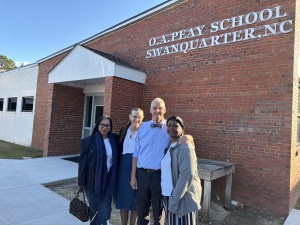
My wife Laura and I, our friend Azalea Mackey (far right) and our friend Michelle Lanier (far left) at the O.A. Peay School for the Hyde County Historical Society’s semi-annual meeting.


David, A gripping story, thank you. It left me with a greater appreciation of NC fishermen. Susan Susan DeWitt Wilder 53 Old Center St. Perkinsville, VT 05151 207.730.0574
“Civility, Compassion and Community”
LikeLike
Thank you so much, Susan!
LikeLike
Thank you so much for all your stories….I enjoy every word that you write. I live in Down East Carteret County and would love for you to speak at the Core Sound Waterfowl Museum at Harkers Island. Thank you for sharing.
Debby Piner, Marshallberg
LikeLike
Thank you so much, Debby! Means a lot to me to hear from you! You call and I will come!
LikeLike
Hey! Ran into my friend at the post office yesterday. She said you were welcome to join me in hearing her story of growing up in Wannish (at end of Lake Waccamaw). I think she has an interesting story to tell of growing up during Jim Crow era. I just need to give her a date for the visit. Are you free after Thanksgiving to ride to the lake? My phone is 910 640-7642. Look forward to hearing from you! Ginger Littrell
Get Outlook for iOShttps://aka.ms/o0ukef
LikeLike