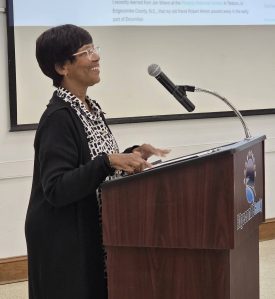
Ms. Mavis Smith, the Phoenix Historical Society’s president, welcomed the Society’s members and supporters to the 25th anniversary celebration at Carmon Auditorium in Tarboro, N.C. Photo courtesy, Curmilus Dancy II/The DCN
Last Saturday I was one of the keynote speakers at the 25th anniversary celebration of the Phoenix Historical Society in Tarboro, N.C.
These were my remarks.
I am very happy to be here with you today to celebrate the Phoenix Historical Society’s 25th anniversary. I have followed your work from your first days, and I have done so with the highest admiration.
Your dedication to uncovering, preserving, and sharing the African American history of Edgecombe County has been extraordinary.
To my knowledge, you have never had any paid staff, your budget has never been large, and you have never had offices of your own.
In the beginning, at least as I remember it, many of your members were coming to meetings straight from the factory floor or after having had a long day in the office or a hectic shift at the hospital.
Yet in my eyes, you have been one of the most pathbreaking historical societies anywhere in the United States.
The rigor of your scholarship, your diligence, your rootedness in this place, and your emergence out of local struggles for social justice and workers’ rights have all set you apart.
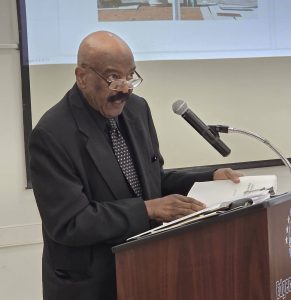
The day was even more special to me because the other keynote speaker was my old friend and colleague, Dr. David Dennard, now professor emeritus of history at East Carolina University. Photo courtesy, Curmilus Dancy II/The DCN
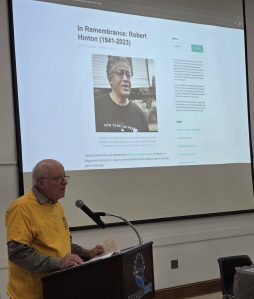
The Phoenix Historical Society’s vice-president, Jim Wrenn, made a special point of recognizing two scholars whose work has been pivotal to the Society throughout its history. One was Dr. Ben Justesen, the author of George Henry White: An Even Chance in the Race of Life (2001). The other was an old friend of mine, Dr. Robert Hinton, author of The Politics of Agricultural Labor: From Slavery to Freedom in a Cotton Culture, 1862-1902. Robert passed away three years ago. Photo courtesy, Curmilus Dancy II/The DCN
I gave my first lecture for the Phoenix Historical Society twenty-three years ago, only a couple years after your founding.
That first lecture was about my book The Waterman’s Song. Some years later, I had the joy of returning here to discuss my book The Fire of Freedom: Abraham Galloway and the Slave’s Civil War.
Later I chaired a panel that you organized to commemorate the life of George H. White at St. Stephen Missionary Baptist Church.
More recently, in the fall of 2023, I was deeply honored to play a small part in the unveiling of a historical marker for the Equal Rights League that met at Hammonds Hill in 1866.
My latest chance to work with you was a less auspicious day, but still memorable for me.
Only a few weeks ago, your vice-president, Jim Wrenn, and his collaborator, Professor Kat Charron at N.C. State, invited me to read and comment on an early draft of an historical article that they are writing .
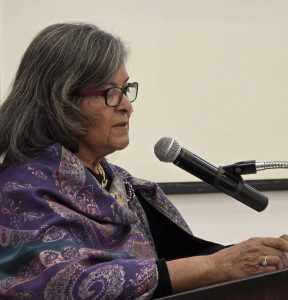
One of the day’s highlights was Carol Quigless’s tribute to her sister, Helen G. Quigless, Jr. Now deceased, Helen played a leading role in founding the Phoenix Historical Society in 2001. Photo courtesy, Curmilus Dancy II/The DCN
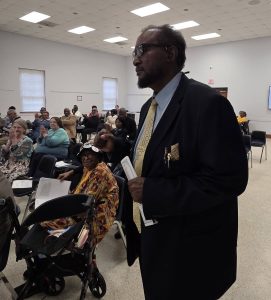
Another highlight was Mr. David Batts’ moving recitation of the names of the Phoenix Historical Society’s members who are no longer with us today. A resident of Kingsboro, Mr. Batts is a county commissioner-elect for Edgecombe County and a longtime member of the Phoenix Historical Society. Photo courtesy, Curmilus Dancy II/The DCN
Their article is the first scholarly work on Ellen Williams, an African American labor activist here in the 1880s and 1890s.
Her story made a deep impression on me.
Born a slave near here, Williams and her family were tenant farmers on a cotton plantation here in Edgecombe County in the first decades after the Civil War.
Williams was a wife, a mother, and a very courageous labor organizer who—Jim and Kat’s story tells us– was a driving force behind the rise of the Knights of Labor here in the 1880s.
Reading about her in Jim and Kat’s article, I was struck above all simply by her sheer audacity in believing that justice and freedom could one day come to the fields of Eastern North Carolina.
To me Jim and Kat’s work on Ellen Williams speaks to all that the Phoenix Historical Society has accomplished over the last quarter century.
You have insisted that, when the history books are written, and the stories of our past are told, we cannot forget the slave, the factory worker, or the oppressed whoever they might be.
You have insisted as well that we cannot forget the freedom fighter, the labor organizer, or the civil rights activist– or any of those like Ellen Williams who refused to accept a world this unfair, this grounded in greed and rapacity, this soulless: we must work to make it better.
—–
Much has changed over the last quarter century.
Twenty-five years ago, you could have visited every historical marker and monument in Edgecombe County and never learned that African American people had any place at all in the county’s history.
That was the case even though Edgecombe County has had a majority-black population since at least 1840.
The invisibility of African Americans here in Tarboro and Edgecombe County, as well as in some of the surrounding counties, is now behind us, thanks in very large part to the Phoenix History Society.
Through your research and advocacy, we now have historical markers here that commemorate the Knights of Labor, George Henry White, Dr. Milton Quigless, the tobacco leaf workers of Operation Dixie, Jazz legend Thelonius Monk and State v. Will, the landmark 1834 N.C. Supreme Court ruling that established the legal recognition of a slave’s humanity.
Because of your efforts, we also now have historical markers for the Equal Rights League that met at Hammonds Hill in 1866 and for the black men who took up arms and defended Washington, N.C., during the Civil War.
Similarly, because of you, we now have historical markers that recognize the East Tarboro Citizens League, an important civil rights group that was organized here in the 1960s.
Another historical marker now tells the story of Citizens for Responsible Zoning, a landmark environmental justice victory in the historically African American community of Kingsboro.
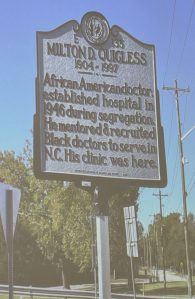
A state historical marker for the pioneering African American physician Dr. Milton D. Quigless now stands at the former site of the Quigless Clinic in Tarboro, N.C. Opening in 1946, the Clinic also included a 25-bed hospital for African Americans who were otherwise denied access to proper medical care in the region’s hospitals. Photo courtesy, Curmilus Dancy II/The DCN
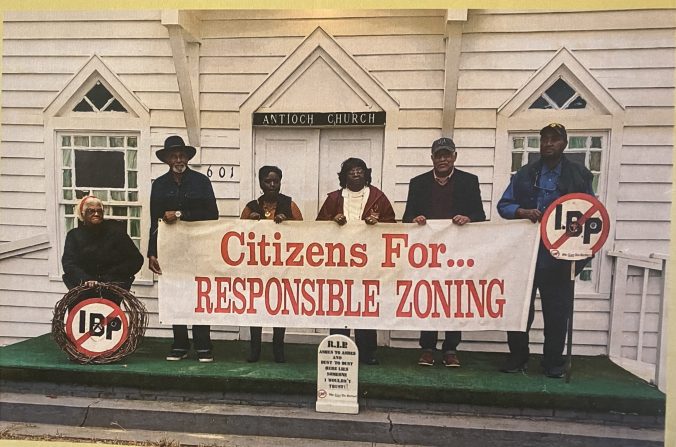
Another of Edgecombe County’s state historical markers recognizes the successful effort of Citizens for Responsible Zoning in preventing the construction of a hog slaughterhouse in the historically black community of Kingsboro. The group’s success was an important moment in the history of the struggle for environmental justice here in North Carolina. Photo courtesy, East Carolina University
Still another recognizes the Rocky Mount Sanitation Workers Strike of 1978, a crucial moment in the region’s labor history.
Even the Tarboro post office is now named after George Henry White, and I understand that his portrait hangs in the Edgecombe County Courthouse as well.
What astonishes me even more is that the single-most prominently displayed historical marker in Tarboro, located in the heart of downtown, honors black farmworkers and tenant farmers.
That historical marker recognizes the tens of thousands of African Americans who organized for workers’ rights and justice during the rise of the Knights of Labor here between 1886 and 1890.
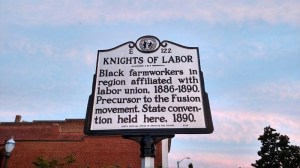
The state historical marker recognizing the Knights of Labor is located on Main Street in the heart of downtown Tarboro. Photo courtesy, The Historical Marker Database
I have also been deeply impressed by the scholars whom you have hosted here over the years.
Even a short list of the speakers who came here at your invitation would be the envy of many of America’s finest universities.
History makers such as Eva Clayon, the Rev. William Barber II, G.K. Butterfield, Toby Fitch, and Montford Point Marine Clarence G. Powell have all participated in Phoenix Historical Society events. .
So have many of our finest scholars, historians, and genealogists. They have included our dear friend Dorothy Redford, the amazing Robin Kelly from UCLA, and Melton McLaurin and John Haley from UNC-W.
Others who have spoken here include my fellow keynote speaker today, my old friend Dr. David Dennard, an esteemed professor emeritus of history at East Carolina University.
Still others have included Anna Edwards from VCU, Bob Korstad from Duke, and Omar Ali from UNC-Greensboro.
At your invitation, the wondrous African American genealogist Nadia Orton has also spoken here, as has Ben Justesen, whose biography of George Henry White helped to spur the founding of your society.
Vince Spaulding, who has also done so much to preserve Congressman White’s legacy, has lectured here as well.
There were still others, including Earl James from the North Carolina Museum of History and Michelle Lanier who, when she visited Tarboro, was director of the African American Historical Commission in Raleigh.
Even another old friend of mine, Dr. Jeffrey Crow, then the head of the N.C. Division of Archives and History, visited Tarboro to speak at one of your events some years ago. Jeff co-authored one of the landmark books on the rise of the white supremacy movement that led to the Wilmington Massacre.
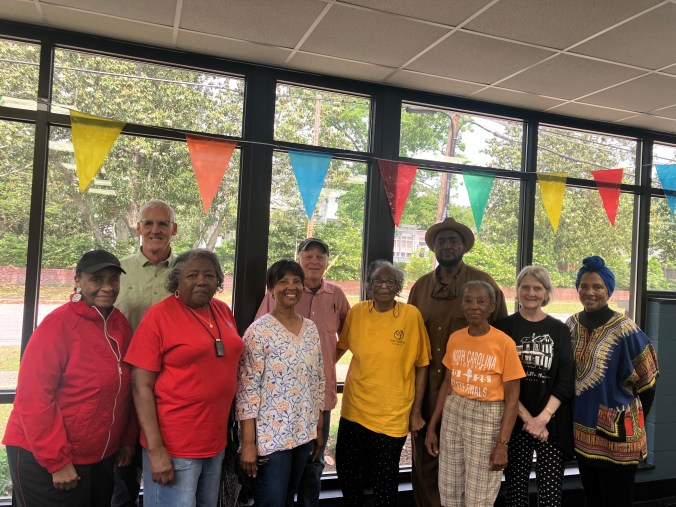
Last spring I had the chance to visit with some of the Phoenix Historical Society’s members at their monthly meeting at the Edgecombe County Memorial Library in Tarboro. Photo by Laura Hanson
As for myself, I feel deeply blessed to have shared even a little bit of your journey with you.
I cherish the times that we gathered here to discuss my research and writing.
I will also never forget the day that we gathered at the Red Hill Missionary Baptist Church for the unveiling of the state historical marker recognizing the birth of the local Equal Rights League.
Likewise, I will not soon forget the day that Rudolph Knight shared a deeply moving and informative historical tour of East Tarboro’s African American history with my Duke and UNC students.
That day we visited St. Stephen’s and the Quigless Clinic. We visited a local cemetery, and we visited the homes of prominent black builders, educators and political activists.
I remember especially our visit to the Mount Lebanon Lodge No. 25, which was founded in the 1880s and has the distinction of being the oldest, continually active Prince Hall Masonic lodge in North Carolina.
When my students and I arrived there, we found perhaps a half-dozen of the lodge’s members steadfastly repairing damage that was sustained to the hall during the flood of ’99.
Yet they still stopped what they were doing and patiently gave my students a wonderful introduction to their lodge’s history and to the political importance of African American Masonic lodges in general from the late 19th century well into the 20th century.
Finally, I know that I will also never forget the day that members of the Phoenix Historical Society took my students and me to see the monument that commemorates the former site of St. Paul AME Zion Church.
Founded by ex-slaves in their very first days of freedom, St. Paul’s had been lost in the flood of ’99.
Standing there by the Tar River, remembering the stories we had heard that day, I listened to the sounds of the river and felt as if I could almost hear the voices of all those who founded the church all those years ago.
Congratulations, Phoenix Historical Society. Twenty-five years is a remarkable accomplishment. Thank you for all you have taught us. Thank you for enriching our understanding of our history. Thank you for listening to those voices by the river and sharing them with us.

