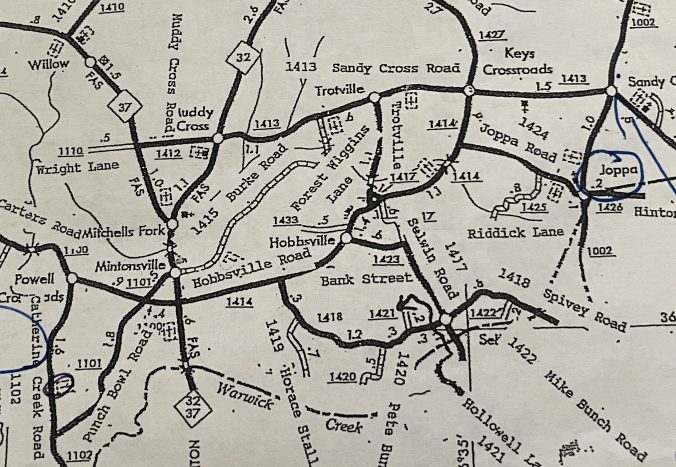
Hobbsville and vicinity, Gates County, N.C. The Chowan River is just west of the area shown here, and the western edge of the Great Dismal Swamp is just east and northeast of Joppa (circled here) and Sandy Creek. Merchants Millpond State Park is not shown on this map, but is just beyond the map’s northwest border. Detail of a state highway map.
When I was up by the Great Dismal Swamp a few days ago, Wanda Lassiter graciously introduced me to the history of Hobbsville, the community where she grew up in Gates County, N.C.
Wanda is the head curator at the Museum of the Albemarle in Elizabeth City and a lifelong resident of Hobbsville.
We started by visiting with two of her former history teachers at Gates County High School, Mrs. Linda Hofler and Mrs. Ellen Riddick. Both were wonderfully informative.
The next morning Wanda was my guide on a tour of Hobbsville and its history.
This is a mix of my notes from our visit with Mrs. Hofler and Mrs. Riddick, my tour with Wanda, and my impressions of the land.
——-
The Great Dismal to the east. The Chowan River to the west. Fields of soybeans, golden in the sun. Cotton. The Chowanoke Indian lands along Catherine Creek, a lovely stream where Wanda’s father used to take her and her brother and sister fishing.
Stories about the railroad coming. A village born. Named after the Hobbs family that had been there for ages.
Downtown, quiet now, but once busy: a church, a school, five or six stores, a train station, a post office, a cotton gin, a doctor’s office, a beauty shop, a barber shop. a hotel.
Also a bank, the Hobbsville National Bank, founded in 1881. One of the few that did not go under during the Great Depression.
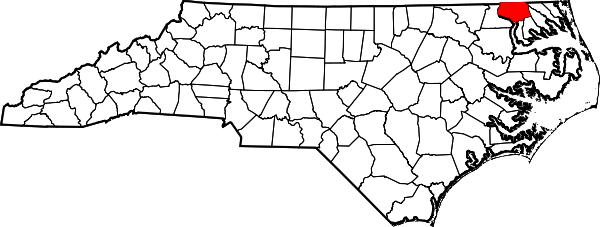
Gates County is in the northeastern part of North Carolina’s coastal plain. The county seat is Gatesville, which had a population of 267 in the most recent federal census. Many people are familiar with the county because it is the location of Merchants Millpond State Park, one of the state’s most beautiful natural areas. Map courtesy of Wikipedia
The hotel’s guests were often traveling salesmen. “Drummers,” people used to call them. I imagine most arrived by train, rode from farm to farm selling their wares, then moved on.
Later, the hotel became the residence for the teachers at the Hobbsville School.
What people call Hobbsville seems to go on forever. Places with their own names but Hobbsville too.
Like Sandy Cross, maybe a mile east of downtown on the edge of the Great Dismal Swamp.
A mill village called Gum Mill used to be there. It had a stave mill, a company store, houses where the workers lived, and miles of narrow-gauge railroad track running into the Great Dismal.
Tough, powerful locomotives, but smaller than the kind that ran on the main lines, hauled old growth black gum and maybe cypress and juniper too out of the bogs and hammocks.
People came to Gum Mill from far and wide. They made new lives there, worked and loved and raised families, then most moved away after the mill shut its doors for good in 1939.
Wanda and I looked around Sandy Cross. Then we drove a couple miles further to Trotville, also a part of Hobbsville now.
Mrs. Hofler and Mrs. Riddick had told me about the explosion that destroyed the Wiggins sawmill there. That was back in 1934. Three men lost their lives.
I was hoping that we might find a trace of the old sawmill, but I guess nothing is left there now, at least nothing that we could see.
On the edge of Warwick Swamp, we paused by an 18th-century plantation house. An old story says that a secret tunnel runs from the house to the swamp, but nobody seems able to find it.
I looked across the fields and thought about the people held in slavery there. I wondered what became of them and where they are buried and where their descendants are now.
___________
Even the names of the roads in Hobbsville were interesting. My favorite was Punch Bowl Road.
Punch Bowl Road runs from near Catherine Creek to Mintonsville, another crossroads that is now considered to be within Hobbsville.
Wanda told me that the road’s name used to be “Punch Pole Road,” which got its name from a tool used in logging.
When they floated logs downriver, logging crews used long staffs called “punch poles” to keep the logs from bunching up or getting stuck on snags and shoals and causing logjams.
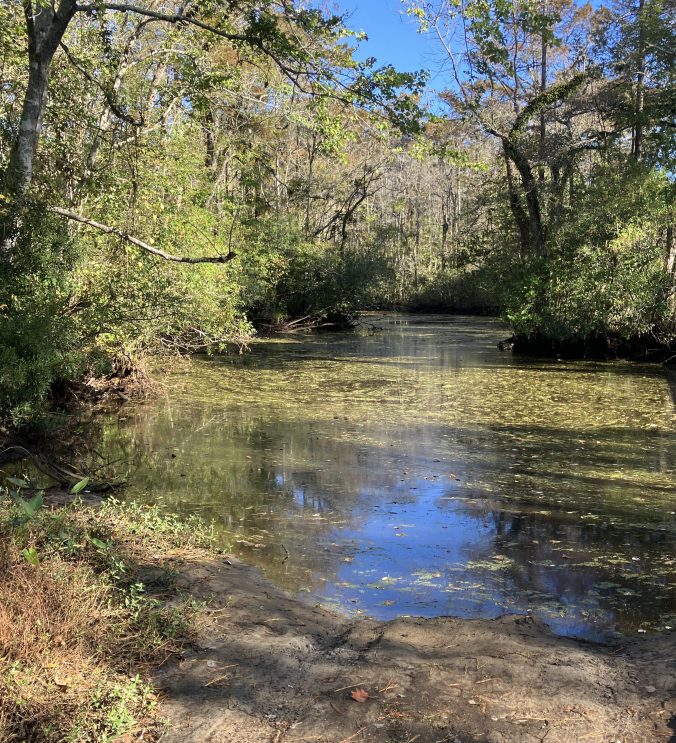
A view of Catherine Creek from the shore by the SR 1100 bridge. The creek flows west into the Chowan River at a point that is approximately 20 miles north of Edenton and the river’s mouth on the Albemarle Sound. Photo by David Cecelski
Over time I guess the log drives began to seem like a distant memory, and local people began saying “Punch Bowl Road” instead of “Punch Pole Road,” which I think is pretty great.
____________
Every mile we drove seemed to have a story. Some big, some small, others that just seemed special to me somehow.
One that I think I will remember for a long time is just a small story, but I found it moving.
When we visited with Mrs. Hofler and Mrs. Riddick, they told me about a Hobbsville man named Herman Spivey.
As a boy, Herman Spivey was a big reader, they said. He would walk down the railroad tracks reading a book, his head in the clouds, and he was said to have read every book in the local library.
The young man did not stay and become a farmer in Hobbsville but moved away and made good up in Virginia.
When he passed away, he left money for a scholarship fund at Gates County High School: one scholarship every year for the “Top Girl” in the senior class, another for the “Top Boy.”
Mrs. Hofler and Mrs. Riddick told me that those scholarships have been making a difference in young people’s lives ever since.
The thought of that boy walking down the railroad tracks, reading a book, his mind full of dreams and stories, then growing up and giving so much back to his home: I love that.
__________
One of our last stops was in Joppa, a community on the east side of Hobbsville. It is about a mile from Sandy Cross and, like Sandy Cross, is right up against the Great Dismal.
Wanda and I stopped and did a little studying in the parking lot at the Joppa Missionary Baptist Church.
She found an entry for the church in Thomas Butchko’s excellent book on Gates County’s historical architecture. We read it while we were sitting there.
The entry said that the church congregation at Joppa dates to the years just after the American Civil War.
An 1870 deed refers to a “house of worship” in Joppa. According to tradition, Butchko noted, the congregation was originally made up of both black and white Baptists.
Butchko observed that in 1870 three of the church’s four trustees—Richard Eason, Mingo Riddick, and Alfred Kee—were African American, but the race of the other trustee was uncertain.
Butchko’s book is called Forgotten Gates: The Historical Architecture of a Rural North Carolina County.
In the book, he explains that Joppa is a Biblical name and means “beauty” in Hebrew. In ancient times, it was a port on the Mediterranean Sea, not far from Jerusalem.
Jonah sailed from Joppa on the voyage in which he was swallowed by the whale. The Apostle Peter also brought the good and charitable woman Tabitha back to life there.
Perhaps most salient to the church’s founders, Joppa was the landing place for the timbers that King Solomon imported from Lebanon to build the temple that would house the Ark of the Covenant.
Most of the church’s early members had presumably come out of slavery. Many must have been loggers, stave and shingle makers, and the like.
In the 18th and 19th centuries, not many men in the vicinity of the Great Dismal, slave or free, did not do that kind of work at one time or another, and many did it all their lives.
I find it easy to imagine, when it came time to build a church, the thoughts of such people turning to the timbers used to build the First Temple, a symbol, above all, of God’s promise not to forsake us.
__________
I will not soon forget the morning light in Hobbsville. The beauty of the fields and woods. The stories.
After I dropped Wanda off at her home, I drove back to the little bridge that crosses Catherine Creek, the stream I mentioned earlier where her father used to take her fishing.
She had taken me there earlier, but I just wanted to be by myself for a few minutes, it was so lovely and I wanted a little time to think about all that I had seen and all the stories I had heard.
* * *
Special thanks to Wanda Lassiter for taking the time to show me around Hobbsville and to Mrs. Linda Hofler and Mrs. Ellen Riddick for so generously sharing so much of Gates County’s history with me.
I would also like to acknowledge the special help of Mrs. Joyce Lassiter, Wanda’s mother.
I did not get the chance to meet Mrs. Lassiter, but prior to my arrival, she spent hours with Wanda sharing stories about Hobbsville’s history so that Wanda could share them with me.
For that I am very grateful. I felt as if my time with Mrs. Hofler, Mrs. Riddick, and Wanda—and through Wanda, Mrs. Lassiter—was a great gift and I thank you all so much.

